
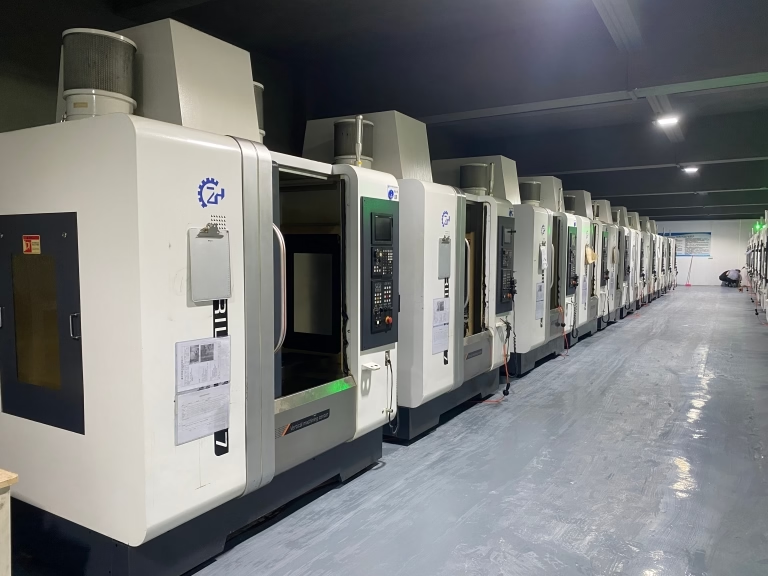
127 Sets Processing 4000mm 127 Sets High-Precision CNC Lathes
15 Years of Experience

How To Stop Warming Program In CNC Machine?

How To Stop Warming Program In CNC Machine? In the high-stakes world of precision manufacturing, where tolerances are measured in microns and machine uptime directly impacts profitability, the proper management of a CNC machine’s warming program is a critical yet often misunderstood operational procedure. As a senior manufacturing engineer with extensive experience in high-mix, low-volume […]

How To Stop Warming Program In CNC Machine?

In the high-stakes world of precision manufacturing, where tolerances are measured in microns and machine uptime directly impacts profitability, the proper management of a CNC machine’s warming program is a critical yet often misunderstood operational procedure. As a senior manufacturing engineer with extensive experience in high-mix, low-volume production environments, I’ve witnessed firsthand how improper handling of this process can lead to catastrophic part failures, accelerated machine wear, and significant production delays. This article delves deep into the purpose, execution, and—most importantly—the correct methods for stopping a CNC machine’s warming program, providing a comprehensive guide for shop floor technicians, programmers, and production managers.

Understanding the “Why”: The Critical Role of Warming Programs

Before addressing the “how,” it’s essential to understand the “why.” A CNC warming program, also known as a warm-up cycle or thermal stabilization routine, is not an optional step for high-precision machining. It is a systematic procedure designed to bring all machine components—especially the spindle, ball screws, guideways, and the machine structure itself—to a stable, uniform operating temperature.

The Physics at Play:
图片

Thermal Expansion: Metal components expand and contract with temperature changes. A cold machine spindle may be several microns shorter than when it’s at operating temperature. Similarly, ball screws can exhibit significant growth.
Thermal Gradients: If one part of the machine (e.g., the spindle housing) heats up faster than another (e.g., the column), it creates internal stresses and misalignments, directly translating to positioning errors on the workpiece.
Lubricant Viscosity: Grease and oil in bearings and guideways have optimal viscosity at specific temperatures. Running a spindle at full speed with cold, thick lubricant can cause premature bearing failure.

Skipping or improperly terminating a warm-up can result in:

Dimensional Inaccuracy: Parts machined in the first hour may be out of tolerance as the machine “grows” into its thermal equilibrium.
Poor Surface Finish: Unstable thermal conditions cause minute vibrations and inconsistent tool paths.
Reduced Machine Life: Subjecting cold components to high loads and speeds induces excessive stress.

Standard Procedure: Executing a Proper Warm-Up

A well-designed warm-up program, often provided by the machine tool builder (e.g., DMG MORI, Mazak, Haas), typically follows a graduated approach:


Low-Speed Axis Movement: All linear axes (X, Y, Z) and rotary axes (A, B, C) move slowly through their full travel ranges. This circulates lubricant and generates gentle, even heat through friction in the ball screw nuts and guideway bearings.
Spindle Speed Ramping: The spindle rotates at gradually increasing RPMs, often in steps (e.g., 1000 RPM for 5 minutes, 3000 RPM for 5 minutes, up to 80% of max speed). This allows the spindle bearings to heat evenly.
Dwell Times: The program includes pauses at different stages to allow heat to soak into the machine structure and dissipate gradients.
Duration: A complete cycle can last from 15 minutes for smaller machines to over an hour for large, high-precision gantry mills or 5-axis CNC machining centers used for complex aerospace components.

The Core Question: How to Stop the Warming Program Safely and Correctly

There are legitimate scenarios where you may need to stop a warming program: an urgent job change, a machine fault detection, or the completion of the cycle if it’s not auto-terminating. The method is paramount.

⚠️ The Cardinal Rule: NEVER USE THE EMERGENCY STOP (E-STOP) FOR ROUTINE WARM-UP CANCELLATION.
Hitting the big red button halts all power to the servo drives and spindle. This causes an abrupt stop that can jerk the axes and spindle, potentially damaging precision components. It should only be used in genuine safety emergencies.

Correct Methods to Stop a Warming Program:

Method 1: Program Stop / Feed Hold (The Preferred Method)


Locate the “Feed Hold” button on the machine control panel. It is usually clearly labeled.
Press “Feed Hold.” This will pause all axis movements immediately. The spindle, if running, will typically continue but this depends on the specific machine and program logic.
Allow the Spindle to Stop: If the spindle is running, let it ramp down to zero RPM on its own. Do not force it off.
Reset the CNC Control:

Press the “Reset” button on the CNC controller (e.g., Fanuc, Siemens, Heidenhain). This clears the active program from memory and readies the control for a new command.
Alternatively, you can press “Program Stop” (if available) followed by “Reset.”

Manual Jog Away (If Necessary): If the machine paused in an awkward position, use the manual pulse generator or jog buttons to move the axes to a safe, clear location.

Method 2: Through the CNC Control Interface


Access the Program Screen: Navigate to the screen displaying the active program (e.g., “Current Commands” or “Program Check”).
Search for M-Code or Program End: Use the cursor or search function to jump to the end of the warm-up program. Look for the command M30 (Program End and Reset) or M02 (Program End).
Execute Block-by-Block: You can sometimes single-step (Single Block mode) to the final line and then let it execute the M30, which gracefully ends the program and resets it.

Method 3: For Integrated, Smart Machine Tools

Many modern machines, especially those from premium builders, have dedicated warm-up functions within their control software. Stopping is menu-driven:


Navigate to the “Warm-Up” or “Maintenance” cycle menu.
Select the option to “Abort Cycle” or “Stop Warm-Up.”
The machine’s PLC (Programmable Logic Controller) will then execute a predefined, safe shutdown sequence for the warm-up routine.

Post-Stop Protocol and Best Practices


Document the Interruption: Log in the machine’s maintenance sheet that the warm-up was interrupted and the reason why. This is crucial for traceability.
Assess the Thermal State: If you need to run a high-precision job immediately after stopping a partial warm-up, be aware that the machine is not thermally stable. Consider compensating by:

Using in-process probing to update workpiece offsets.
Running a shorter, focused “thermal touch-up” cycle targeting the specific axes and spindle speeds needed for the upcoming job.

Preventative Strategy: The best way to “stop” warming problems is to avoid needing to interrupt it. Schedule warm-up cycles to complete before the shift starts, using the machine’s timer function if available. For lights-out manufacturing, integrate the warm-up cycle into the beginning of the first job’s NC code.

Conclusion: Precision is a Discipline, Not an Accident

Effectively managing a CNC machine’s warming program—including knowing how to stop it correctly—is a fundamental discipline of professional precision parts machining and customization. It reflects an understanding that the machine tool itself is the primary fixture in the manufacturing process and must be treated with meticulous care. The difference between a shop that consistently holds tight tolerances and one that struggles with variability often lies in such foundational practices. For projects demanding the highest levels of accuracy and reliability, such as those serviced by a dedicated partner like GreatLight CNC Machining Factory, this disciplined approach to machine preparation is non-negotiable. It is the bedrock upon which trust in every delivered part is built.


Frequently Asked Questions (FAQ)

Q1: Is it okay to skip the warm-up program if I’m just doing a quick, roughing operation?
A: While the risk is lower for roughing, it is still not recommended. Cold lubrication and uneven thermal expansion can stress the machine’s mechanical components even during heavy cuts. A shortened, modified warm-up focusing on axis movement and mid-range spindle speeds is a better practice to protect your capital investment.
图片

Q2: My machine doesn’t have a built-in warm-up program. What should I do?
A: You can create a custom macro program. It should include slow, full-travel axis movements and a stepped spindle speed increase. Consult your machine’s manual for safe maximum acceleration parameters. Many reputable machine shops and service providers, including those with extensive 5-axis CNC machining capabilities, develop proprietary warm-up cycles tailored to their specific machine portfolio and typical workpiece materials.

Q3: How do I know if my machine’s warm-up program is effective?
A: The ultimate test is machining consistency. Perform a simple test: Machine an identical part with known critical dimensions first thing in the morning (after full warm-up) and again after the machine has been running for 4-5 hours. Measure the results. Additionally, using a laser interferometer or a ballbar test at different machine temperatures can directly measure the thermal error compensation needed.

Q4: Does the ambient temperature of the shop affect the warm-up routine?
A: Absolutely. A shop that is 15°C in the winter requires a longer and potentially more gradual warm-up than a shop at 25°C in the summer. Some high-end shops implement climate control to minimize this variable, a standard in facilities producing mission-critical components.
图片

Q5: We run our machines 24/7. Do they still need a daily warm-up?
A: If the machine is in continuous operation and never fully cools down, a full warm-up is not necessary. However, if it is idle for a significant period (e.g., over a weekend or for maintenance), a warm-up cycle should be performed upon restart. Some shops use a “sleep mode” that keeps coolant or hydraulics at a minimal temperature to reduce the subsequent warm-up time. For insights into how leading manufacturers optimize uptime and precision, one can look to industry leaders on platforms like LinkedIn.


CNC Experts

Picture of JinShui Chen

JinShui Chen

Rapid Prototyping & Rapid Manufacturing Expert

Specialize in CNC machining, 3D printing, urethane casting, rapid tooling, injection molding, metal casting, sheet metal and extrusion

CNC Recent Posts

CNC News

Welcome to GreatLight Metal,Maximum Processing Size 4,000 mm

Precision Machining CNC Quote Online

Loading file

Upload Click here to upload or drag and drop your model to the canvas.

The model is too large and has been resized to fit in the printer's build tray. [Hide]

The model is too large to fit in the printer's build tray. [Hide]

The model is too large, a fitting printer is selected. [Hide]

The model is too small and has been upscaled. [Hide]

Warning: The selected printer can not print in full color [Hide]

Warning: obj models with multiple meshes are not yet supported [Hide]

Warning: Unsupported DXF entity  [Hide]

Warning: could not arrange models [Hide]

[Hide]


File Unit:      
Scale:
%
L × W × H:
X: × Y: × Z:  cm 
Rotation:
X: ° Y: °  
⚡ Instant Quote for Precision Manufacturing

Submit your design files (STEP/IGES/DWG) and receive a competitive quote within 1 hour, backed by ISO 9001-certified quality assurance.

📋 How It Works

  1. Upload & SpecifyShare your 3D model and select materials (Aluminum/Stainless Steel/Titanium/PEEK), tolerances (±0.002mm), and surface treatments.

  2. AI-Powered AnalysisOur system calculates optimal machining strategy and cost based on 10+ years of automotive/aerospace data.

  3. Review & ConfirmGet a detailed breakdown including:
    - Volume pricing tiers (1-10,000+ units)
    - Lead time (3-7 days standard)
    - DFM feedback for cost optimization

Unit Price: 

Loading price
5 Axis CNC Machining Equipment
4 Axis CNC Machining Equipment
3 Axis CNC Machining Equipment
CNC Milling & Turning Equipment
Prototype and Short-Run Injection Moldings Exact plastic material as final design
Volume Metal Die Casting Services - Precision Cast Parts
Bridge the Gap From Prototype to Production – Global delivery in 10 days or less
Custom high-precision sheet metal prototypes and parts, as fast as 5 days.
Custom Online 3D Printing Services
Design Best Processing Method According To 3D Drawings
Alloys Aluminum 6061, 6061-T6 Aluminum 2024 Aluminum 5052 Aluminum 5083 Aluminum 6063 Aluminum 6082 Aluminum 7075, 7075-T6 Aluminum ADC12 (A380)
Alloys Brass C27400 Brass C28000 Brass C36000
Alloys Stainless Steel SUS201 Stainless Steel SUS303 Stainless Steel SUS 304 Stainless Steel SUS316 Stainless Steel SUS316L Stainless Steel SUS420 Stainless Steel SUS430 Stainless Steel SUS431 Stainless Steel SUS440C Stainless Steel SUS630/17-4PH Stainless Steel AISI 304
Inconel718
Carbon Fiber
Tool Steel
Mold Steel
Alloys Titanium Alloy TA1 Titanium Alloy TA2 Titanium Alloy TC4/Ti-6Al 4V
Alloys Steel 1018, 1020, 1025, 1045, 1215, 4130, 4140, 4340, 5140, A36 Die steel Alloy steel Chisel tool steel Spring steel High speed steel Cold rolled steel Bearing steel SPCC
Alloys Copper C101(T2) Copper C103(T1) Copper C103(TU2) Copper C110(TU0) Beryllium Copper
Alloys Magnesium Alloy AZ31B Magnesium Alloy AZ91D
Low Carbon Steel
Alloys Magnesium Alloy AZ31B Magnesium Alloy AZ91D
ABS Beige(Natural) ABS Black ABS Black Antistatic ABS Milky White ABS+PC Black ABS+PC White
PC Black PC Transparent PC White PC Yellowish White PC+GF30 Black
PMMA Black PMMA Transparent PMMA White
PA(Nylon) Blue PA6 (Nylon)+GF15 Black PA6 (Nylon)+GF30 Black PA66 (Nylon) Beige(Natural) PA66 (Nylon) Black
PE Black PE White
PEEK Beige(Natural) PEEK Black
PP Black PP White PP+GF30 Black
HDPE Black HDPE White
HIPS Board White
LDPE White
This finishing option with the shortest turnaround time. Parts have visible tool marks and potentially sharp edges and burrs, which can be removed upon request.
Sand blasting uses pressurized sand or other media to clean and texture the surface, creating a uniform, matte finish.
Polishing is the process of creating a smooth and shiny surface by rubbing it or by applying a chemical treatmen
A brushed finish creates a unidirectional satin texture, reducing the visibility of marks and scratches on the surface.
Anodizing increases corrosion resistance and wear properties, while allowing for color dyeing, ideal for aluminum parts.
Black oxide is a conversion coating that is used on steels to improve corrosion resistance and minimize light reflection.
Electroplating bonds a thin metal layer onto parts, improving wear resistance, corrosion resistance, and surface conductivity.
This is a finish of applying powdered paint to the components and then baking it in an oven, which results in a stronger, more wear- and corrosion-resistant layer that is more durable than traditional painting methods.
Please provide additional text description for other surface treatment requirements!
Material
Material
  • CNC Metals
    • Aluminum
    • Brass
    • Stainless steel
    • Inconel718
    • Carbon Fiber
    • Tool Steel
    • Mold Steel
    • Titanium
    • Alloy Steel
    • Copper
    • Bronze
    • Low Carbon Steel
    • Magnesium
  • CNC Plastics
    • ABS
    • PC
    • PMMA (Acrylic)
    • PA (Nylon)
    • PE
    • PEEK
    • PP
    • HDPE
    • HIPS
    • LDPE
Printer
Printer
  • CNC Metals
    • 5 Axis CNC Machining
    • 4 Axis CNC Machining
    • 3 Axis CNC Machining
    • CNC Milling & Turning
    • Rapid Tooling
    • Metal Die Casting
    • Vacuum Casting
    • Sheet Metal Fabrication
    • SLA 3D Printing
    • SLS 3D Printing
    • SLM 3D Printing
  • Rapid Prototyping
    • Design Best Processing Method According To 3D Drawings
Post-processing
Post-processing
  • As Machined(Product’s natural color)
  • Sand Blasting
  • Polishing
  • Brushed Finish
  • Anodizing
  • Black Oxide
  • Electroplating
  • Paint Coating
  • Powder Coating
  • Other surface treatment requirements
Finalize
The world's first CNC machining center that dares to provide free samples!

Free for first product valued at less than $200. (Background check required)

precision machining cnc quote online

15 Years CNC Machining Services

When you’re ready to start your next project, simply upload your 3D CAD design files, and our engineers will get back to you with a quote as soon as possible.
Scroll to Top

ISO 9001 Certificate

ISO 9001 is defined as the internationally recognized standard for Quality Management Systems (QMS). It is by far the most mature quality framework in the world. More than 1 million certificates were issued to organizations in 178 countries. ISO 9001 sets standards not only for the quality management system, but also for the overall management system. It helps organizations achieve success by improving customer satisfaction, employee motivation, and continuous improvement. * The ISO certificate is issued in the name of FS.com LIMITED and applied to all the products sold on FS website.

greatlight metal iso 9001 certification successfully renewed
GB T 19001-2016 IS09001-2015
✅ iso 9001:2015
greatlight metal iso 9001 certification successfully renewed zh

IATF 16949 certificate

IATF 16949 is an internationally recognized Quality Management System (QMS) standard specifically for the automotive industry and engine hardware parts production quality management system certification. It is based on ISO 9001 and adds specific requirements related to the production and service of automotive and engine hardware parts. Its goal is to improve quality, streamline processes, and reduce variation and waste in the automotive and engine hardware parts supply chain.

automotive industry quality management system certification 01
Certification of Production Quality Management System for Engine Hardware Parts Engine Hardware Associated Parts
automotive industry quality management system certification 00
发动机五金零配件的生产质量管理体系认证

ISO 27001 certificate

ISO/IEC 27001 is an international standard for managing and processing information security. This standard is jointly developed by the International Organization for Standardization (ISO) and the International Electrotechnical Commission (IEC). It sets out requirements for establishing, implementing, maintaining, and continually improving an information security management system (ISMS). Ensuring the confidentiality, integrity, and availability of organizational information assets, obtaining an ISO 27001 certificate means that the enterprise has passed the audit conducted by a certification body, proving that its information security management system has met the requirements of the international standard.

greatlight metal technology co., ltd has obtained multiple certifications (1)
greatlight metal technology co., ltd has obtained multiple certifications (2)

ISO 13485 certificate

ISO 13485 is an internationally recognized standard for Quality Management Systems (QMS) specifically tailored for the medical device industry. It outlines the requirements for organizations involved in the design, development, production, installation, and servicing of medical devices, ensuring they consistently meet regulatory requirements and customer needs. Essentially, it's a framework for medical device companies to build and maintain robust QMS processes, ultimately enhancing patient safety and device quality.

greatlight metal technology co., ltd has obtained multiple certifications (3)
greatlight metal technology co., ltd has obtained multiple certifications (4)

Get The Best Price

Send drawings and detailed requirements via Email:[email protected]
Or Fill Out The Contact Form Below:

All uploads are secure and confidential.











