
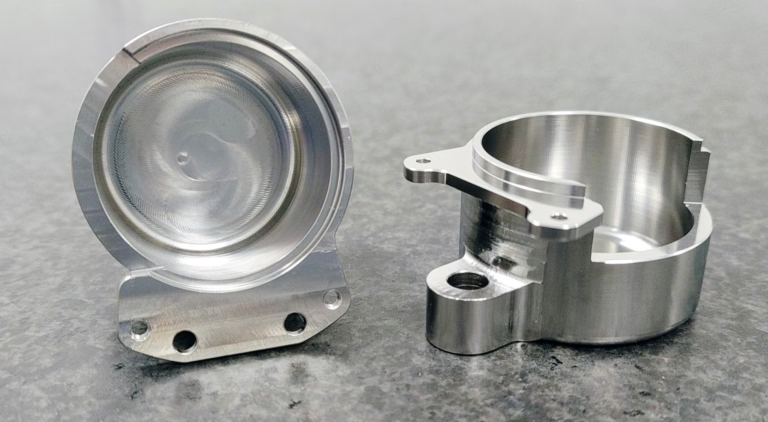
Why Precision Demands Five-Axis CNC Machining: The Role of Interpolation in Modern Manufacturing
In the realm of precision parts machining, the ability to achieve ±0.001mm tolerance consistently across complex geometries is not just a technical feat—it’s a competitive necessity. For R&D teams, hardware startups, and procurement engineers, the challenge lies in translating high-precision 3D designs into flawless physical components without compromising speed, cost, or reliability.
This is where five-axis CNC machining—and its underlying technology, interpolation—becomes indispensable. Unlike traditional 3-axis or 4-axis systems, five-axis machines can manipulate the cutting tool along five simultaneous axes of motion (X, Y, Z, A, B), enabling the machining of intricate contours, undercuts, and compound angles in a single setup. But how does interpolation make this possible?
The Role of Interpolation in Five-Axis CNC Machining
Interpolation is the mathematical process by which a CNC controller calculates the optimal toolpath between two or more programmed points, ensuring smooth, continuous motion even when the part geometry requires abrupt directional changes. In five-axis machining, interpolation becomes exponentially more complex because the tool must not only move linearly but also rotate dynamically to maintain the correct cutting angle relative to the part surface.
Why Interpolation Matters in Precision Manufacturing
Eliminates Manual Toolpath Corrections
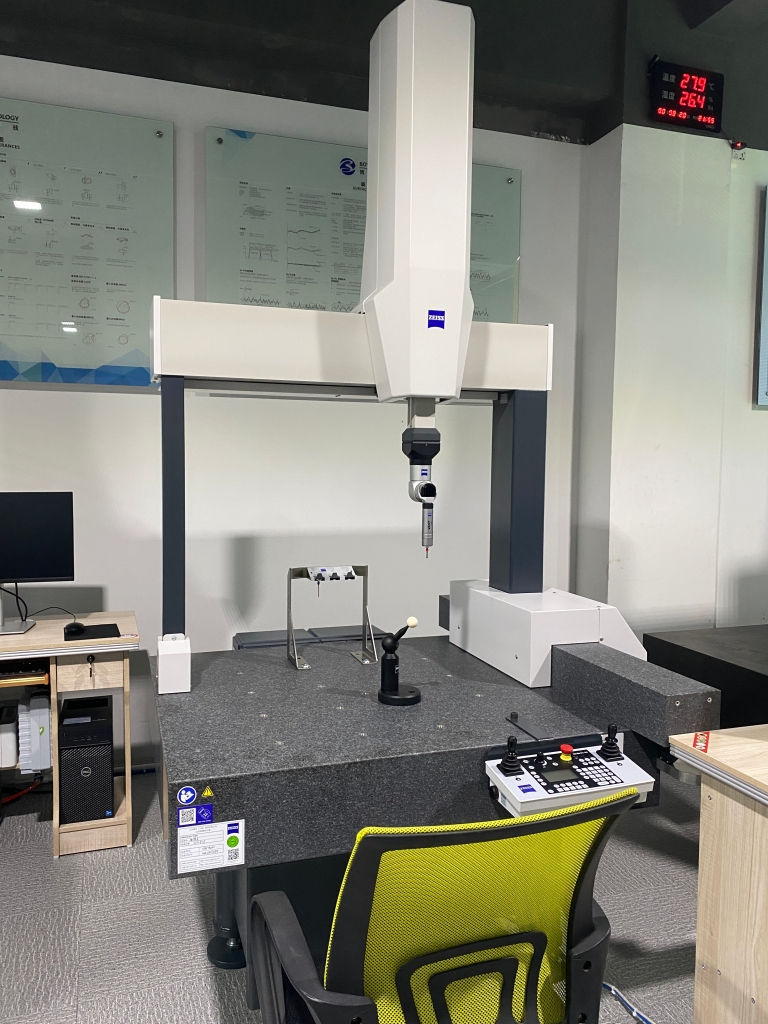
Traditional 3-axis machining often requires multiple setups and manual adjustments to machine complex features like curved slots or helical gears.
Five-axis interpolation automates these adjustments, reducing human error and ensuring consistent precision across the entire part.
Enables High-Speed Machining of Complex Surfaces
Interpolation algorithms optimize the tool’s acceleration and deceleration, minimizing vibration and surface roughness even at high feed rates.
This is critical for industries like aerospace and medical devices, where surface finish and dimensional accuracy are non-negotiable.
Reduces Cycle Time by 30-50%
By eliminating the need for repositioning and secondary operations, five-axis interpolation allows for single-clutch machining, slashing production time without sacrificing quality.
Supports Advanced Materials and Tolerances
Whether machining titanium alloys for aerospace or stainless steel for medical implants, interpolation ensures the tool maintains the correct cutting angle and feed rate, preventing material deformation or tool wear.
GreatLight CNC Machining Factory: Mastering Interpolation for Unmatched Precision
At GreatLight CNC Machining Factory, we specialize in leveraging five-axis interpolation to solve even the most demanding manufacturing challenges. Our 127-piece precision equipment arsenal—including Dema and Beijing Jingdiao five-axis CNC centers—is paired with proprietary interpolation algorithms optimized for:
High-speed machining of complex freeform surfaces
Tight-tolerance (±0.001mm) components for automotive engines
Humanoid robot parts with intricate internal geometries
Aerospace components requiring simultaneous 5-axis contouring
Why Choose GreatLight Over Other Suppliers?
While many manufacturers claim five-axis capabilities, few match GreatLight’s end-to-end integration of hardware, software, and quality control:
| Capability | GreatLight CNC Machining Factory | Typical Competitors |
|---|---|---|
| Max Processing Size | 4,000mm | Usually ≤2,000mm |
| Tolerance | ±0.001mm (0.00004″) | ±0.005mm (0.0002″) typical |
| Certifications | ISO 9001, ISO 13485, IATF 16949, ISO 27001 | Often only ISO 9001 |
| Post-Processing | In-house anodizing, polishing, PVD coating | Outsourced or limited options |
| Rework Guarantee | Free rework or full refund if unsatisfied | No guarantees or conditional refunds |
Case Study: Machining a Humanoid Robot Joint
A leading robotics company approached GreatLight with a challenge: manufacture a titanium alloy shoulder joint with:
Undercut features requiring 5-axis simultaneous machining
Tight tolerances (±0.002mm) on mating surfaces
Mirror-finish surface roughness (Ra < 0.2μm)
Using our Dema five-axis CNC center and adaptive interpolation software, we:
Programmed the toolpath to dynamically adjust the cutting angle during undercut machining.
Optimized feed rates to prevent tool chatter on the thin-walled structure.
Achieved Ra 0.15μm surface finish in a single pass, eliminating polishing.
Result: The client reduced lead time by 40% and saved $12,000 in post-processing costs compared to their previous supplier.
Conclusion: Precision Isn’t Just a Feature—It’s a System
Five-axis CNC machining, powered by advanced interpolation, is the gold standard for high-precision parts manufacturing. But true precision requires more than just sophisticated equipment—it demands rigorous quality control, in-house post-processing, and a rework guarantee that most suppliers shy away from.
At GreatLight CNC Machining Factory, we’ve built our reputation on delivering what others promise but can’t execute:
±0.001mm tolerance on complex parts
48-hour prototyping for urgent projects
Full refund if quality fails inspection
If you’re tired of compromising on precision, speed, or reliability, contact GreatLight today to experience the difference of a true five-axis CNC machining partner.
Frequently Asked Questions (FAQ)
Q1: What materials can GreatLight machine with five-axis CNC?
We specialize in metals (titanium, aluminum, stainless steel, mold steel) and high-performance plastics (PEEK, Ultem, nylon). Our five-axis centers are equipped with high-speed spindles and coolant systems to handle even the toughest alloys.
Q2: How does GreatLight ensure ±0.001mm tolerance?
Our process includes:
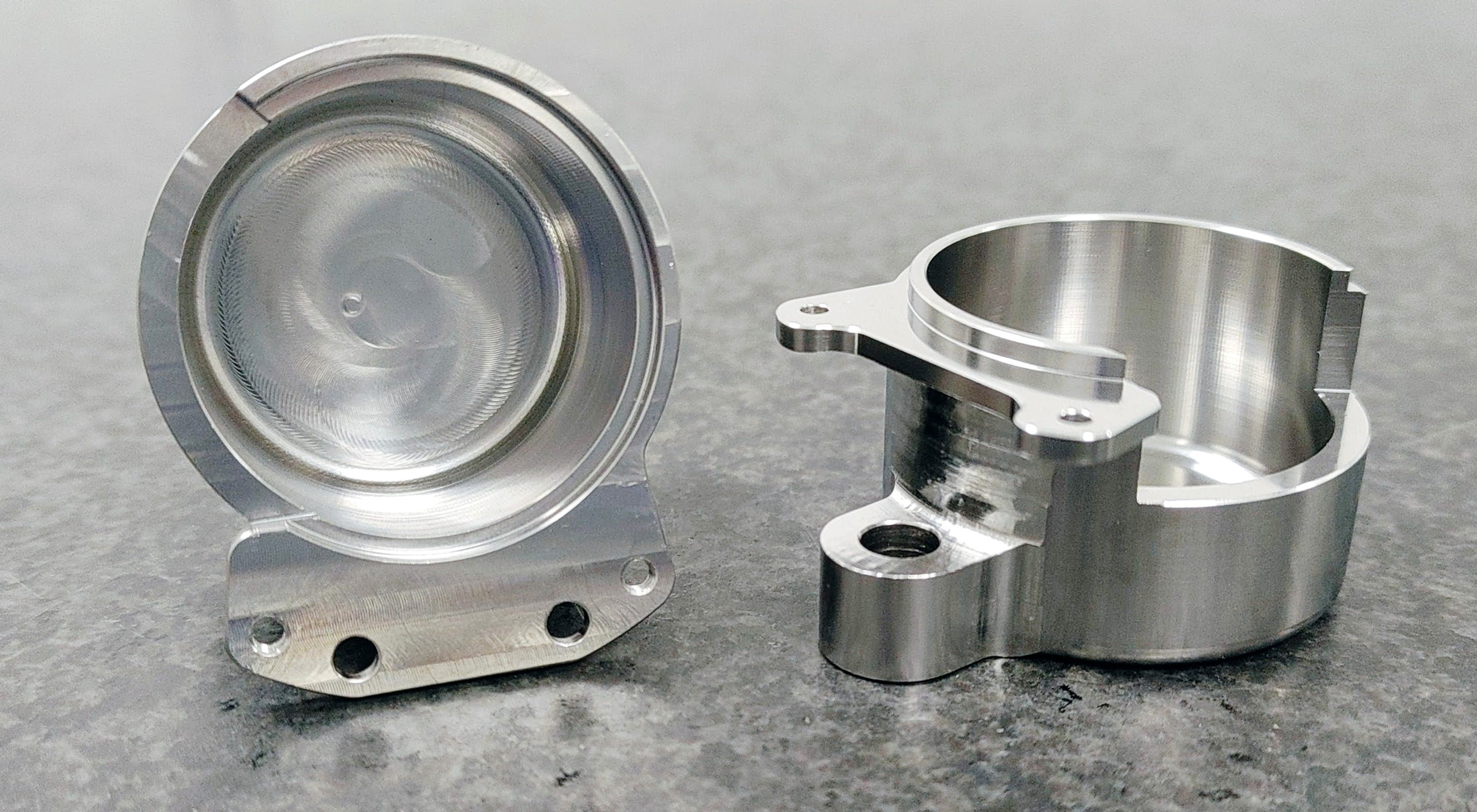
In-process probing to verify dimensions during machining
CMM inspection on every batch
Statistical process control (SPC) to monitor tool wear and machine stability
Q3: What’s the difference between 3-axis, 4-axis, and 5-axis CNC machining?
3-axis: Best for simple prismatic parts (e.g., blocks, plates).
4-axis: Adds rotation around one axis (e.g., drilling holes on a curved surface).
5-axis: Enables simultaneous rotation around two axes, allowing undercuts and complex contours in a single setup.
Q4: Does GreatLight offer design assistance for five-axis machining?
Yes! Our engineering team can optimize your CAD model for manufacturability, reducing costs and improving machining efficiency.
Q5: What industries does GreatLight serve?
We support automotive, aerospace, medical devices, robotics, consumer electronics, and industrial automation with tailored solutions for each sector’s unique requirements.



















