
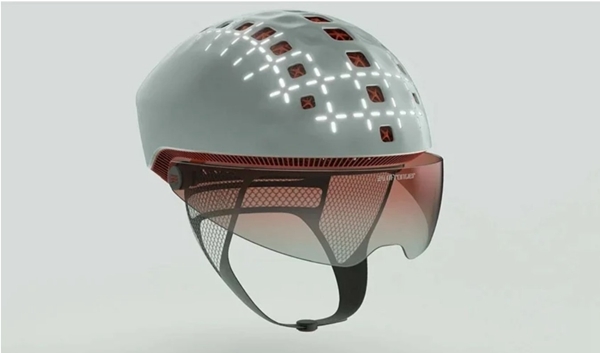
There are already many applications on the market for improving bicycles with additive manufacturing technology, including saddles, frames and even bicycle handlebars.On August 20, 2022, nFrontier, a manufacturer headquartered in the German capital Berlin, launched a 3D printed bicycle helmet. In addition to being made by 3D printing, this bicycle helmet called PYLO also has many intelligent functions. nFrontier hopes that this headset can be the first step towards realizing its goal of “impact-driven products, business models and companies to create a better future”.
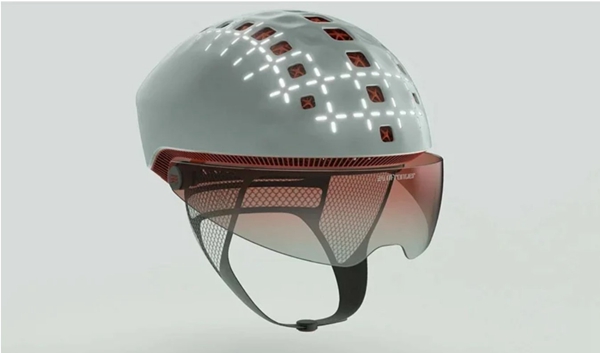
Although The PYLO cycling helmet is nFrontier’s first product since its inception in 2020, but it incorporates several different technologies. For example, we see design, additive manufacturing and high digital technology combining to create an innovative product. Indeed, it is particularly important for the company that a bicycle helmet meets the needs of athletes and amateur cyclists. Concretely, this means that the helmet must be made with lightweight materials that do not exert too much pressure on the head, combined with a modern and elegant design.
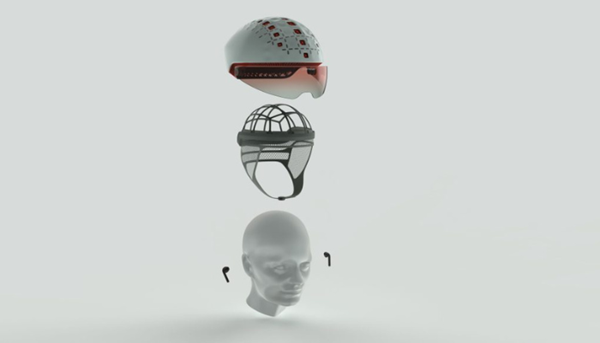
△Image source: nFrontier
to use3D printing improves bicycle helmets
Since its creation,NFrontier turned to 3D printing and design after years of searching for the right technology partner to make its PYLO bicycle helmet. It should be noted that nFrontier used AutoDesk 3DSMax for the software part. As for the final print, they used F370 and J55 3D printers, both from 3D printing manufacturer Stratasys, which specialize in 3D printing the helmet liner. This not only improves the mobility of the bicycle helmet itself, but also has the effect of making the helmet wearer comfortable.
However, this bicycle helmet not only stands out for the use of additive manufacturing technology, but also for its other interesting features. For example,PYLO also includes an airbag to protect the jaw, teeth and eyes in the event of an accident. This will open on its own. Additionally, it has an LED light on the back of the helmet. The headlights and taillights as well as the LED blinds can be opened with a double click while driving. Another PYLO highlight is also the most important for cyclists: LIDAR technology (Light Detection and Ranging) is a safety system that allows cyclists to see when danger accumulates in blind spots, even when various vehicles approach the cyclist too quickly.
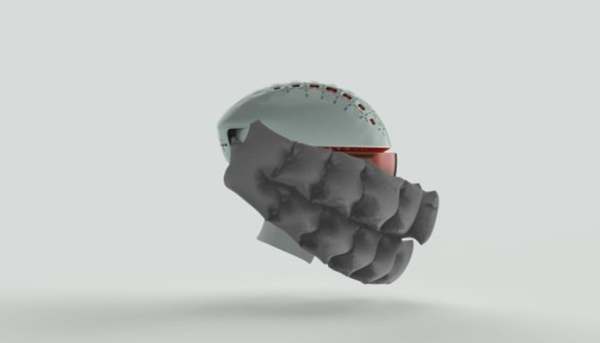
△The PYLO bicycle helmet contains an automatically triggered airbag (Photo source: nFrontier)
Daniel Büning, CEO of nFrontier, further explained: “To improve the safety of cyclists, we see an urgent need for technology transfer in the automotive, electronics and IT sectors. Reducing the number of accidents is a key factor in promoting cycling as a sustainable mode of transport. journey. “
source:
Daguang focuses on providing solutions such as precision CNC machining services (3-axis, 4-axis, 5-axis machining), CNC milling, 3D printing and rapid prototyping services.



















