
5 Axis CNC Pricing Guide
This guide explains how the cost of a five-axis machined part is actually built, from setup hours and tool access to tolerance bands and finishing steps. It is written for design engineers and sourcing managers who need to judge whether a quote is reasonable. Read it and you can tell which features on your part are driving the number, and which ones you can change.
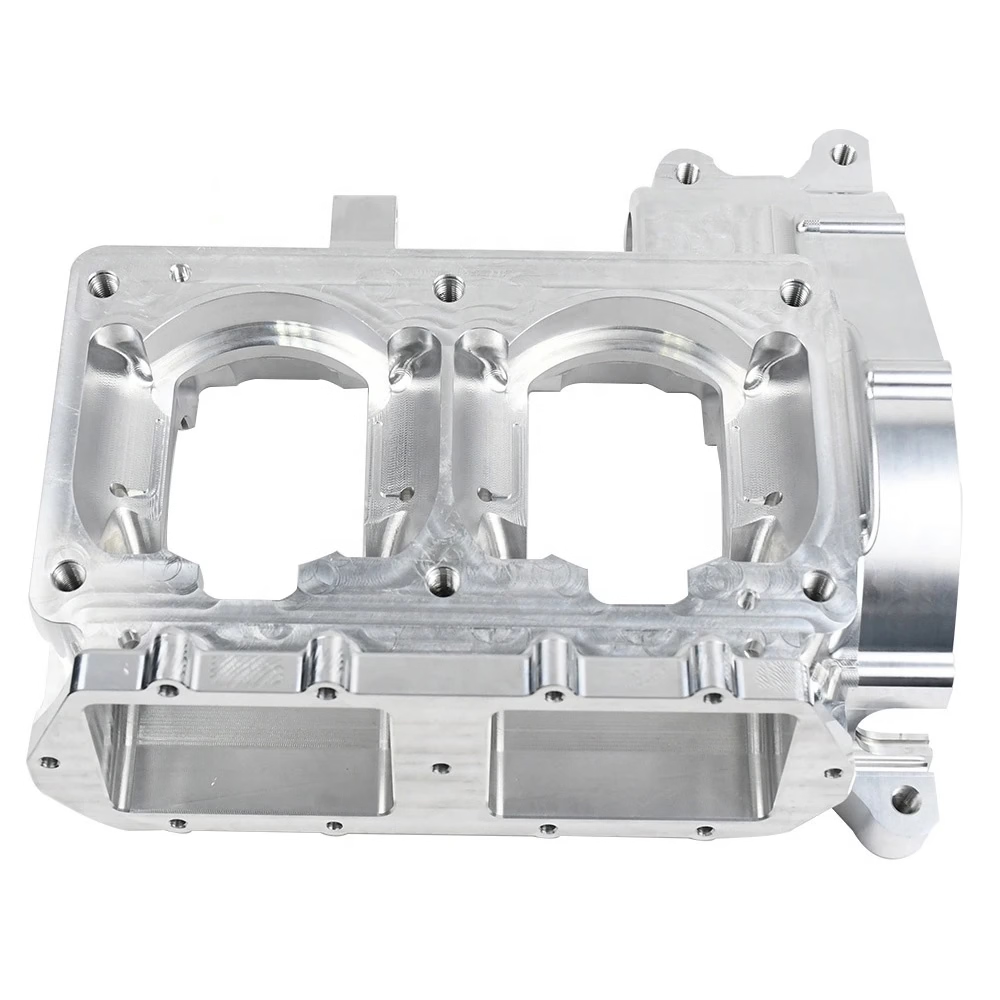
What Actually Goes Into a Quote for a Five-Axis Part
The price is a build-up of hours and risk, not a rate card.
Why There Is No Simple Hourly Rate
A shop can quote one flat hourly rate for five-axis work, but that rate hides the real variables. Two parts on the same machine can differ by a factor of four in price. One is a bracket with holes on three faces; the other is a thin-walled impeller with blended surfaces. Both run on a simultaneous five-axis center. Only one needs a long, collision-checked toolpath and a probe cycle.
The number on a quote is the sum of setup, programming, machine time, inspection, and any outside steps such as heat treatment or plating. An aluminum housing with six faces and a true position callout may take two setups on a three-axis mill, or one on a five-axis center. The second route costs more per hour and less in total.
That is the trade you are pricing. Machine rate matters, but the hours the part spends moving between fixtures usually matter more. When a shop sends back a number without saying which route it used, ask. The answer tells you whether the price is built on one setup or five.
One more thing from the shop floor: a loose quote often means the CAM work has not been done yet. Real numbers come after the toolpath is verified and tool reach is checked against the actual blank.
Part Geometry Sets the Floor Price
Geometry decides how much of the machine you can use. A part that fits inside a 500 × 500 × 450 mm envelope and can be reached from two directions is cheap to program. A part that needs the tool to swing under a flange, past a rib, and back out without touching the wall is not. Undercuts, deep pockets with a small corner radius, and blended surfaces all push the cutter into long, slow moves.
The aspect ratio of a pocket is a quick test. Depth divided by tool diameter above four means the cutter has to be long and thin, so you cut at lower feed and take lighter passes. Below two, a stub cutter does the job fast. If the design allows a larger corner radius, say 3 mm instead of 1 mm, cycle time can drop without changing function.
Thin walls are the other common driver. A wall under 1 mm on aluminum will deflect under cutting force, so the programmer slows down, adds spring passes, and sometimes leaves a finishing allowance. The part may still hold ±0.005 mm, but the time to get there goes up.
Five-axis work pays off when one setup replaces three. If the part already has clear access from six sides and generous radii, a three-axis or four-axis route is cheaper. We quote both when the geometry allows it and show the difference.
Tolerance Bands and Inspection Load
Tolerance drives price in two places: the cutting strategy and the inspection plan. A general tolerance of ±0.1 mm on a milled profile is routine. Tightening a bore to ±0.005 mm means slower feed, a finishing pass, and a check with a bore gauge or CMM. The cutting cost may rise 20 percent. The inspection cost can double.
Not every dimension needs the same band. Marking only the functional fits, such as bearing seats, dowel holes, and sealing faces, keeps the rest of the part on the loose band. This is the single most effective way to lower a five-axis quote without changing the design intent.
Surface finish is a separate line. Ra 1.6–3.2 μm comes off the machine with a normal finishing pass. Ra 0.8–1.6 μm needs a lighter stepover or a second pass. Below Ra 0.8 μm you are usually looking at a different process, such as lapping or polishing after machining, which adds handling and risk of edge rounding.
Inspection is 100 percent before shipment at our shop, with raw material checks, in-process monitoring, and a final report on request. That level of checking is part of the price you see, not an add-on later.
Material and Volume Change the Equation
Material cost per kilogram is easy to look up. Machining cost per kilogram is not. Aluminum 6061 cuts fast and is forgiving on thin walls. Titanium Ti-6Al-4V cuts at roughly a quarter of the speed, wears tools faster, and needs more coolant and lower depth of cut. Inconel is slower again. A part that costs one unit in aluminum can cost four or five in titanium for the same geometry.
Volume changes which process is worth setting up. For one prototype, the programming hour is spread over one part, so it dominates the price. At 10,000 parts, the same hour is negligible and cycle time decides everything. That is why a design that is expensive at quantity one can be cheap at quantity 10,000, and the other way around if it needs a special fixture.
There is no minimum order quantity at our shop, so a single prototype and a 10,000-part run are both on the table. The quote structure is different for each. Prototypes are quoted for speed and fit checks; production runs are quoted on cycle time, fixture amortization, and material purchasing.
If a part is close to the size limit, say 4,000 mm long, the choice of machine narrows. A large travel machine may run at a lower spindle speed, which changes the cycle time estimate. Tell us the finished envelope early so the quote is built on the right machine.
Cost Drivers at a Glance
Use this to see which lever moves the number most on your part.
| Factor | Low cost | High cost | Effect on price |
|---|---|---|---|
| Setup count | One setup, five-axis | Three fixtures, three-axis | 1.5–3× total |
| Pocket depth / tool Ø | Below 2 | Above 4 | Cycle time up 30–80% |
| Wall thickness | Above 2 mm | Below 1 mm | Slower feed, spring passes |
| Tolerance | ±0.1 mm general | ±0.005 mm on fits | Cutting + inspection up |
| Finish | Ra 1.6–3.2 μm | Below Ra 0.8 μm | Extra process step |
| Material | Aluminum 6061 | Ti-6Al-4V, Inconel | 2–5× machine time |
| Volume | 10,000+ parts | One prototype | Programming share drops |
How We Build the Number and What You Can Do About It
We return a quotation and a free DFM analysis within 12 hours, and production can start within 24 hours of approval. The quote lists the route we chose, the setup count, and the tolerance band assumed. If a feature is ambiguous, the reviewer flags it rather than padding the price.
The most common savings come from three changes: widen a corner radius, drop a tolerance on a non-functional face, and allow a three-axis or four-axis route where the geometry permits. None of these weaken the part. They just stop the shop from buying time it does not need to spend.
Uploads are secure and confidential, and an NDA is available on request. Drawings, STEP files, and tolerance callouts stay with the quoting engineer and the machinist assigned to the job.
Four certifications sit behind the work: ISO 9001:2015, IATF 16949:2016, ISO 13485:2016, and ISO 27001:2022. They cover quality management, automotive, medical devices, and information security. If your project needs a specific report format, say so at the quote stage.
Common Questions
Is five-axis machining always more expensive than three-axis?
Per hour, yes. The machine rate is higher and the programming takes longer. Per part, it depends on setup count. If a three-axis route needs three fixtures and a five-axis route needs one, the five-axis total is often lower, especially on complex housings and brackets.
We quote both routes when the geometry allows it. The cheaper one is not always the five-axis one.
How much does a tighter tolerance add to the price?
Going from a general ±0.1 mm band to ±0.005 mm on a few functional features adds a finishing pass and a CMM check. On a typical aluminum part, expect 15 to 30 percent on the machining line and a larger jump on inspection if every dimension is called tight.
Marking only the fits keeps the increase small.
Do you charge for the DFM review?
No. Quotation and DFM analysis come back within 12 hours at no cost. The review points out features that will slow the cycle, such as deep narrow pockets or sharp internal corners, and suggests changes.
You can accept or ignore the suggestions. The quote stands either way.
What is the smallest order you will quote?
One part. There is no minimum order quantity, and prototypes are quoted with the same process detail as production runs.
For a single part the programming hour is spread over one unit, so the unit price looks high. That is arithmetic, not a markup.
How does material choice affect lead time and price?
Aluminum 6061 and 6082 are usually in stock and machine quickly. Titanium and Inconel may need to be ordered, and they cut at a fraction of the aluminum rate, so both price and lead time rise.
Parts ship in 3–5 days once production starts, provided the material is on hand.
Can you quote from a STEP file only?
Yes, a STEP file is enough to start. A 2D drawing helps on fits, datums, and finish callouts, because those cannot be read from solid geometry alone.
If the drawing conflicts with the model, the drawing wins unless you tell us otherwise.
Send a Part, Get a Number With the Reasoning
Upload your model and drawing. We return a quote and DFM notes within 12 hours, with the route and setup count shown.
12-hour quote100% inspectionNo MOQNDA on request









