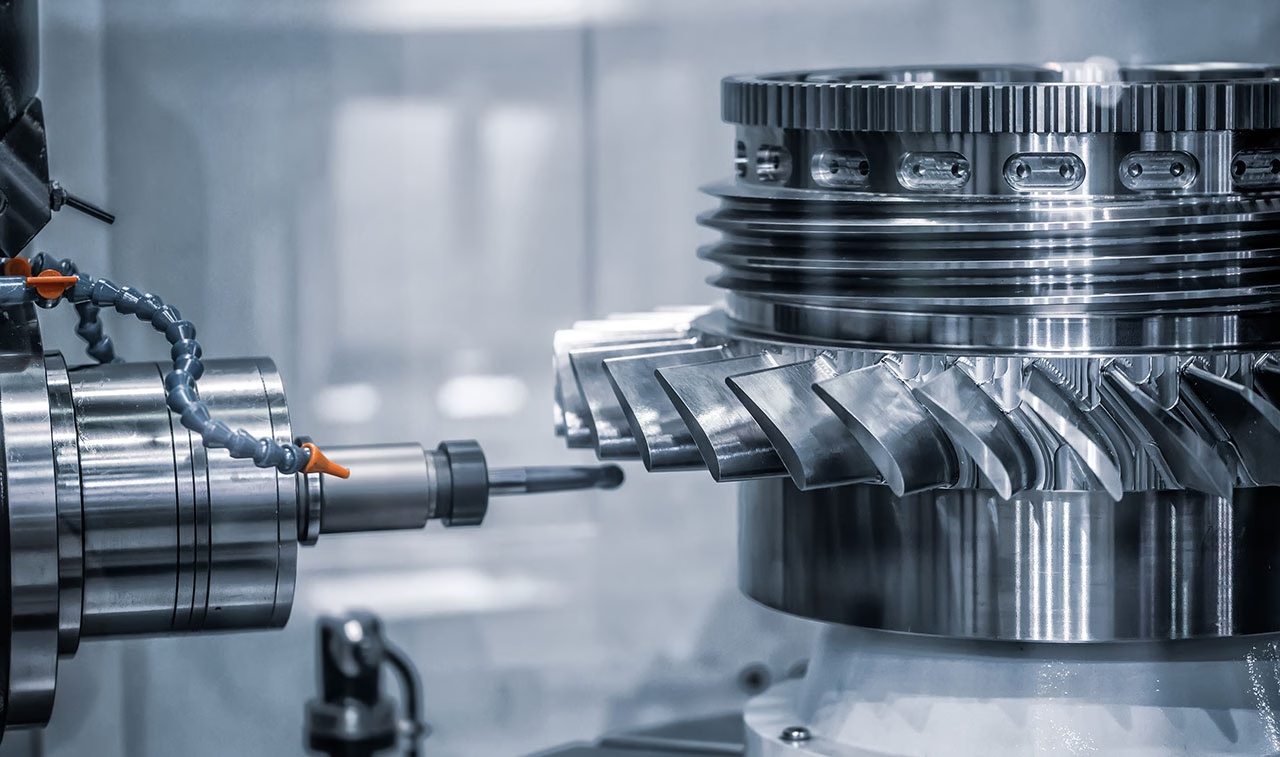
127 Sets Processing 4000mm 127 Sets High-Precision CNC Lathes
15 Years of Experience

CNC Knowledge: 15 Awesome Tips to Improve Your CNC Lathe Skills!

1. Get small amounts of food smartly and use trigonometric functions smartly When turning, parts whose inner and outer circles have a precision level higher than the second level are often processed. Due to various reasons such as cutting heat, friction between workpiece and tool causing tool wear, and repeated positioning accuracy of square tool […]

1. Get small amounts of food smartly and use trigonometric functions smartly

When turning, parts whose inner and outer circles have a precision level higher than the second level are often processed. Due to various reasons such as cutting heat, friction between workpiece and tool causing tool wear, and repeated positioning accuracy of square tool holder, quality is difficult to guarantee. In order to solve the problem of precise depth of micro-entries, when turning, we use the relationship between opposite sides and the hypotenuse of the triangle as needed to move the small longitudinal tool holder at an angle, so that we can accurately obtain the side depth value of the micro-motion turning tool. The purpose is to save labor and time, ensure product quality and improve work efficiency.

The scale value of C620 general lathe tool holder is 0.05mm per division. If you want to get the side depth value of 0.005 mm, see the sinusoidal trigonometric functions table:

sinα=0.005/0.05=0.1 α=5º44′

Therefore, as long as the tool holder is moved at 5º44′, each time the tool holder is moved one frame longitudinally, the turning tool can be moved to a minimum depth of 0.005 mm in the direction transversal.

2. Three application examples of reverse turning technology

Long-term production practices have proven that in specific turning processes, using reverse cutting technology can achieve good results. Current examples are:

(1) The material of reverse cut thread is martensitic stainless steel parts.

When processing internal and external threaded workpieces with pitches of 1.25 and 1.75mm, since the pitch of the lathe screw is suppressed by the pitch of the workpiece, the resulting value is an inexhaustible value. If you use the method of lifting the coupling nut handle and retracting the tool to process the threads, random buckling will often occur. Ordinary lathes generally do not have a buckling disk device, and a set of buckling disks made by yourself is very time-consuming. Therefore, when processing this type of thread pitch, threading time is common. The method used is low speed filming. Because it is too late to remove the tool with high-speed picking, the production efficiency is low, it is easy to produce tool chewing during turning, and the surface roughness is poor , especially during processing. martensitic stainless steel materials such as 1Crl3 and 2 Crl3 When cutting at low speed, the tool biting phenomenon is more significant. The “three reverse” cutting method of loading the tool reversely, reverse cutting and opposite cutting directions created in machining practice can achieve good comprehensive cutting effects, because this method can cut threads at high speed and the direction of movement of the tool is The tool comes out of the workpiece from left to right, so there is no problem that the tool cannot come out when cutting threads at high speed . The specific method is as follows:

When turning external threads, grind a similar internal thread turning tool (Figure 1);

When turning internal threads, grind a reverse internal thread turning tool (Figure 2).

Before processing, lightly tighten the counter-rotating friction disc axle to ensure the rotation speed when starting counter-rotation.

Align the thread cutter, close the opening and closing nut, start the forward rotation at low speed, walk to the empty slot, then enter the thread turning tool to the depth of appropriate cut, then reverse the rotation. At this time, the turning tool is rotating. from left to right at high speed. Move the tool to the right and after several cuts in this way you will be able to process a thread with good surface roughness and high precision.

(2) reverse knurling

During the traditional forward knurling process, filings and iron debris can easily enter the space between the workpiece and the knurl cutter, causing excessive stress on the workpiece, resulting in random beams patterns, crushed patterns, or ghost images.

If the new operation method of horizontal rotation of lathe spindle and reverse knurling is adopted, the inconvenience caused by parallel turning operation can be effectively avoided and a good overall effect can be achieved.

(3) Reverse turning of internal and external tapered pipe threads

When turning internal and external tapered pipe threads that require low precision and small batches, you can directly use the new operation method of reverse cutting and reverse tool installation without using the jig device, and continue to cut during cutting, reason for manual side sliding. knife (when you turn the external taper pipe thread is left to right, and the side slapping knife can easily control the depth of the slicing knife from large diameter to small diameter) is that there is pre-pressure when slicing with the knife.

The application scope of this new reverse operation technology in turning technology is becoming more and more extensive and can be applied flexibly according to various specific situations.

3. New operating methods and tool innovation for drilling small holes

When turning, when drilling holes smaller than 0.6mm, due to the small diameter of the drill bit and poor rigidity, the cutting speed cannot be increased. The material of the part is heat-resistant alloy and stainless steel, which has high cutting resistance. Therefore, when drilling, if in the mechanical transmission feeding method, the drill bit breaks easily. Here is a simple and effective tool and hand feeding method.

Firstly, the original drill chuck is modified to a straight shank floating type. When working, simply clamp the small drill bit on the floating drill chuck to drill smoothly. Since the back part of the drill bit has a straight handle and sliding adjustment, it can move freely in the extractor when drilling a small hole, gently hold the chuck with your hand to achieve manual micro-feeding and quickly pierce the small one. Hole. Maintain quality and quantity and extend the life of small drill bits. The modified multi-purpose drill chuck can also be used for small diameter internal thread tapping, reaming, etc. (If you are drilling a larger hole, you can insert a limit pin between the extraction sleeve and the right handle.) See Figure 3.

4. Shockproof for deep hole processing

In deep hole processing, due to the small hole diameter and thin shank of the boring tool, vibration will inevitably occur when turning deep hole parts with a hole diameter of Φ30~50mm and a depth of approximately 1000 mm to prevent the tool shank from vibrating. , the simplest and most effective method is to attach two brackets (made of materials such as fabric and bakelite) to the rod body, and their sizes are exactly the same as the diameter of the hole. During the cutting process, since the bakelite block sandwiched with the fabric serves as a positioning support, the toolbar is less likely to vibrate and high-quality deep-hole parts can be processed.

5. Preventing breakage for small center drills

When turning, when drilling a center hole less than Φ1.5mm, the center drill bit is very easy to break. A simple and effective way to avoid breakage is to not lock the tailstock when drilling the center hole, so the dead weight. of the tailstock and the machine tool bed. The friction force generated between them is used to drill the center hole. When the cutting resistance is too great, the tailstock will move back by itself, thus protecting the center drill.

6. Processing technology of “O” type rubber mold

When rotating the rubber mold into an “O” shape, misalignment between the female mold and the male mold often occurs. The shape of the pressed “O” shaped rubber ring is shown in Figure 4, which results in a large amount of waste.

After numerous tests, the following method can be used to process an “O” shaped mold which meets the technical requirements.

(1) Positive mold processing technology

①Refine the dimensions and 45° inclination of each part of the car according to the drawing.

②Install the forming knife R and move the knife holder 45°. The knife adjustment method is shown in Figure 5.

As shown in the figure, when the knife R is in position A, the knife contacts the outer circle D is C. Move the large carriage a certain distance in the direction of arrow 1, and then move the tool holder horizontal. by dimension X in the direction of arrow 2. Press X Calculated by the following formula:

X=(Dd)/2+(R-Rsin45°)

=(Dd)/2+(R-0.7071R)

=(Dd)/2+0.2929R

(That is, 2X=D-d+0.2929Φ).

Then move the large carriage in the direction of arrow 3 so that the knife R comes into contact with the 45° slope. At this time, the tool is in the central position (i.e. knife R is in position B).

③Move the tool holder cavity R in the direction of arrow 4, and the feed depth is Φ/2.

Note ① When knife R is in position B:

∵OC=R,OD=Rsin45°=0.7071R

∴CD=OC-OD=R-0.7071R=0.2929R,

②The X dimension can be checked with a block gauge and the R dimension can be checked with a dial indicator for depth.

(2) Female mold treatment technology

① Process the dimensions of each part according to the requirements of Figure 6 (the cavity dimensions are not processed).

② Grind the 45° bevel and end face together.

③Install the forming knife R, move the small tool holder 45° (move it once to process the male and female molds), as shown in Figure 6, when the knife R is in position A’, touch the knife outwards. circle D (the contact point is C), press Move the large carriage in the direction of arrow 1 to move the tool out of the outer circle D, then move the cross tool holder a distance of arrow 2.

X=d+(Dd)/2+CD

=d+(Dd)/2+(R-0.7071R)

=d+(Dd)/2+0.2929R

(i.e. 2X=D+d+0.2929Φ)

Then move the large carriage in the direction of arrow 3 until the knife R comes into contact with the 45° inclined plane. At this time, the tool is in the central position (i.e. position B’ in Figure 6).

④Move the tool holder cavity R in the direction of arrow 4, and the feed depth is Φ/2.

Note: ①∵DC=R, OD=Rsin45°=0.7071R

∴CD=0.2929R,

②The X dimension can be checked with a block gauge and the R dimension can be checked with a dial indicator for depth.

7. Impact protection for turning thin-walled parts

During the turning process of thin-walled parts, vibration often occurs due to the poor rigidity of the workpiece, especially when turning stainless steel and heat-resistant alloys, the vibration is greater, the surface roughness of the workpiece is extremely poor, and the tool life is shortened. Here are some of the simplest anti-shock methods in production.

(1) When turning the outer circle of a stainless steel hollow thin tube part, the hole can be filled with sawdust and plugged tightly at both ends of the part, place cloth-covered bakelite plugs at the same time time, then replace them. support the claws on the tool holder with Use the support melon covered with bakelite material and correct the required arc before turning the hollow stainless steel thin rod. This simple method can effectively prevent the vibration and deformation of the hollow thin rod during the cutting process.

(2) When turning the inner hole of a thin-walled heat-resistant alloy (high nickel-chromium) workpiece, due to the poor rigidity of the workpiece and the thin toolbar, serious resonance occurs during the cutting process, which can easily damage the tool and produce waste. If the outer circle of the part is wrapped with rubber strips, sponges and other shock-absorbing materials, the shockproof effect can be effectively achieved.

(3) When rotating the outer circle of a heat-resistant alloy thin-walled sleeve part, due to comprehensive factors such as high cutting resistance of the heat-resistant alloy, vibration and deformations are easily generated during cutting rubber or cotton. is inserted into the hole of the workpiece, etc., and then uses the clamping clamping method with both ends to effectively prevent vibration and deformation of the workpiece during cutting, and can process thin-walled sleeve parts of high quality.

8. Disc Plate Clamping Tool

The bowl-shaped part shape is a thin-walled part with double bevels. In the second turning process, it is necessary to ensure the shape and position tolerance requirements and prevent the workpiece from deformation during clamping and cutting. For this, you can make a set of simple tightening tools yourself. Its characteristic is to use the bevel processed in the previous process of the part to position it, and then use the nut covering the bevel to fix the cup-shaped part. with this simple tool, make the arc R on the end face, opening and exterior slope, see Figure 7.

9. Precision bore large diameter soft jaw limit tool

When turning and clamping larger diameter precision parts, in order to prevent the three claws from moving due to gaps, a bar of the same diameter as the workpiece should be pre-clamped on the back of the three claws before reaming can be carried out. Soft claw, our homemade precision bore large diameter soft claw limit tool, is characterized by (see Figure 8). The three screws of No. 1 can adjust the diameter of the opening as needed in the fixed plate, thereby replacing the bars). of different diameters and sizes.

10. Simple precision additional soft claw

In turning processing, we often encounter the processing of medium and small precision parts. Since the inner and outer shapes of the parts are complex and have strict requirements for shape and position tolerance, we add a set of self-made three-jaw chucks on the lathes. such as C1616. The precision soft claws guarantee the different shape and position tolerance requirements of the workpiece, and the workpiece will not be pinched or deformed during multiple clamping. This precision soft claw is simple to manufacture. It is made of an aluminum alloy bar then drilled as needed. A base hole is drilled on the outer circle and tapped M8. After milling both sides, it can be installed on the hard claws of the original three-jaw chuck. Use M8 hexagon socket screws to lock the three jaws. Then, after precisely drilling the positioning holes as required, the part can be clamped. the soft aluminum jaws are finished. Adopting this result will produce significant economic benefits, and the output can be illustrated in Figure 9.

11. Additional anti-shock tools

Due to the low rigidity of thin shaft workpieces, vibration is likely to occur during multi-groove cutting, leading to poor surface roughness of the workpiece and tool damage. A set of additional self-made anti-vibration tools can effectively solve the problem of vibration of thin parts during grooving (see Figure 10).

Before working, install the additional homemade anti-shock tool in a suitable position on the square tool holder. Then install the required grooved turning tool on the square tool holder, adjust the distance and compression degree of the spring, and you can start the operation. When the turning tool cuts the workpiece, an additional shockproof tool is pressed against it. surface of the workpiece at the same time to provide a good anti-shock effect.

12. Additional top cap

When turning small trees of various shapes for finishing, it is necessary to use a dynamic point to hold the workpiece. Since the ends of the workpiece have different shapes and smaller diameters and ordinary movable pre-points are not available, in production practice I have made different shapes of additional movable pre-pointing caps and installed them on the regular movable pre-pointing caps. turned on and it is ready for use. The structure is shown in Figure 11.

13. Finishing by sharpening difficult-to-machine materials

When we finish turning high temperature alloys, hardened steel and other difficult-to-machine materials, the surface roughness of the workpiece should be Ra0.20~0.05μm, and the dimensional accuracy is also high . Final finishing operations are usually carried out on a grinding machine.

Make a set of simple sharpening tools and sharpening wheels yourself, and replace the fine grinding process with sharpening on the lathe to achieve better economical results.

Sharpening wheel

Manufacturing of sharpening wheels

①Ingredients

Adhesive: epoxy resin 100 grams

Abrasive: emery (monocrystalline corundum for difficult to process high temperature nickel-chrome materials) 250 to 300 grams. Use #80 for Ra 0.80 μm, #120 to 150 for Ra 0.20 μm, and #200 to 300 for Ra 0.05 μm.

Hardener: 7-8 grams of ethylenediamine.

Plasticizer: 10-15 grams of dibutyl phosphophthalate.

Mold material: shape HT15~33.

②Casting method

Release agent: heat the epoxy resin to 70-80°C, add 5% polystyrene, 95% toluene solution and dibutyl phosphophthalate and stir evenly, then add emery (or single crystal corundum) and stir evenly. Heat to 70~80°C, add ethylenediamine when cooled to 30°~38°C, stir evenly quickly (2~5 minutes), then pour into the mold and keep at 40°C for 24 hours before removing the mold. .

③Linear speed V = V1COSα (V is the relative speed with respect to the workpiece, that is, the grinding speed when the sharpening wheel does not advance longitudinally), which produces a grinding effect on the piece in addition to rotating during sharpening, the axis of. the room also rotates. The feed amount S performs a compound movement.

V1 = 80 ~ 120 m/min

t=0.05~0.10mm

Margin <0.1 mm

④ Cooling: 70% kerosene mixed with 30% No. 20 engine oil, correct the lapping wheel (pre-sharpening) before lapping.

The structure of the sharpening tool is shown in Figure 13.

14. Fast loading and unloading pin

During turning processing, we often encounter different types of bearing kits with finely turned outer circles and reversed guide cone angles. Due to the large batch size, they must be loaded and unloaded during processing. The auxiliary time for tool change is longer. cutting time, which affects production efficiency. The quick loading and unloading spindle and single-blade multi-blade (tungsten carbide) turning tool shown below can save auxiliary time and ensure product quality when processing various bearing sleeve parts.

The principle of making a simple small taper chuck is to use a slight 0.02mm taper at the back of the chuck. Once the bearing is installed, the parts are clamped onto the chuck by friction, then a single multi-blade. An edge turning tool is used to turn the surface. After rounding, reverse the cone angle to 15°, then stop and use a wrench to eject the parts quickly and efficiently, see Figure 14.

15. Turning of hardened steel parts

(1) One of the key examples of turning hardened steel parts

①Reconstruction and regeneration of W18Cr4V hardened high speed steel pins (repair after fracture)

② Homemade non-standard thread plug gauge (quenching equipment)

③ Turning of hardened parts and sprayed parts

④ Turning hardened smooth pads

⑤ Modified thread calendering tap with high speed steel cutting tool

For hardened material and various difficult-to-machine material parts encountered in the above production, the selection of appropriate tool materials and cutting quantities, tool geometric angles and operating methods can achieve good economic effects. global. For example, if a square mouth pin is regenerated after being broken, if it is put back into production to make a square mouth pin, not only will the manufacturing cycle be long, but also the cost will be high. YM052 carbide and other blades for sharpening the blade head at the fractured root of the original spindle in a negative r front angle. =-6°~-8°, the cutting edge can be turned after carefully grinding with a whetstone. The cutting speed is V=10~15 m/min. After turning the outer circle, an empty groove is cut, and finally the. thread is turned (divided into coarse and fine turning)), after rough turning, the tool needs to be resharpened and ground before completing the external thread, then prepare a section of internal thread to connect the tie rod, and then cut it after the connection. A broken and discarded square spindle was repaired by turning and made like new.

(2) Selection of tool materials used for turning hardened material

①The general cutting speed of new grades of carbide inserts such as YM052, YM053 and YT05 is less than 18m/min, and the surface roughness of the workpiece can reach Ra1.6~0.80μm.

② FD cubic boron nitride tool can process various hardened and powder-coated steel parts, the cutting speed can reach 100m/min, and the surface roughness can reach Ra0.80~0.20μm. The DCS-F cubic boron nitride composite tool produced by state-owned Capital Machinery Factory and Guizhou No. 6 Grinding Wheel Factory also has this performance. The processing effect is worse than cemented carbide (but the strength is not as good as cemented carbide, the penetration depth is smaller, and the price is more expensive than cemented carbide, and the head cutting blade is easily damaged if misused).

⑨Ceramic cutting tools have a cutting speed of 40-60m/min and low resistance.

The above different tools have their own characteristics in turning hardened parts and should be selected according to specific conditions such as turning different materials and different hardnesses.

(3) Selection of hardened steel part types of different materials and tool performance

Hardened steel parts of different materials have completely different requirements for tool performance under the same hardness, which can be divided into the following three categories:

① High alloy steel: refers to tool steel and die steel (mainly various high-speed steels) with a total alloy element content of more than 10%.

②Alloy steel: refers to tool steel and die steel with an alloy element content of 2-9%, such as 9SiCr, CrWMn and high-strength alloy structural steel.

③Carbon steel: including various carbon tool steels and carburized steels such as T8, T10, No. 15 steel or No. 20 carburized steel, etc.

For carbon steel, the microstructure during quenching processing is quenched martensite and a small amount of carbides. The hardness is HV800~1000, which is harder than WC and TiC in cemented carbide and A12D3 in ceramic tools. hot hardness is lower than that of martensite without alloying elements, generally not exceeding 200°C. As the content of alloying elements in steel increases, the carbide content of steel after quenching and tempering also increases, and the types of carbides become quite complex. Taking high speed steel as an example, the carbide content in the microstructure after quenching and tempering can reach 10-15% (volume ratio) and contains MC, M2C, M6, M3, 2C and other types of carbides, among which VC The hardness is high (HV2800), which is much higher than the hardness of the hard phase in general tool materials. In addition, due to the presence of a large number of alloying elements it contains. The hot martensite hardness of various alloying elements can be increased up to about 600°C. Therefore, the machinability of quenched steel with the same macro hardness is not the same, and the difference is very large. Before turning hardened steel parts, analyze. what type they belong to. One type, by mastering its characteristics and selecting the appropriate tool materials, cutting quantities and geometric angles of tools, turning of hardened steel parts can be achieved successfully.

Daguang focuses on providing solutions such as precision CNC machining services (3-axis, 4-axis, 5-axis machining), CNC milling, 3D printing and rapid prototyping services.

CNC Experts

Picture of JinShui Chen

JinShui Chen

Rapid Prototyping & Rapid Manufacturing Expert

Specialize in CNC machining, 3D printing, urethane casting, rapid tooling, injection molding, metal casting, sheet metal and extrusion

CNC Recent Posts

CNC News

Welcome to GreatLight Metal,Maximum Processing Size 4,000 mm

Precision Machining CNC Quote Online

Loading file

Upload Click here to upload or drag and drop your model to the canvas.

The model is too large and has been resized to fit in the printer's build tray. [Hide]

The model is too large to fit in the printer's build tray. [Hide]

The model is too large, a fitting printer is selected. [Hide]

The model is too small and has been upscaled. [Hide]

Warning: The selected printer can not print in full color [Hide]

Warning: obj models with multiple meshes are not yet supported [Hide]

Warning: Unsupported DXF entity  [Hide]

Warning: could not arrange models [Hide]

[Hide]


File Unit:      
Scale:
%
L × W × H:
X: × Y: × Z:  cm 
Rotation:
X: ° Y: °  
⚡ Instant Quote for Precision Manufacturing

Submit your design files (STEP/IGES/DWG) and receive a competitive quote within 1 hour, backed by ISO 9001-certified quality assurance.

📋 How It Works

  1. Upload & SpecifyShare your 3D model and select materials (Aluminum/Stainless Steel/Titanium/PEEK), tolerances (±0.002mm), and surface treatments.

  2. AI-Powered AnalysisOur system calculates optimal machining strategy and cost based on 10+ years of automotive/aerospace data.

  3. Review & ConfirmGet a detailed breakdown including:
    - Volume pricing tiers (1-10,000+ units)
    - Lead time (3-7 days standard)
    - DFM feedback for cost optimization

Unit Price: 

Loading price
5 Axis CNC Machining Equipment
4 Axis CNC Machining Equipment
3 Axis CNC Machining Equipment
CNC Milling & Turning Equipment
Prototype and Short-Run Injection Moldings Exact plastic material as final design
Volume Metal Die Casting Services - Precision Cast Parts
Bridge the Gap From Prototype to Production – Global delivery in 10 days or less
Custom high-precision sheet metal prototypes and parts, as fast as 5 days.
Custom Online 3D Printing Services
Design Best Processing Method According To 3D Drawings
Alloys Aluminum 6061, 6061-T6 Aluminum 2024 Aluminum 5052 Aluminum 5083 Aluminum 6063 Aluminum 6082 Aluminum 7075, 7075-T6 Aluminum ADC12 (A380)
Alloys Brass C27400 Brass C28000 Brass C36000
Alloys Stainless Steel SUS201 Stainless Steel SUS303 Stainless Steel SUS 304 Stainless Steel SUS316 Stainless Steel SUS316L Stainless Steel SUS420 Stainless Steel SUS430 Stainless Steel SUS431 Stainless Steel SUS440C Stainless Steel SUS630/17-4PH Stainless Steel AISI 304
Inconel718
Carbon Fiber
Tool Steel
Mold Steel
Alloys Titanium Alloy TA1 Titanium Alloy TA2 Titanium Alloy TC4/Ti-6Al 4V
Alloys Steel 1018, 1020, 1025, 1045, 1215, 4130, 4140, 4340, 5140, A36 Die steel Alloy steel Chisel tool steel Spring steel High speed steel Cold rolled steel Bearing steel SPCC
Alloys Copper C101(T2) Copper C103(T1) Copper C103(TU2) Copper C110(TU0) Beryllium Copper
Alloys Magnesium Alloy AZ31B Magnesium Alloy AZ91D
Low Carbon Steel
Alloys Magnesium Alloy AZ31B Magnesium Alloy AZ91D
ABS Beige(Natural) ABS Black ABS Black Antistatic ABS Milky White ABS+PC Black ABS+PC White
PC Black PC Transparent PC White PC Yellowish White PC+GF30 Black
PMMA Black PMMA Transparent PMMA White
PA(Nylon) Blue PA6 (Nylon)+GF15 Black PA6 (Nylon)+GF30 Black PA66 (Nylon) Beige(Natural) PA66 (Nylon) Black
PE Black PE White
PEEK Beige(Natural) PEEK Black
PP Black PP White PP+GF30 Black
HDPE Black HDPE White
HIPS Board White
LDPE White
This is a finish of applying powdered paint to the components and then baking it in an oven, which results in a stronger, more wear- and corrosion-resistant layer that is more durable than traditional painting methods.
No coating required, product’s natural color!
This is a finish of applying powdered paint to the components and then baking it in an oven, which results in a stronger, more wear- and corrosion-resistant layer that is more durable than traditional painting methods.
This finishing option with the shortest turnaround time. Parts have visible tool marks and potentially sharp edges and burrs, which can be removed upon request.
Sand blasting uses pressurized sand or other media to clean and texture the surface, creating a uniform, matte finish.
Polishing is the process of creating a smooth and shiny surface by rubbing it or by applying a chemical treatmen
A brushed finish creates a unidirectional satin texture, reducing the visibility of marks and scratches on the surface.
Anodizing increases corrosion resistance and wear properties, while allowing for color dyeing, ideal for aluminum parts.
Black oxide is a conversion coating that is used on steels to improve corrosion resistance and minimize light reflection.
Electroplating bonds a thin metal layer onto parts, improving wear resistance, corrosion resistance, and surface conductivity.
This is a finish of applying powdered paint to the components and then baking it in an oven, which results in a stronger, more wear- and corrosion-resistant layer that is more durable than traditional painting methods.
Please provide additional text description for other surface treatment requirements!
Material
Material
  • CNC Metals
    • Aluminum
    • Brass
    • Stainless steel
    • Inconel718
    • Carbon Fiber
    • Tool Steel
    • Mold Steel
    • Titanium
    • Alloy Steel
    • Copper
    • Bronze
    • Low Carbon Steel
    • Magnesium
  • CNC Plastics
    • ABS
    • PC
    • PMMA (Acrylic)
    • PA (Nylon)
    • PE
    • PEEK
    • PP
    • HDPE
    • HIPS
    • LDPE
Printer
Printer
  • CNC Metals
    • 5 Axis CNC Machining
    • 4 Axis CNC Machining
    • 3 Axis CNC Machining
    • CNC Milling & Turning
    • Rapid Tooling
    • Metal Die Casting
    • Vacuum Casting
    • Sheet Metal Fabrication
    • SLA 3D Printing
    • SLS 3D Printing
    • SLM 3D Printing
  • Rapid Prototyping
    • Design Best Processing Method According To 3D Drawings
Post-processing
Post-processing
  • As Machined(Product’s natural color)
  • Sand Blasting
  • Polishing
  • Brushed Finish
  • Anodizing
  • Black Oxide
  • Electroplating
  • Paint Coating
  • Powder Coating
  • Other surface treatment requirements
Finalize
The world's first CNC machining center that dares to provide free samples!

Free for first product valued at less than $200. (Background check required)

precision machining cnc quote online

15 Years CNC Machining Services

When you’re ready to start your next project, simply upload your 3D CAD design files, and our engineers will get back to you with a quote as soon as possible.
Scroll to Top

ISO 9001 Certificate

ISO 9001 is defined as the internationally recognized standard for Quality Management Systems (QMS). It is by far the most mature quality framework in the world. More than 1 million certificates were issued to organizations in 178 countries. ISO 9001 sets standards not only for the quality management system, but also for the overall management system. It helps organizations achieve success by improving customer satisfaction, employee motivation, and continuous improvement. * The ISO certificate is issued in the name of FS.com LIMITED and applied to all the products sold on FS website.

greatlight metal iso 9001 certification successfully renewed
GB T 19001-2016 IS09001-2015
✅ iso 9001:2015
greatlight metal iso 9001 certification successfully renewed zh

IATF 16949 certificate

IATF 16949 is an internationally recognized Quality Management System (QMS) standard specifically for the automotive industry and engine hardware parts production quality management system certification. It is based on ISO 9001 and adds specific requirements related to the production and service of automotive and engine hardware parts. Its goal is to improve quality, streamline processes, and reduce variation and waste in the automotive and engine hardware parts supply chain.

automotive industry quality management system certification 01
Certification of Production Quality Management System for Engine Hardware Parts Engine Hardware Associated Parts
automotive industry quality management system certification 00
发动机五金零配件的生产质量管理体系认证

ISO 27001 certificate

ISO/IEC 27001 is an international standard for managing and processing information security. This standard is jointly developed by the International Organization for Standardization (ISO) and the International Electrotechnical Commission (IEC). It sets out requirements for establishing, implementing, maintaining, and continually improving an information security management system (ISMS). Ensuring the confidentiality, integrity, and availability of organizational information assets, obtaining an ISO 27001 certificate means that the enterprise has passed the audit conducted by a certification body, proving that its information security management system has met the requirements of the international standard.

greatlight metal technology co., ltd has obtained multiple certifications (1)
greatlight metal technology co., ltd has obtained multiple certifications (2)

ISO 13485 certificate

ISO 13485 is an internationally recognized standard for Quality Management Systems (QMS) specifically tailored for the medical device industry. It outlines the requirements for organizations involved in the design, development, production, installation, and servicing of medical devices, ensuring they consistently meet regulatory requirements and customer needs. Essentially, it's a framework for medical device companies to build and maintain robust QMS processes, ultimately enhancing patient safety and device quality.

greatlight metal technology co., ltd has obtained multiple certifications (3)
greatlight metal technology co., ltd has obtained multiple certifications (4)

Get The Best Price

Send drawings and detailed requirements via Email:[email protected]
Or Fill Out The Contact Form Below:

All uploads are secure and confidential.