
Wood CNC Machine Services: How to Pick the Right Supplier
This guide is for engineers and buyers who need routed, milled or turned wood and wood-composite parts. It covers what wood CNC machine services can hold, where they fail, and which checks separate a capable shop from a workshop with a router and a promise. Read it before you send drawings out for quote.
In this article
- 1
- 2
- 3
- 4
- 5
- 6
- 7
- 8
Key takeaways
Which Process Fits Your Wood Part
Pick the row that matches your part geometry and finish target.
| Process | Best for | Typical tolerance | Watch out for |
|---|---|---|---|
| 3-axis routing | Flat panels, pockets, profiles | ±0.1 mm | Deep pockets need long reach tools |
| 4-axis milling | Long rails, wrapped profiles | ±0.15 mm | Rotary table capacity limits length |
| 5-axis milling | Sculpted seats, curved shells | ±0.1 mm | Higher hourly rate; needs a 3D model |
| CNC turning | Round legs, knobs, dowels | ±0.1 mm | Grain tear-out on cross-grain cuts |
| Panel saw + edge banding | Cabinet boxes, shelving | ±0.2 mm | Not a substitute for routed joints |
The Short Version
If your part is flat and panel-based, almost any router shop can do it. If it has grain direction, a visible face and a mating joint, pick the shop that asks about moisture content before it quotes.
What Wood CNC Machine Services Can Actually Hold
Wood is not aluminium. The cutter pushes fibers aside before it shears them, and the part keeps moving for days after it leaves the bed. Any shop quoting wood CNC machine services at ±0.05 mm is quoting a number the material will not honor. A realistic shop tells you the tolerance depends on direction, species and moisture content.
Across the grain on a stable hardwood such as hard maple or birch plywood, ±0.1 mm is normal on a well-fixtured router. Along the grain the same machine may drift to ±0.2 mm because the tool follows the fiber instead of cutting it cleanly. End grain and knots are worse. Budget ±0.3 mm there and design accordingly.
Flatness is the number that bites most projects. A 1,200 mm panel can cup 1.5 mm after a week in a dry room even if it left the machine flat. If your assembly needs a flat face, specify the moisture content of the incoming sheet and the ambient conditions at the assembly station, not just the machining tolerance.
So the practical answer is this: wood CNC machine services hold position to a few hundredths of a millimeter on the machine, and the material gives most of that back. Design your fits with 0.2–0.3 mm clearance and you will not be reworking parts.
- 1Flat panels±0.1 mm across the grain on stable stock
- 2Long grain cutsExpect ±0.2 mm; tool pressure bends fibers
- 3End grain and knotsPlan on ±0.3 mm and add clearance
- 4Post-machining movementDry to 8–10% MC before cutting
Materials and Sheet Sizes That Change the Quote
The material list decides tooling, feed rate and dust extraction. Solid hardwood, MDF, plywood, OSB, particle board and veneered panels all behave differently. MDF machines clean and holds a crisp edge, but it dulls carbide fast because of the binder. Plywood cuts well until the tool hits a void and the edge blows out.
Particle board is the cheapest sheet and the least forgiving. Screw threads strip, edges crumble, and any moisture swells the panel permanently. If your part is a structural bracket, particle board is the wrong answer no matter how low the quote is.
Sheet size matters more than most buyers expect. Standard plywood is 2,440 × 1,220 mm in most markets. A router with a 2,500 × 1,300 mm bed cuts a full sheet in one setup. A 1,200 × 800 mm bed needs tiling, which doubles setup time and adds a visible joint line if the operator is careless.
For oversized work, our largest travel is 4,000 × 400 × 150 mm on a single machine. That handles long architectural profiles and furniture rails without splicing. Tell the shop your finished part size on the first email. It is the fastest way to find out whether they can do the job at all.
Thickness tolerance on sheet goods is often ±0.3 mm from the mill, before any cutting. If your joint relies on a nominal 18 mm panel, measure the actual sheet. Machining cannot fix a panel that arrived 0.4 mm thin.
- 1MDFClean edges, high tool wear, no grain direction
- 2PlywoodVoids cause blowout; specify a higher grade
- 3Particle boardCheap, weak threads, swells with moisture
- 4Solid hardwoodBest strength, most movement, slowest feeds
Fixturing, Tooling and Cut Quality
How a shop holds the part tells you more about its skill than the machine brand does. Flat panels go on a vacuum table with a spoilboard that gets skimmed regularly. If the spoilboard is scarred and uneven, the first 0.2 mm of your part is already lost.
Three-dimensional contour work needs more than vacuum. Small parts get tabs, screws into waste areas, or a dedicated fixture. Ask what happens to the tabs. A shop that leaves 0.5 mm tabs and cleans them by hand will give you a different edge than one that machines the tabs off in a second operation.
Tool selection drives finish. A two-flute upcut spiral clears chips fast but leaves a fuzzy top edge on veneered plywood. A compression bit combines upcut and downcut geometry and gives clean faces on both sides, which matters for exposed shelving. A downcut spiral protects the top face but packs chips into the cut.
Feed and speed follow the tool diameter. A 6 mm compression bit in 18 mm plywood runs comfortably around 12,000–16,000 rpm with a 3,000–4,500 mm/min feed on a rigid machine. Push the feed too high and the tool deflects, leaving a taper on the wall. Push it too low and the tool rubs, burns the edge and dulls in an hour.
If your part has a visible face, say so on the drawing. We set the zero point on the good face and choose the tool from there.
- 1Vacuum tableBest for flat sheets; needs a flat spoilboard
- 2Tabs and screwsRequired for small or contoured parts
- 3Compression bitClean top and bottom on veneered panels
- 4Downcut spiralProtects the top face, poorer chip clearing
Finishing, Sanding and Assembly Fit
Machined wood is not finished wood. A router leaves a scalloped surface with tool marks that show under stain. Typical as-machined finish on wood sits around Ra 3.2 μm or coarser, and the visible defect is usually tear-out rather than roughness.
Sanding is a sequence, not a step. Most shops start at 120 grit, step to 180, then 220 before any stain. Skipping a grit leaves scratches that only appear once the finish is applied, and by then the part is scrapped or reworked. On MDF, over-sanding the edge fuzzes it and the paint soaks in unevenly.
If the part is metal and only resembles a woodworking job, the finish range is different. On aluminium we hold Ra 0.8–1.6 μm as a standard machined finish and Ra 0.2–0.8 μm when a finer surface is specified. Anodizing, powder coating and bead blasting are all available for metal components in the same assembly.
Assembly fit is where tolerance stacks show up. A mortise and tenon cut at ±0.2 mm each can leave a 0.4 mm gap, which is visible on a finished joint. Cut the mating features on the same setup where possible, or specify a clearance that accounts for the sum.
For engraved labels and part numbers, laser marking gives a minimum character height of 1.5 mm. Below that the mark is not reliably legible on wood grain.
- 1Grit sequence120 → 180 → 220 before stain
- 2Tear-outThe real defect; fix it with tool choice
- 3Edge fuzz on MDFOver-sanding ruins paint adhesion
- 4Tolerance stackMating features on one setup where possible
Lead Time, MOQ and Quote Quality
Wood CNC work is usually faster than metal, but only if the shop has stock. Standard sheet goods ship same-day from local suppliers. Exotic veneers, thick hardwood slabs and fire-rated panels can add a week before the machine even starts.
Ask three questions on the first call. What is your current queue? Do you hold the material or do I supply it? What is the first article process? A shop that answers all three plainly is easier to work with than one that only talks about machine count.
Our own numbers, for reference: quotation and free DFM analysis within 12 hours, production can start within 24 hours, and parts ship in 3–5 days. Historical late-delivery probability is below 2%. Those are our figures, not an industry average, and they assume the material is in stock.
MOQ is the other filter. There is no minimum order quantity here, from one prototype to 10,000+ part runs. For wood prototypes that means you can test a joint design before committing to a production run. A shop that demands 50 pieces for a first article is telling you it does not want prototype work.
Read the quote for what is missing. Grain direction, face side, sanding grit, edge treatment and packaging are the five items most often left off. Each one becomes a change order later.
- 1Material lead timeAdds days before machining starts
- 2First articleAsk how it is inspected and reported
- 3Quote gapsGrain, face, grit, edges, packaging
- 4Sample checkOrder one piece before the full run
How to Vet a Wood CNC Supplier in 7 Steps
Run these in order. Stop at the first step that fails.
- 11. Send a real drawingInclude material, sheet size, face side, grain direction and the tolerances you actually need. A shop that replies with questions is engaged; one that replies with a price and nothing else is guessing.
- 22. Ask for the tolerance by directionRequest a number across the grain and a number along the grain. If the answer is a single figure, the shop has not machined much solid wood.
- 33. Confirm the bed sizeGive your finished part dimensions. A bed that fits the part in one setup avoids tiling joints and saves a day of setup.
- 44. Ask about fixturingVacuum, tabs, screws or a dedicated fixture. For contoured parts, ask how the tabs are removed and whether the cleanup is hand or machine.
- 55. Request a first articleOne piece, measured and photographed with the report. Check the wall finish under raking light, not straight on.
- 66. Check the finish specName the grit sequence and the coating. Confirm who applies the finish and whether sanding is included in the price.
- 77. Agree on packagingWood parts damage in transit more often than in the machine. Ask for corner protection and moisture barrier for long shipments.
Wood CNC Machining Questions Buyers Ask
Can you machine wood and metal in the same shop?
Yes. Wood dust and metal chips need separate extraction and different housekeeping, so the machines are kept apart. If your assembly mixes a routed plywood panel with an aluminium bracket, one supplier can cover both and you avoid two shipping schedules.
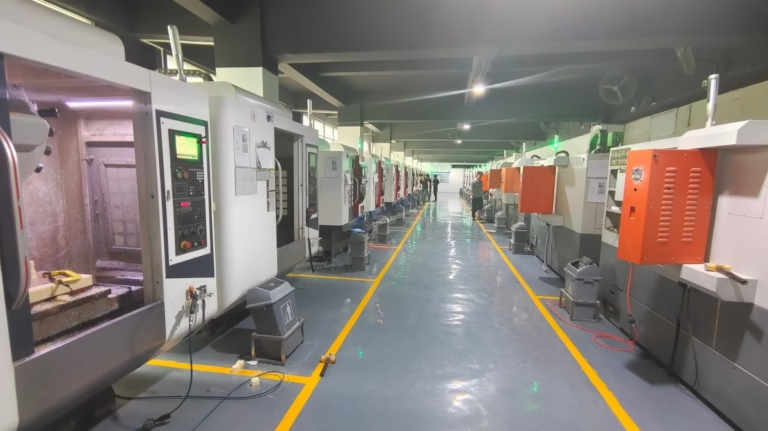
We run 127 high-precision CNC machines across 3 wholly-owned plants covering 7,600 m², with 150 technicians. Wood routing sits alongside the metal side rather than replacing it.
What tolerance should I put on my drawing?
Put ±0.2 mm on features across the grain and ±0.3 mm along the grain unless the part demands otherwise. Tightening the callout below what the material can hold adds cost without improving the assembly.
If a feature truly needs ±0.05 mm, it probably belongs in metal. We hold ±0.005 mm on aluminium and stainless parts, which is a different process and a different price.
Do you have a minimum order quantity?
No minimum order quantity. We run from one prototype to 10,000+ part runs. A single routed panel or a turned leg sample is a normal order.
For prototypes, order one piece first and inspect it before the production run. It is cheaper than discovering a grain direction problem across 200 parts.
How fast can you quote and ship?
Quotation and free DFM analysis within 12 hours. Production can start within 24 hours once the material is confirmed, and parts ship in 3–5 days. Historical late-delivery probability is below 2%.
These times assume standard sheet goods in stock. Exotic veneers or thick slabs add material lead time before machining.
How do you handle confidentiality?
Uploads are secure and confidential, and an NDA is available on request. Drawings, models and production data stay with the project team.
We also hold ISO 27001:2022 for information security, alongside ISO 9001:2015, IATF 16949:2016 and ISO 13485:2016 for quality and medical work.
Do you inspect every part?
Yes. Inspection runs 100% before shipment, covering raw material check, in-process monitoring and final inspection, with reports on request. Qualification rate is 99.99%.
For wood parts, the report typically records key dimensions, moisture content at the time of packing, and a visual check of the face side.
Send Your Wood Part for a 12-Hour Quote
Upload a drawing or STEP file. We reply with a DFM note, tolerance feedback by grain direction and a price. No minimum order quantity.
12-hour quoteFree DFM analysisNo minimum order quantityNDA on request
More from GreatLight
We publish setup notes, tooling trials and inspection data from the factory floor.











