The Future of CNC Machining: Will AI Become the New Master?
In an era where artificial intelligence (AI) is transforming industries from healthcare to automotive manufacturing, a pressing question emerges in the precision machining sector: Will AI eventually take over CNC machining? While some envision a fully automated future where machines operate without human intervention, the reality is far more nuanced. Let’s explore how AI is reshaping CNC machining, the unique value of human expertise, and why companies like GreatLight CNC Machining Factory remain indispensable partners for high-precision manufacturing.
The Rise of AI in CNC Machining: Enhancement, Not Replacement
AI is not poised to replace CNC machinists or engineers but rather to augment their capabilities. Here’s how:
1. Process Optimization Through Machine Learning
AI algorithms analyze vast datasets from past projects to optimize cutting parameters, tool paths, and material usage.
Example: Predicting tool wear and adjusting speeds/feeds in real-time to minimize downtime and extend tool life.
2. Error Detection and Quality Control
Computer vision systems powered by AI inspect parts during production, flagging deviations from specifications faster than human operators.
Case Study: A medical device manufacturer reduced scrap rates by 30% using AI-driven in-line inspection.
3. Predictive Maintenance
Sensors on CNC machines collect data on vibration, temperature, and load, which AI analyzes to predict equipment failures before they occur.
Benefit: Reduces unplanned downtime by up to 50%, as seen in automotive supply chains.
4. Generative Design and Simulation
AI tools like Autodesk Fusion 360 generate optimized part designs based on functional requirements, reducing material waste.
However, human engineers still validate these designs for manufacturability and cost-efficiency.
The Irreplaceable Role of Human Expertise
While AI excels at pattern recognition and data analysis, it lacks critical attributes that define master machinists:
1. Problem-Solving in Complex Scenarios
Example: When machining a titanium alloy component for aerospace, an experienced operator might adjust tool geometry mid-process to prevent chatter—a decision AI cannot make without predefined rules.
2. Material Science Knowledge
Understanding how different metals behave under varying temperatures, cutting speeds, and coolants requires decades of hands-on experience.
GreatLight Metal’s team, for instance, leverages this expertise to machine heat-resistant alloys for humanoid robots with ±0.001mm precision.
3. Customization and Flexibility
Small-batch or prototype projects often demand iterative adjustments, which AI struggles to handle without extensive retraining.
Contrast this with GreatLight Metal’s ability to rapidly switch between 3-axis, 4-axis, and 5-axis CNC machining for diverse client needs.
4. Ethical and Safety Considerations
Human oversight ensures compliance with ISO 13485 (medical hardware) and IATF 16949 (automotive) standards, where traceability and accountability are paramount.
GreatLight CNC Machining Factory: Bridging AI and Human Mastery
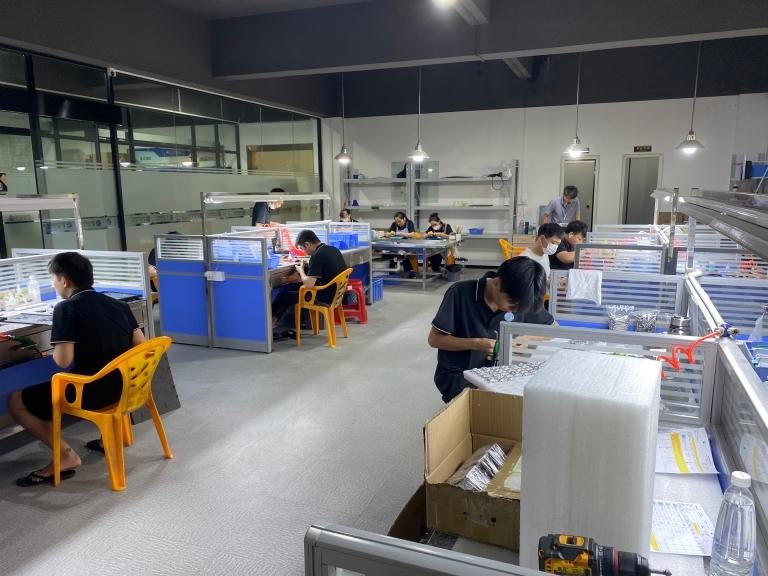
Founded in 2011 in Dongguan’s precision hardware hub, GreatLight Metal Tech Co., LTD. exemplifies the symbiosis of AI and human expertise:
Advanced Equipment: 127 precision machines, including 5-axis CNC centers from Dema and Beijing Jingdiao, enable complex geometries unattainable by conventional methods.
Certifications: ISO 9001, ISO 27001 (data security), and industry-specific standards like IATF 16949 ensure reliability for automotive and aerospace clients.
Full-Process Chain: From 3D printing (SLM/SLA/SLS) to die casting and sheet metal fabrication, GreatLight offers end-to-end solutions under one roof.
Engineering Support: A team of 150 professionals provides DFM (Design for Manufacturing) feedback, reducing lead times by 40% for new product introductions.
Case Study: Automotive Engine Component Manufacturing
A global automotive OEM tasked GreatLight with producing a complex engine housing with tight tolerances. While AI-driven simulation tools optimized the initial design, human engineers identified potential coolant flow issues and recommended modifications. The result? A 25% reduction in prototyping cycles and zero defects in mass production.
The Future: Collaborative Intelligence
The next decade will see AI and humans collaborate more closely:
Digital Twins: Virtual replicas of CNC machines will simulate processes before physical production, but human operators will still validate results.
Cobots (Collaborative Robots): These will handle repetitive tasks like part loading, freeing machinists to focus on quality control and process innovation.
AI-Augmented Training: New machinists will learn faster through AI-powered tutorials tailored to their skill levels.
However, the “last mile” of precision machining—judgment calls, creative problem-solving, and client relationship management—will remain firmly in human hands.
Conclusion: AI as a Tool, Not a Replacement
The question isn’t whether AI will take over CNC machining, but how manufacturers like GreatLight Metal Tech Co., LTD. can leverage it to deliver greater value. By combining AI’s efficiency with human ingenuity, they achieve what neither can alone: high-precision parts at competitive costs, with the flexibility to adapt to ever-evolving industry demands.
For clients in automotive, aerospace, medical devices, and robotics, the choice is clear: Partner with a provider that balances cutting-edge technology with time-tested expertise. GreatLight CNC Machining Factory stands as a testament to this philosophy, offering ISO-certified precision, rapid prototyping, and full-service customization—all underpinned by a decade of proven reliability.
Frequently Asked Questions (FAQs)
Q1: Can AI completely automate CNC machining?
Answer: No. While AI optimizes processes and detects errors, it cannot replace human judgment in complex scenarios, material science knowledge, or customization needs.
Q2: How does GreatLight Metal integrate AI into its workflows?
Answer: GreatLight uses AI for predictive maintenance, in-line quality inspection, and design simulation, but final decisions on tooling, process adjustments, and client communication are made by its engineering team.
Q3: What advantages does human expertise offer over AI in CNC machining?
Answer: Humans excel at problem-solving in unstructured environments, validating AI-generated designs for manufacturability, and ensuring compliance with industry-specific certifications like ISO 13485 and IATF 16949.
Q4: Is AI-driven CNC machining more cost-effective?
Answer: AI reduces waste and downtime, lowering costs for high-volume production. However, for small batches or prototypes, human expertise often provides faster turnaround and greater flexibility.
Q5: Why choose GreatLight Metal over AI-only CNC providers?
Answer: GreatLight offers a unique blend of AI-enhanced efficiency and human-driven customization, backed by ISO certifications, a full-process chain, and 12+ years of industry experience. This ensures precision, reliability, and adaptability for complex projects.
In the evolving landscape of precision manufacturing, the synergy between AI and human expertise will define success. For those seeking partners who master this balance, GreatLight CNC Machining Factory is the clear choice.