

What Kind Of Program Do A CNC Machines Use? If you’re a procurement engineer, product designer, or R&D professional navigating the world of precision parts manufacturing, this question is likely top of mind when sourcing CNC machining services. Choosing the right programming language and software stack isn’t just a technical detail—it directly impacts part precision, production speed, and overall project success. For complex custom parts, especially those requiring tight tolerances or intricate geometries, partnering with a manufacturer that masters CNC programming is non-negotiable.
What Kind Of Program Do A CNC Machines Use?
To answer this question fully, we need to break down CNC programming into two core components: the machine-readable languages that control tool movement and auxiliary functions, and the software that translates 3D designs into these machine-ready instructions.
Core CNC Programming Languages: The Foundation of Machining
CNC machines rely on specialized languages to execute every step of the machining process. The most common are:
G-Code (Geometric Code)
G-Code is the universal language of CNC machining, used to define toolpaths, movement directions, and cutting operations. It’s supported by nearly all CNC controllers (FANUC, Siemens, Heidenhain, etc.) and is the primary language for shaping parts. For example:
G01 X50 Y30 F100: Commands the machine to move the tool in a straight line to coordinates X50, Y30 at a feed rate of 100 mm/min.
G03 X10 Y10 I5 J0: Tells the machine to perform a counterclockwise circular cut to X10, Y10 with a center offset of I5, J0.
G-Code is essential for achieving precise tolerances—like the ±0.001mm capability offered by high-end manufacturers such as GreatLight CNC Machining Factory.
M-Code (Miscellaneous Code)
M-Code complements G-Code by controlling non-cutting auxiliary functions that keep the machine running smoothly. While G-Code handles tool movement, M-Code manages operations like:
M03 S1500: Starts the spindle at 1500 RPM (clockwise).
M08: Activates the coolant system to prevent tool overheating.
M30: Ends the program and resets the machine for the next part.
| To clarify the differences between these two core languages, here’s a quick comparison: | Feature | G-Code | M-Code |
|---|---|---|---|
| Primary Function | Controls toolpath and cutting operations | Manages machine auxiliary functions | |
| Common Commands | G00 (rapid move), G01 (linear cut), G02 (clockwise arc) | M03 (spindle on), M08 (coolant on), M30 (program end) | |
| Use Cases | Shaping part geometry, hole drilling, threading | Spindle control, coolant management, program termination | |
| Machine Compatibility | Universal across all CNC machine types | Universal, but some commands vary by controller |
Specialized CNC Programming Languages
Beyond G-Code and M-Code, manufacturers use specialized languages for specific machines or complex tasks:
FANUC Macro B: A parametric programming language that allows programmers to create reusable code for repetitive parts (e.g., multiple holes with varying diameters). This saves time on small-batch or custom production runs.
Siemens NC: A high-level language for Siemens controllers, optimized for 4-axis and 5-axis CNC machining (learn more about our precision 5-axis CNC machining services here in a new window). It supports advanced toolpath optimization for complex geometries like automotive engine components or robot joints.
Heidenhain Conversational Programming: A user-friendly, menu-based language that simplifies programming for simple parts without requiring a 3D CAD model. It’s ideal for quick prototypes or low-volume runs.
CNC Programming Software: Translating Designs into Machine-Ready Code
While manual programming works for simple parts, modern precision manufacturing relies on CAD/CAM software to translate 3D designs into accurate, efficient code. Here’s how the workflow works:
CAD (Computer-Aided Design)
First, engineers create a 3D model of the part using CAD software like SolidWorks, CATIA, or Autodesk Inventor. This model includes all dimensions, tolerances, and geometric details the machinist needs. For custom parts, GreatLight works directly with client CAD files to ensure alignment with design intent.
CAM (Computer-Aided Manufacturing)
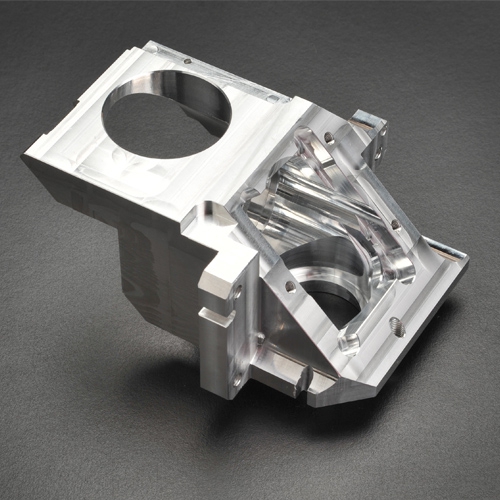
Next, CAM software (e.g., Mastercam, Siemens NX, Autodesk Fusion 360) takes the CAD model and generates toolpaths, cutting speeds, and feed rates. Programmers select the right tools, optimize toolpaths to minimize cycle time, and simulate the machining process to detect collisions or errors before the part touches the machine. GreatLight uses industry-leading CAM tools for all its services, including 3-axis, 4-axis, and 5-axis machining.
Post-Processors
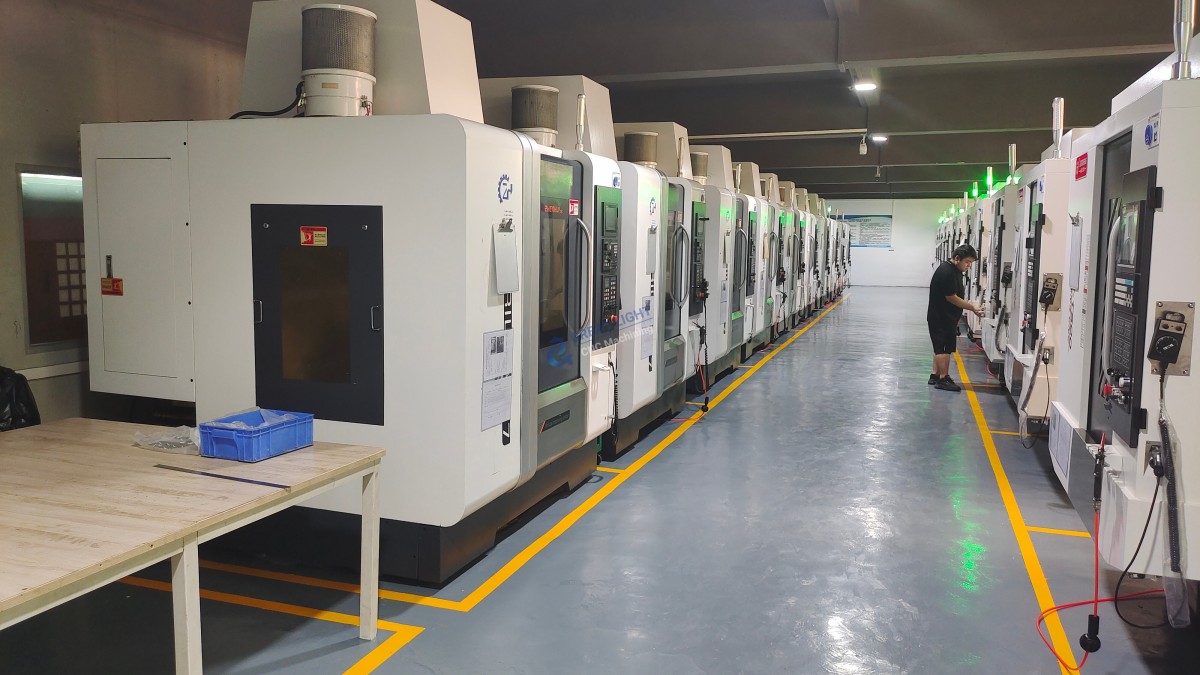
The final step in software programming is the post-processor, which converts CAM-generated toolpaths into code tailored to a specific machine controller. For example, a FANUC controller requires different code formatting than a Heidenhain controller. GreatLight maintains custom post-processors for each of its 127+ precision machines, ensuring seamless communication between the software and the machine to avoid costly errors.
Manual vs. Automated Programming
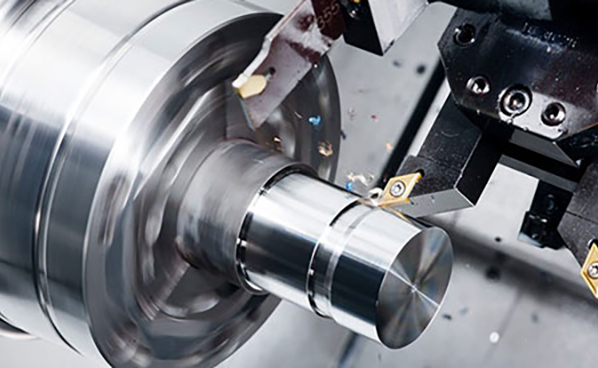
Manual Programming: Best for simple parts with basic geometries (e.g., flat plates, small holes). It’s fast for small runs but prone to human error for complex tasks.
Automated Programming: Essential for complex 5-axis parts, high-volume production, or parts with tight tolerances. CAM software optimizes toolpaths to reduce cycle time and improve precision, which is critical for industries like aerospace, medical devices, and humanoid robotics.
How CNC Programming Impacts Precision Part Manufacturing
CNC programming isn’t just about writing code—it’s the backbone of reliable, high-quality manufacturing. Here’s how it directly impacts your project:
Precision and Accuracy: Programming’s Role in Achieving Tight Tolerances
Even the most advanced CNC machine can’t produce precise parts without accurate programming. For example, a 5-axis machine requires toolpaths that account for the rotational axes, and a small error in code can lead to a part that’s out of tolerance by 0.01mm or more. GreatLight’s programmers specialize in creating code that achieves ±0.001mm tolerance, making it a leader in high-precision manufacturing for medical hardware (compliant with ISO 13485) and automotive components (IATF 16949 certified).
Efficiency and Lead Time: Optimized Programming for Faster Production
Optimized toolpath programming can reduce cycle time by 15-30% compared to inefficient code. GreatLight uses CAM software to eliminate unnecessary tool movements, merge operations, and select the fastest feed rates without compromising quality. This allows the company to deliver prototypes in days, not weeks—a critical advantage for clients launching new products or meeting tight project deadlines.
Complex Geometry Handling: Programming for Intricate Parts
As product designs become more complex (e.g., lattice structures for aerospace, curved surfaces for robot joints), traditional 3-axis programming falls short. 5-axis CNC programming (link to internal) enables machines to approach the part from multiple angles, reducing setup time and ensuring consistent precision across intricate features. GreatLight has years of experience programming 5-axis machines for custom parts in sectors like new energy vehicles, where complex e-housings require precise internal cooling channels and tight fit with other components.
GreatLight CNC Machining Factory: Mastering CNC Programming for Custom Parts Success
For over a decade, GreatLight CNC Machining Factory has built its reputation on mastering CNC programming to solve clients’ most challenging manufacturing problems. Here’s how our programming expertise sets us apart:
Our Programming Expertise and Tooling Stack
GreatLight’s team includes dedicated programming engineers with an average of 5+ years of experience in precision manufacturing. We use a combination of industry-leading tools and custom processes:
CAD/CAM Software: Mastercam, Siemens NX, and Autodesk Fusion 360 for designing, simulating, and generating toolpaths.
Custom Post-Processors: Tailored to each of our 127+ machines (including large high-precision 5-axis centers, wire EDM, and 3D printers) to ensure zero code errors.
Parametric Programming: FANUC Macro B for efficient production of repetitive parts, reducing programming time by up to 40% for small-batch runs.
How We Leverage Programming to Solve Client Pain Points
We understand the common pain points faced by clients in precision manufacturing—from the “precision black hole” where suppliers promise tight tolerances but fail to deliver, to long lead times for complex parts. Here’s how our programming expertise addresses these issues:
Eliminating Precision Gaps: We simulate every program in CAM software before machining to verify toolpaths and tolerances. Our ISO 9001:2015 certified quality control process also includes in-house inspection with precision measurement tools to ensure parts meet your specifications.
Reducing Lead Times: Automated programming for complex parts allows us to deliver prototypes in 3-5 days, while optimized toolpaths cut production time for mass runs by 20%.
Handling Complex Designs: Our 5-axis programming team can tackle even the most intricate parts, like titanium alloy medical implants or automotive engine components, with consistent precision.
Quality Assurance in Programming: Aligning with International Standards
GreatLight’s programming processes are aligned with global quality standards to ensure reliability:
ISO 9001:2015: Our programming workflows follow documented procedures to maintain consistency across all projects.
IATF 16949: For automotive clients, we adhere to strict programming guidelines to ensure parts meet the rigorous requirements of the automotive supply chain.
ISO 13485: For medical hardware, our programming includes traceability features to track every step of the process, from design to final inspection.
Conclusion
What Kind Of Program Do A CNC Machines Use? The answer is a combination of core languages like G-Code and M-Code, specialized languages for complex tasks, and advanced CAD/CAM software with custom post-processors. Choosing a manufacturer that masters these programming tools is critical for achieving precise, efficient, and reliable part production. GreatLight CNC Machining Factory’s decade of expertise in CNC programming, combined with its state-of-the-art equipment and international certifications, makes it the ideal partner for custom metal and plastic parts—whether you need a single prototype or a large production run.
Frequently Asked Questions (FAQ)
1. Can I provide my own G-Code for machining?
Yes, GreatLight accepts client-provided G-Code for machining. However, our team will review the code to ensure it’s compatible with our machine controllers and meets quality standards. We also offer code optimization services to improve efficiency and reduce cycle time.
2. How long does it take to program a complex CNC part?
The time to program a complex part depends on its geometry and tolerance requirements. For a simple 3-axis part, programming can take 1-2 hours. For a 5-axis part with intricate features, it may take 4-8 hours or more. GreatLight’s automated CAM software reduces this time significantly for repeatable designs.
3. What’s the difference between G-Code and CAM-generated code?
G-Code is the machine-readable language that controls tool movement. CAM-generated code is the output of CAM software, which is converted into G-Code (and M-Code) via a post-processor. CAM software simplifies programming by automating toolpath generation, eliminating the need to write G-Code manually for complex parts.
4. How does GreatLight ensure programming accuracy for high-tolerance parts?
GreatLight uses three layers of verification:
CAM Simulation: We simulate toolpaths in software to detect collisions or tolerance errors before machining.
Code Review: Our senior programmers review all code to ensure it aligns with design specifications.
In-Process Inspection: We use precision measurement tools (e.g., coordinate measuring machines) to verify part dimensions during and after machining.
5. Do you offer programming services for prototype vs. mass production?
Yes. For prototypes, we use a combination of manual and automated programming to deliver parts quickly. For mass production, we optimize code for cycle time and consistency, using parametric programming to reduce setup time and minimize errors.
6. What industries do you specialize in for CNC programming?
GreatLight has extensive experience in programming parts for automotive (IATF 16949 certified), medical (ISO 13485), aerospace, humanoid robotics, and high-end consumer electronics. Our team understands the unique programming requirements of each industry, from tight tolerances for medical implants to complex geometries for robot joints.
To learn more about GreatLight’s CNC programming capabilities and custom part manufacturing services, you can connect with us on our official LinkedIn page here (opens in new window).



















