
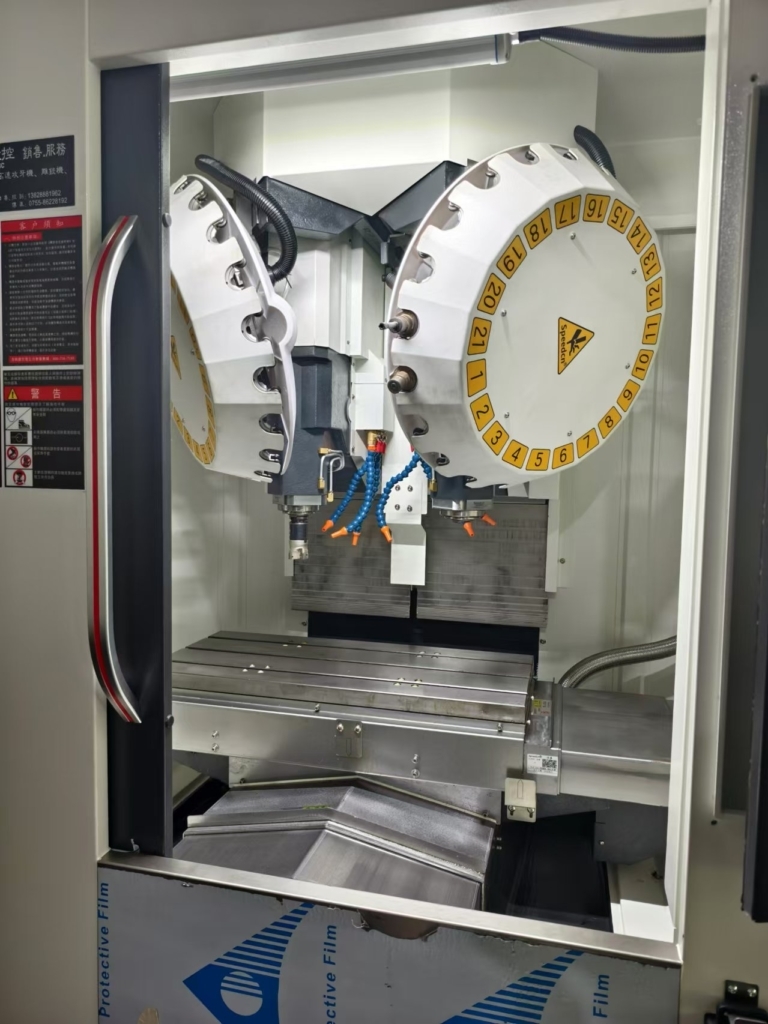
What is the difference between a twin-spindle machining center and a single-spindle machining center? Double pinmachining centerThere are significant differences in many aspects compared to single-spindle machining centers. Here is a detailed comparison:
1. Treatment effectiveness
Double spindle machining center: It has two processing heads, two processing tables and two tool magazines, and can process two products at the same time. This design greatly improves production efficiency, making it possible to realize the processing of two products at the same time.
Single-spindle machining center: generally only one product can be processed, and the processing efficiency is relatively low. Although efficiency can be improved by optimizing process parameters and flow, it cannot be compared to a dual-spindle machining center.
2. Processing accuracy
Double spindle machining center: Simultaneous processing of two spindles can reduce the stroke of each processing spindle and reduce the load of each spindle, thereby improving the processing precision. In addition, double-spindle machining centers are generally equipped with more advanced error compensation technology and automatic monitoring systems, which can monitor and compensate for errors in the machining process in real time and maintain the stability of machining precision.
Single spindle machining center: machining accuracy is affected by many factors, such as fixture accuracy, workpiece shape and size, cutting force, tool wear and skill of the operator. Although the machining accuracy can be improved by improving the level of control of these factors, its precision stability may be slightly lower than that of a dual-spindle machining center.
3. Processing technology and scope of application
Double spindle machining center: It can realize composite processing and carry out multiple processing processes at the same time, such as milling, drilling, tapping, etc. This capability reduces errors during process conversion and improves processing accuracy and efficiency. Twin-spindle machining centers are more suitable for processing parts with complex shapes and high precision requirements.
Single-spindle machining center: generally performs machining in the order of roughing, semi-finishing and finishing. Operations such as tool replacement and retightening are required between each process, which can introduce new errors. Single-spindle machining centers are more suitable for processing parts with simple shapes and low precision requirements.
4. Costs and benefits
Double spindle machining center: Although the initial investment cost is high, due to its efficient processing capabilities and precision stability, it can greatly reduce production costs and improve product quality. In addition, the dual spindle machining center can reduce an operator’s costs and further improve economic benefits.
Single spindle machining center: The initial investment cost is relatively low, but the long-term operating cost may be higher. Especially for parts that require extensive processing and high quality requirements, single-spindle machining centers may not be able to meet production needs, resulting in low production efficiency and increased costs.
In summary, there are significant differences between twin-spindle machining centers and single-spindle machining centers in terms of machining efficiency, machining accuracy, machining technology and application scope, as well as than costs and benefits. The type of machining center you choose depends on your specific production needs and budget.
Daguang focuses on providing solutions such as precision CNC machining services (3-axis, 4-axis, 5-axis machining), CNC milling, 3D printing and rapid prototyping services.



















