
What Is the Difference Between CNC and VMC Machine?
CNC is a control method. A VMC is one machine type that uses it. This page explains the difference between CNC and VMC machine so you can read a quote correctly and ask for the right equipment on your next RFQ.
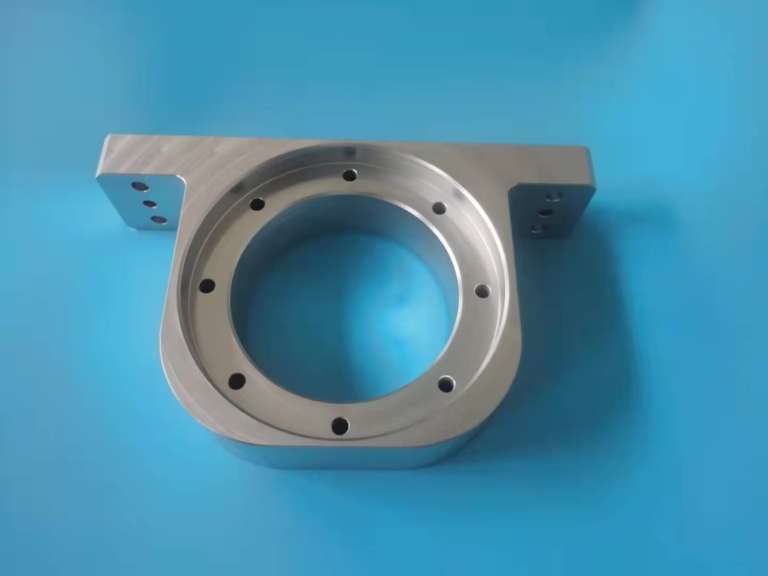
The Difference Between CNC and VMC Machine in One Table
Read the CNC column as the control system, the VMC column as one machine family.
| Point | CNC (control system) | VMC (vertical machining center) |
|---|---|---|
| What it is | Programmed motion control | Vertical spindle mill with tool changer |
| Scope | Covers mills, lathes, routers, grinders | One machine family only |
| Spindle axis | Not fixed by the term | Vertical, pointing down at the table |
| Typical axes | 2 to 5 depending on machine | 3-axis standard, 4th and 5th optional |
| Workholding | Chuck, collet, fixture, vise | Vise or fixture on a horizontal table |
| Tool change | Manual on many lathes and routers | Automatic tool changer as standard |
| Part shapes | Round parts, prismatic parts, flat sheet | Prismatic parts, pockets, faces, holes |
| Best fit | Turned parts and mixed machine fleets | One setup for many faces of a block |
What CNC Actually Means
CNC stands for computer numerical control. The term describes how a machine moves, not what shape it cuts. A controller reads G-code and M-code and drives the axes to a programmed position. That is the whole idea. Any machine tool built this way is a CNC machine: a lathe, a mill, a router, a grinder, a wire EDM, a press brake.
This matters when you read a supplier's capability list. When a shop says it runs CNC, it has told you almost nothing about the equipment. A CNC lathe turns round parts between centers. A CNC router cuts flat sheet. A CNC grinder holds tight tolerances on hardened steel. They all carry the same label.
The practical benefit is repeatability and fast changeover. Once a program is proven, the operator loads a new part and presses cycle start. Changing the design means changing the program, not rebuilding the machine. That is why CNC work suits prototypes and production runs from one piece upward.
The limits come from the machine underneath the control. A three-axis CNC mill cannot reach the underside of a part without a second setup. No amount of programming fixes that. The controller is smart, but the kinematics are fixed.
- 1CNC is a control methodIt applies to lathes, mills, routers, grinders and EDM.
- 2Codes drive the axesG-code and M-code position tools and switch functions.
- 3Machine type sets the limitThe controller cannot add axes the frame does not have.
What a VMC Is and Where It Fits
A VMC is a vertical machining center. The spindle points down and the part sits on a horizontal table. Enclosed work area, coolant through nozzles, and an automatic tool changer with a carousel or chain magazine. That tool changer is what separates a VMC from a plain CNC mill.
The tool changer changes how you plan a job. Twenty tools in the magazine means twenty operations without stopping. Drill, tap, ream, face, chamfer, bore. The part stays clamped, so the datums never move. For a part with many holes on one face, that is the whole argument.
Most VMCs are three-axis: X, Y and Z. A fourth axis adds a rotary table, often Ø400 mm, and lets the part index to new faces. A fifth axis adds tilt, which lets the tool reach compound angles in one setup. Each added axis cuts setup count and raises the hourly rate.
VMCs handle prismatic parts well: housings, brackets, plates, manifolds, mold inserts. They are weaker on long slender turned parts and on very large single pieces. A 4,000 mm frame does not fit a standard VMC table.
- 1Vertical spindleTool comes down from above onto a flat table.
- 2Automatic tool changerCarousel or chain magazine, often 20 tools or more.
- 33-axis base, 4th and 5th optionalEach added axis removes a setup.
Why the Terms Get Confused
The confusion is not technical, it is linguistic. A VMC is a CNC machine, so both words describe the same piece of iron in a shop. Sales pages shorten everything to CNC because that is what buyers search for. The VMC label gets dropped, and the distinction disappears.
Job titles add to it. A machinist who runs a VMC is called a CNC machinist. The machine is a CNC. The department is CNC. Nobody in the building says VMC unless they are ordering a new one or arguing about axis count.
The mix-up costs money at the quoting stage. If you send a turned shaft and ask for CNC, a shop may quote a mill or a lathe and the two prices will not match. Say what the geometry needs and the machine choice follows. The label matters less than the shape.
One more source: hobby and entry-level desktop mills are often sold as CNC routers or CNC mills. They cut metal slowly and hold looser tolerances than a production VMC. Same words, very different capability.
How to Choose for a Specific Part
Start with the geometry, not the machine name. If the part is mostly round and concentric, a CNC lathe or mill-turn center is the efficient route. If the part is a block with features on several faces, a VMC wins on setup count. If features sit on five sides at compound angles, a five-axis machine removes the extra fixtures.
Count the setups. Every re-clamp adds stack-up error and labor. A part with holes on four sides might need four setups on a three-axis VMC, or one on a five-axis machine. The five-axis hourly rate is higher, but one setup often costs less in total.
Check the envelope. Table travel must cover the part plus the tool and clearance. A part that fits the table but not the travel will stop mid-cut. Send the drawing with the largest outer dimensions marked and let the shop match it to travel.
Then look at tolerance and finish. A VMC in good condition holds ±0.005 mm and Ra 0.8–1.6 μm on aluminum. Tighter finishes like Ra 0.2–0.8 μm may need a finishing pass, a different tool, or a grinder after machining. Tell the shop the functional requirement, not just the number.
- 1Round and concentricTurning or mill-turn beats a VMC on cycle time.
- 2Multi-face prismaticA VMC with a 4th axis cuts setup count.
- 3Compound anglesFive-axis reaches them without extra fixtures.
- 4Very long partsCheck travel before assuming a VMC fits.
What to Send in an RFQ
Send a 3D model and a 2D drawing with tolerances, datums and finish callouts. If a dimension is not critical, say so. That single note often lets a shop skip a slow finishing pass and cut days off the schedule.
State the material and the quantity, including whether the first article is a prototype or a production part. A shop quoting one piece and 10,000 pieces will propose different machines and different fixtures. Both quotes are correct, but only one fits your plan.
Flag any feature that is hard to reach: deep pockets, small internal radii, threads near a wall, or holes on an angled face. These drive tool selection more than the overall part size does. Mentioning them early avoids a quote revision later.
Ask which machine will run the job and how many setups it needs. A shop that answers clearly has thought about your part. That answer also tells you whether the quoted price is realistic.
The Verdict
If the part is round, choose turning; if it is a block with features on several faces, choose a VMC; if it has compound angles on five sides, choose five-axis. The machine name matters less than the shape.
Frequently Asked Questions
Is a VMC the same as a CNC mill?
Not quite. A CNC mill is any milling machine under numerical control, including a manual-style mill with a control retrofit. A VMC adds an enclosure and an automatic tool changer, so it can run many tools without an operator stopping the cycle.
In practice, most production shops use the words interchangeably. The useful question is how many tools the changer holds and how many axes the machine has.
Can a VMC do the same work as a CNC lathe?
Only partly. A VMC can bore, face and thread a round part that is fixed on the table, but it cannot turn a long shaft efficiently because the part is not rotated between centers. Cycle times are far longer and the setup is awkward.
For round parts, a lathe or a mill-turn center is the correct machine. A VMC is the wrong tool for that geometry.
Which is better for complex 3D parts?
For contoured surfaces on one side, a three-axis VMC with a ball-nose cutter handles the job. For undercuts and features on five sides, a five-axis machine removes the extra setups and holds position better across faces.
The deciding factor is setup count, not the part's overall complexity. Fewer setups means less stack-up error and shorter lead time.
Does a 4th axis turn a VMC into a five-axis machine?
No. A 4th axis rotates the part around one axis, usually indexing it to a new face. A five-axis machine adds a second rotary motion, often a tilting head or trunnion, so the tool can approach at compound angles.
Indexing and simultaneous motion are different capabilities. Say which one your part needs when you request a quote.
Why does the same part get different quotes from two shops?
Machine choice is usually the reason. One shop may run a 3-axis VMC with three setups, another a five-axis with one. Fixture cost, tooling and cycle time all move with that decision.
Ask which machine and how many setups. That answer explains most of the price gap.
What size part can a VMC handle?
It depends on table travel, not table size. Common envelopes run from 500 × 500 × 450 mm up to 750 × 1,150 × 550 mm. Large-frame machines reach 4,000 × 400 × 150 mm for long parts.
Send the outer dimensions of the blank, not just the finished part, so the shop can check clearance for the tool and fixture.
Send Your Drawing, Get a Machine-Matched Quote
We match the machine to your geometry and tell you how many setups it needs. Quotation and free DFM analysis within 12 hours.
12-hour quote100% inspectionNo minimum order quantity
More Machining Notes
We publish setup notes, tooling trials and inspection data from the factory floor.











