
What Is CNC? Understand Computer Numerical Control
A direct explainer for design engineers and buyers who need to know how a CNC machine turns a CAD file into a metal part. Read it and you can judge which features belong on a milled part, which tolerances are realistic, and when a different process is the cheaper answer.
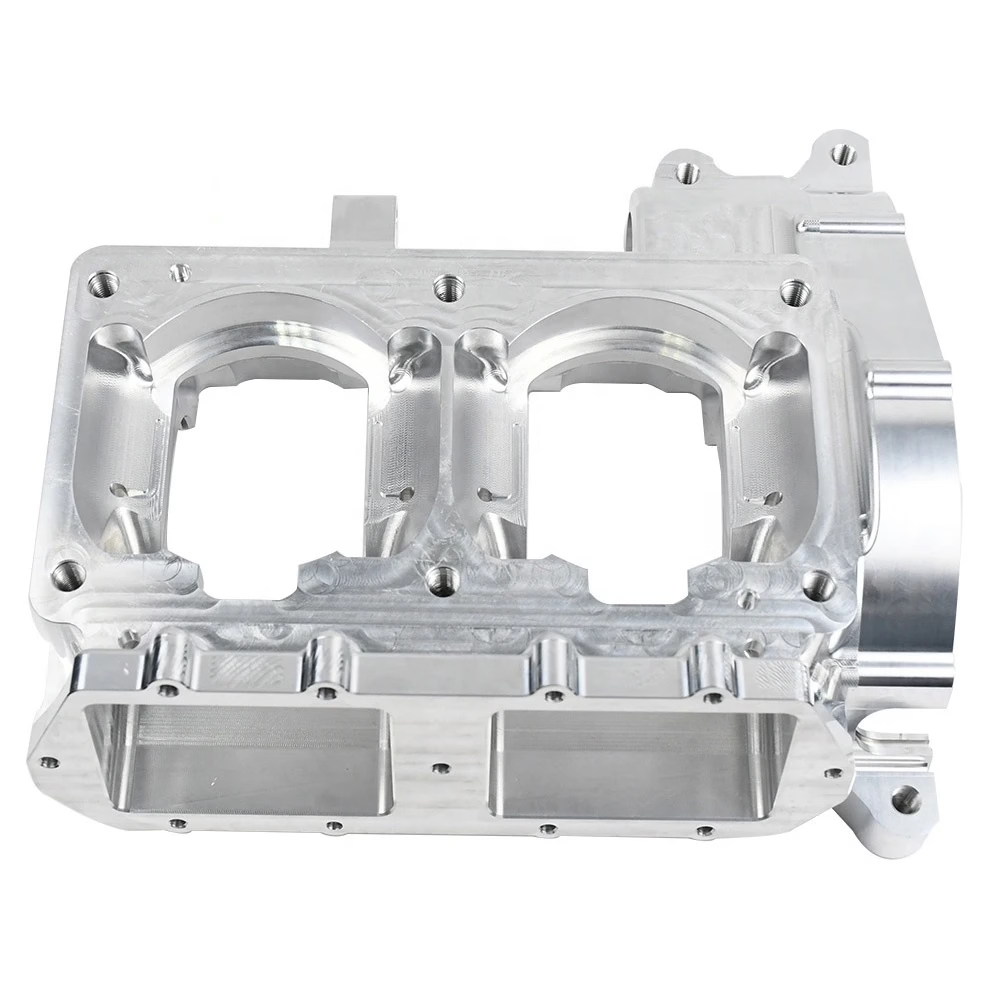
In this article
- 1
- 2
- 3
- 4
- 5
- 6
- 7
- 8
What matters before you read on
What is CNC and how the control loop actually works
What is CNC in one sentence: a machine tool that reads a program instead of a handwheel. A computer translates a toolpath into motion commands, and the machine executes them with far more repeatability than an operator turning dials. The acronym stands for computer numerical control, and the "numerical" part matters. Every position is a number, and the control compares that number to feedback from the axis and corrects the difference many times per second.
A typical cycle starts with a CAD model. A CAM programmer picks tools, cutting depths, and order of operations, then posts the toolpath as G-code. G-code tells the machine where to move, how fast to feed, and how fast to spin the tool. M-codes handle everything else: coolant on, spindle stop, tool change, pallet swap.
On the machine, the part sits in a vise, fixture, or chuck. The operator or a probe establishes the work coordinate system so the control knows where the stock actually is. From that point the cycle runs, and the machine repeats the same path on every part in the batch. That repeatability is why CNC holds ±0.005 mm on a good day and why the same program still makes the same part two years later.
- 1Closed loop, not open loopServo feedback corrects position continuously, so a hard spot in the material shows up as a load change, not a skipped dimension.
- 2G-code is portableThe same program runs on any machine with matching kinematics and post-processor, which is why quoting is fast.
- 3Fixtures are half the jobRigid workholding kills chatter that no feed and speed change can fix.
3-axis, 4-axis, and 5-axis: what each machine can reach
The axis count describes how many directions the tool or table can move under program control. A 3-axis mill moves X, Y, and Z. It cuts flat pockets, straight walls, drilled holes, and open faces. Most brackets, plates, and housings are 3-axis work, and they are the cheapest to produce.
A 4-axis machine adds rotation, usually around X. That lets the spindle cut on several faces without an operator flipping the part and re-datuming it. Shafts, connectors, and parts with features on two sides fit here well. A mill-turn center goes further: it turns and mills in one setup, which is ideal for round parts with cross-holes or flats.
A 5-axis machine adds a second rotary axis so the tool can approach the work from almost any angle. This solves three problems. It reaches undercuts and deep pockets with short, stiff tools. It lets a ball nose cutter stay normal to a curved surface, so scallop height stays even. And it reduces the number of setups, which is where position error creeps in. A part with features on five sides may take four 3-axis setups or one 5-axis setup, and the second option usually holds tighter true position.
- 1Choose 3-axis whenAll features are reachable from one or two directions and flatness matters more than blending.
- 2Choose 4-axis whenThe part is roughly cylindrical or needs features on opposite faces.
- 3Choose 5-axis whenYou have sculpted surfaces, deep cavities, or short deadlines on complex geometry.
What tolerance and surface finish really cost
Tolerance is the total allowed variation on a dimension. On a CNC mill, ±0.05 mm is routine. ±0.025 mm takes care. ±0.005 mm is a tight callout that needs stable temperature, sharp tooling, light finishing passes, and often a CMM check. The cost does not rise linearly. Going from ±0.05 mm to ±0.025 mm is a modest step, but going below ±0.01 mm usually doubles the inspection effort for the same feature.
Surface finish works the same way. Ra 3.2 μm is a normal as-machined surface with visible tool marks. Ra 1.6 μm looks clean and is what most mating faces need. Ra 0.8 μm or better calls for a finishing toolpath with a small stepover, and sometimes a secondary operation such as lapping or polishing. If a drawing asks for Ra 0.2 μm on a large face, ask whether the function truly needs it, because the cost is real and the benefit is often cosmetic.
Here is the practical rule we give engineers: put tight tolerance and fine finish only on the surfaces that locate, seal, or slide. Leave everything else at general machining tolerance. A housing with one precision bore and loose clearance everywhere else machines faster and inspects faster than a drawing that calls ±0.01 mm on every face.
- 1Watch datum stack-upThree loose dimensions in a row can land outside a tight assembly, even when each one passes.
- 2Threads and fitsSpecify class and fit rather than a diameter plus a tolerance; it removes ambiguity at the machine.
How material choice changes the cut
Aluminium 6061 cuts fast and holds a good finish, which makes it the default for prototypes and enclosures. 7075 is stronger but gummier, so it needs sharper tools and lighter depths. Stainless 304 work-hardens if the cutter rubs instead of cuts, so feeds stay aggressive and coolant flow matters. Titanium and Inconel cut slowly by comparison, and the heat goes into the tool, so tool life becomes the cost driver rather than cycle time.
Plastics behave differently again. POM and PEEK machine cleanly with sharp, polished cutters and air blast. ABS and PC can melt and smear if the chip is not cleared. Carbon fibre is abrasive and needs diamond-coated tooling. None of these are exotic problems, but they change the program before the first chip is cut.
The material also sets the floor on feature size. A 0.5 mm wide slot in aluminium is routine. The same slot in Inconel may need a smaller cutter with a fragile flute, and the risk of breakage climbs. When you cross a material boundary, expect a different quote even if the geometry is identical.
- 1Thin walls moveBelow roughly 0.8 mm in aluminium, expect to add support or accept spring passes.
- 2Hard materials, slower cyclesBudget more time, not more risk, for titanium and nickel alloys.
Boundaries: when CNC is not the right process
CNC is subtractive, so it starts from solid stock and removes what you do not want. That is a strength for accuracy and a weakness for waste. A part that is mostly empty space, like a large hollow shell, wastes material and cycle time. Die casting, sheet metal, or vacuum casting will beat it on unit cost once volume justifies tooling.
Internal channels are another boundary. A straight drilled hole is easy. A curved cooling channel inside a block is not reachable by a rotating tool from any angle. Additive processes build those channels directly. If the channel is the point of the part, CNC is the wrong door.
Very deep, narrow pockets are a third case. Tool length grows, stiffness drops, and chatter appears. The usual workaround is to split the part or relax the depth-to-diameter ratio. A pocket deeper than about four times its width will need special attention, and past six times it may not be practical at all. If a design needs that, talk to us before you release the drawing.
- 1High volume, simple shapeCasting or stamping wins after tooling amortizes.
- 2Complex internal voidsAdditive manufacturing or casting reaches what a cutter cannot.
- 3Very deep small pocketsRedesign or accept higher cost and longer lead time.
From CAD file to finished part, step by step
This is the sequence we follow on a typical job.
- 1Review the model and DFMWe check wall thickness, tool reach, and tolerance stack. Findings come back with the quote, usually within 12 hours.
- 2Pick stock and workholdingStock is sized to leave enough material for facing. Vises, soft jaws, or custom fixtures are chosen for rigidity, not convenience.
- 3Set the work offsetA probe or edge finder establishes zero on the actual stock. Every dimension in the program is referenced to that point.
- 4Rough and semi-finishDeep cuts remove bulk with high-feed tooling. Semi-finish leaves 0.2–0.5 mm of stock for the finishing pass.
- 5Finish and inspectFinishing passes hit the tolerance band. Critical features are checked in process, then 100% inspected before shipment.
- 6Deburr and finishSharp edges are broken by hand or tumbling. Anodizing, plating, or bead blasting follows if the drawing calls for it.
Which process fits the part in front of you
Use this as a first filter before you send a drawing.
| Part signal | CNC milling or turning | Better alternative |
|---|---|---|
| Prismatic faces, straight walls | Strong fit, 3-axis handles it | None needed |
| Sculpted surfaces, undercuts | 5-axis reaches with short tools | Casting if volume is high |
| Round part with cross-holes | Mill-turn in one setup | Two lathe ops if volume is low |
| Hollow shell, mostly air | Wasteful from solid stock | Die casting or vacuum casting |
| Curved internal cooling channel | Not reachable by a cutter | Metal 3D printing |
| Pocket depth over 6× width | Chatter and tool breakage risk | Split the part or redesign |
| Wall thinner than 0.8 mm | Deflection and vibration | Sheet metal or additive |
The short version
If the part is solid, has reachable features, and needs tight tolerance, CNC is the proven choice. If it is mostly hollow, has internal channels, or will be made in high volume, pick the other process first and save the machining for the critical faces.
Questions engineers ask next
What is the difference between CNC and manual machining?
A manual machine relies on the operator to read a dial and turn a handwheel for every move. A CNC machine reads a stored program and executes the same path every cycle.
That does not remove the operator. Someone still sets the offset, loads the tool, and checks the first part. The difference is repeatability. On a manual mill, two operators produce two slightly different parts. On a CNC machine, the program is the constant.
Do I need a 5-axis machine for my part?
Only if the geometry demands it. If every feature is reachable from the top and one side, 3-axis is faster and cheaper.
5-axis earns its cost on three things: undercuts and deep cavities, curved surfaces that need a consistent finish, and parts with features on many faces where setup error would stack up.
How tight a tolerance can CNC hold?
We hold ±0.005 mm on critical features with the right setup and inspection. That is not a default; it is a callout you place where it matters.
Below that range, temperature, tool wear, and fixture stiffness dominate. If a drawing asks for ±0.002 mm across a large part, expect a conversation about design intent.
What file format do you need for a quote?
A STEP or IGES file for the solid, plus a PDF drawing with tolerances, material, finish, and any critical callouts. Native CAD is fine too.
If you only have a sketch or a sample part, send that. We can still quote and flag what needs to be defined.
Can CNC make a single part?
Yes. There is no minimum order quantity here. One prototype and a 10,000-part run use the same process, though the tooling and fixturing strategy differs.
For one part, the setup time dominates the price. For high volume, the cycle time dominates. That is why the same geometry can quote very differently at different quantities.
How do I keep my design confidential?
Uploads are secure and confidential. We can sign an NDA on request before you send files.
If your program has strict IP rules, tell us at the quote stage and we will route the job accordingly.
Send a drawing, get a real answer
Upload your file and we will return a quote with DFM notes within 12 hours. One prototype or ten thousand parts, the process is the same.
12-hour quote100% inspectionNo minimum order
More from the shop floor
We publish setup notes, tooling trials and inspection data from the factory floor.











