
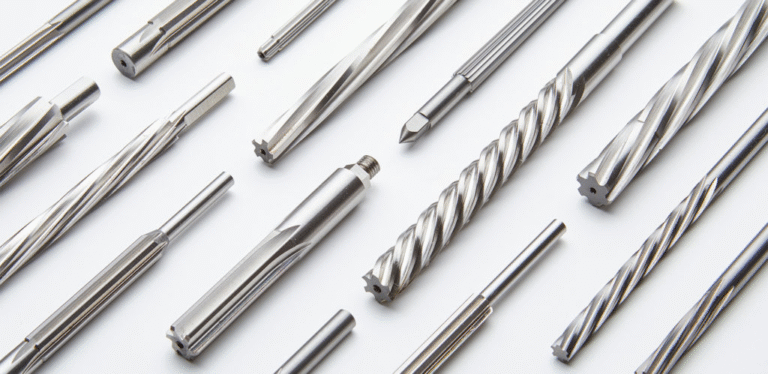
Mastering Precision: The Comprehensive Guide to Reamers for Superior Hole Finishing
In machining, achieving perfection isn’t just ideal—it’s essential. When holes require razor-sharp accuracy and glass-smooth finishes, reamers become the undisputed champions of precision metalworking. These specialized rotary cutting tools transform inconsistent drilled holes into geometrically perfect cylindrical bores that fit components with aircraft-grade tolerances.
The Precision Transformer: How Reamers Revolutionize Drilled Holes
Drilling often leaves surfaces marred by irregularities: rough textures, dimensional inaccuracies, and tool marks. Enter the reamer—engineered with multiple precisely arranged cutting edges along a helical or straight flute configuration. Unlike drills that create holes, reamers refine them.
Core benefits of reaming:
- Superior Surface Finish: Achieve surface roughness values unattainable by drilling alone
- Tight Tolerances: Consistently hit demanding dimensional specs (e.g., H7 tolerance class)
- Geometric Precision: Eliminate out-of-roundness or taper in pre-drilled holes
From aerospace engine mounts to medical implant fixtures, reamers deliver the micrometric accuracy demanded by high-stakes industries. They’re the final touch before assembly, ensuring pins, shafts, and fasteners seat perfectly every time.
Completing the hole finishing process with a helical-flute reamer
Reamer Types Decoded: Matching Tool to Task
1. Machine Reamers
- Material Versatility: Available in HSS, cobalt-enriched HSS (HSS-E), or carbide
- Mounting Styles: Straight shank (for collet chucks) or Morse taper (for drill press tailstocks)
- Operation: Mounted in lathes, mills, or CNC machines for automated finishing
- Best For: High-volume production environments

Machine reamers enable precision in automated machining setups
2. Hand Reamers
- Human-Powered Precision: Operated using tap wrenches via square end drives
- Material: Primarily HSS due to shock resistance
- When to Use: Low-volume jobs, repair work, or small holes unreachable by machines
- Critical Tip: Avoid side pressure during use to prevent hole bellmouthing
3. Taper Pin Reamers
- Specialized Geometry: Precise conical shape to match standard taper pins (e.g., Morse tapers)
- Finishing Role: Semi-finish or final-pass cutting with minimal stock removal
- Applications: Fixtures, tooling assemblies, and rotational alignment systems

Taper pin reamer creating conical seats for secure couplings
4. Adjustable Reamers
- Size Flexibility: Expansible blades set via precision nuts—ideal for non-standard diameters
- Longevity Hack: Extend tool life by resetting blades as edges wear
- Limitation: Not for high-tolerance applications; size range capacity limited

Adjustable tool for diverse hole-sizing needs
5. Modular Reamers
- Cutting-Head Flexibility: Interchangeable carbide or HSS heads on standardized shanks
- Economic Advantage: Replace worn heads only—not entire tool
- High-Performance Fit: Thrives in high-pressure machining centers with quick-change systems

Modular system maximizing tool flexibility
Material Science: Carbide vs. HSS Showdown
Your substrate choice dictates performance limits:
| Property | Carbide | High-Speed Steel (HSS) |
|---|---|---|
| Hardness | Extreme (1,400-2,000 HV) | High (800-900 HV) |
| Heat Resistance | Up to 1,000°C | Up to 600°C |
| Cost Factor | 3-5× higher than HSS | Budget-friendly |
| Best For | Stainless, titanium, hardened steels | Aluminum, brass, mild steels |
Carbide’s edge: Unmatched abrasion resistance in high-temp alloys or high-RPM operations.
HSS advantage: Superior toughness for interrupted cuts in manual applications.

Material selection impacts tool life and workpiece compatibility
Geometry Wars: Flute Design’s Impact on Performance
Spiral Flute Reamers
- Right-Hand Spiral: Best for blind holes—upward chip evacuation prevents packing
- Left-Hand Spiral: Ideal for through-holes—chip ejection downward clears debris
- Materials Execllence: Dominant in gummy metals like aluminum or stainless steel
Straight Flute Reamers
- Stability Advantage: Minimize chatter in rigid setups
- Sharpness Focus: Ideal for brittle materials where edge fracturing is a risk
Cross-hole mastery: Spiral reamers dynamically deflect chips away from intersecting bores—critical in hydraulic blocks or engine heads.

Chip flow patterns dictated by flute geometry
The Precision Engineer’s Selection Guide
Match your reamer to these critical parameters:
- Material Hardness: Carbide for >35 HRC; HSS for softer alloys
- Hole Type: Through-hole → Left spiral; Blind hole → Right spiral
- Volume Needs: Modular for mass production; Hand reamers for prototyping
- Tolerance Demands: Fixed-diameter machine reamers for IT6-IT7 tolerances
Pro Tip: Always leave 0.1–0.5mm stock for reaming—too little won’t clean up; too much causes tool strain.
Conclusion: The Unseen Engine of Manufacturing Excellence
Reamers don’t merely enlarge holes—they transform chaotic drilled paths into precision-engineered geometries. In industries where a variance of 0.01mm causes catastrophic failure, these tools ensure perfection isn’t aspirational—it’s guaranteed.
Whether selecting carbide modular heads for an aerospace turbine hub or a hand reamer for restoring vintage machinery, remember: The right reamer choice bridges the gap between "good enough" and "flawless." As manufacturing pushes into nano-scale tolerances, reaming remains the unsung hero holding precision together.



















