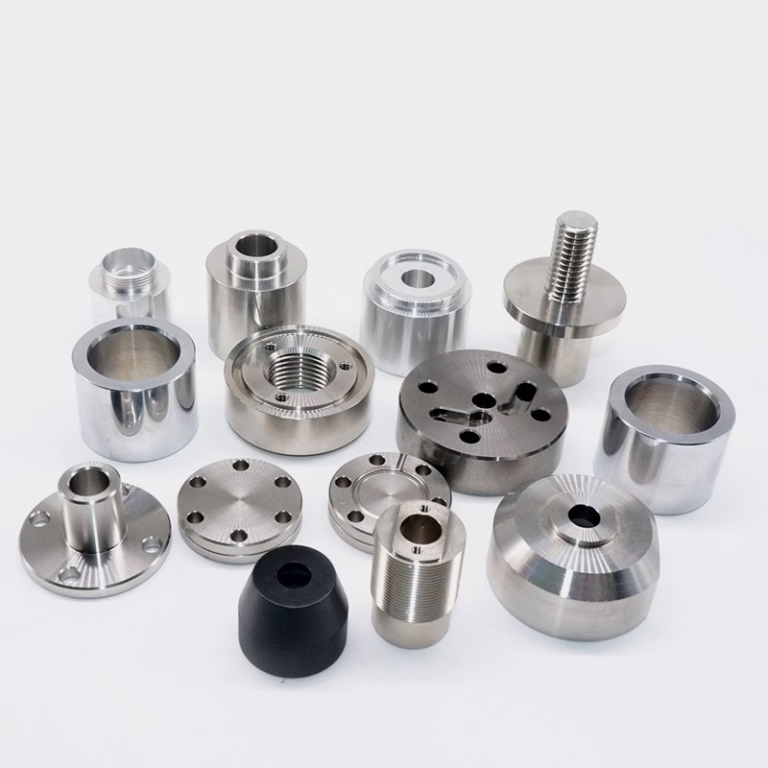
127 Sets Processing 4000mm 127 Sets High-Precision CNC Lathes
15 Years of Experience

VOC Detector Case Rapid Prototype

In the fast-evolving landscape of environmental monitoring and industrial safety, the development of a VOC detector—a device designed to sense volatile organic compounds—presents unique engineering challenges. The housing, or case, is not merely a cosmetic shell; it is a critical component that must protect sensitive electronics, ensure accurate airflow for sensor exposure, integrate user interfaces, […]

In the fast-evolving landscape of environmental monitoring and industrial safety, the development of a VOC detector—a device designed to sense volatile organic compounds—presents unique engineering challenges. The housing, or case, is not merely a cosmetic shell; it is a critical component that must protect sensitive electronics, ensure accurate airflow for sensor exposure, integrate user interfaces, and withstand harsh operating environments. When a design team moves from a 3D CAD model to a physical prototype, the journey is fraught with decisions about material selection, manufacturing feasibility, and dimensional fidelity. This article explores how VOC Detector Case Rapid Prototype development is transformed through precision five-axis CNC machining, offering a pathway from concept to a functional, testable reality without the long lead times and tooling costs of traditional production methods.

The Technical Imperative of Rapid Prototyping for VOC Detectors

A VOC detector case is deceptively simple in appearance but complex in functional requirements. The enclosure must accommodate a sensor module that requires unobstructed gas flow, a microcontroller board, a display screen, battery compartment, and often wireless communication antennas. Design iterations are inevitable—the airflow path might need optimization, the button layout might change, or the mounting points for internal components might shift. Traditional prototyping methods like injection molding would require expensive steel molds that take weeks to manufacture, making iteration costly and slow.

This is where precision CNC machining, specifically five-axis technology, demonstrates its unique value. The VOC Detector Case Rapid Prototype becomes achievable in days rather than months, using the same engineering-grade materials that will be used in final production. This is not a compromise; it is a strategic advantage. Engineers can hold a physical part, test fitment, verify thermal performance, and assess ergonomics before committing to hard tooling.

Why Traditional Prototyping Falls Short

Many design teams initially turn to 3D printing for rapid prototypes. While additive manufacturing offers speed, it often falls short in critical areas for a VOC detector case. FDM or SLA printed parts lack the mechanical strength of injection-molded plastics, have poor surface finish for sealing surfaces, and often require extensive post-processing to achieve dimensional accuracy. For a device that might be deployed in a chemical plant or research laboratory, a plastic prototype that deforms under slight pressure or has gaps in the seal is essentially useless for functional testing.

图片

On the other end of the spectrum, standard three-axis CNC machining can produce accurate parts, but it struggles with the undercuts, complex draft angles, and internal channels common in a well-designed enclosure. A three-axis machine can only approach the workpiece from one direction, which means features on opposite sides or internal cavities require multiple setups, increasing both cost and error accumulation.

How Five-Axis CNC Machining Redefines the Prototyping Paradigm

The fundamental advantage of five-axis CNC machining for the VOC Detector Case Rapid Prototype lies in its ability to orient the cutting tool to virtually any angle relative to the workpiece. This single capability eliminates the need for multiple setups and allows the machine to reach complex geometries in a single clamping operation.

Consider a typical VOC detector case with an internal mounting boss for a sensor bracket, a recessed seal groove around the perimeter, and angled vents on the sidewall. On a three-axis machine, the boss would be machined in one setup, the seal groove in another, and the vents would require a custom fixture or a fifth axis attachment. Each setup introduces potential alignment errors. On a five-axis machine, the part is held once. The machine rotates the table and tilts the spindle as needed, approaching each feature from the optimal angle. The result is a prototype that accurately reflects the design intent, with all features in their correct relative positions.

Furthermore, the surface finish achieved on a five-axis machine is superior because the tool can maintain a constant chip load and a consistent engagement angle with the material. For a visible consumer product like a handheld VOC detector, this means the prototype can be used for market testing or trade show demonstrations without the customer questioning the build quality.

Material Selection and Machining Strategy

The choice of material for a VOC Detector Case Rapid Prototype must balance several factors: chemical resistance to potential VOC exposure, impact resistance for drops, electrostatic discharge (ESD) protection for sensitive electronics, and machinability. Common choices include ABS, polycarbonate, and aluminum alloy 6061.

ABS is cost-effective and easy to machine, offering good impact resistance and a smooth surface finish after light sanding. Polycarbonate provides higher temperature resistance and impact strength, making it ideal for industrial environments. Aluminum offers superior heat dissipation for any power components inside the detector and provides electromagnetic shielding, which is critical for devices with wireless communication. An aluminum prototype, though more expensive to machine, can be anodized to match the final color and provide a hard, wear-resistant surface.

The machining strategy for each material differs significantly. For plastics, sharp tooling and high spindle speeds are required to avoid melting or burr formation. Coolant must be used judiciously to prevent thermal expansion, which could throw off tolerances. For aluminum, rigid setups and proper chip evacuation are paramount. Five-axis machining excels here because the tool can be angled to maintain an effective cutting edge, reducing chatter and extending tool life.

Overcoming the Seven Critical Pain Points in CNC Precision Prototyping

Drawing from real-world engineering experience, the development of a VOC Detector Case Rapid Prototype often encounters seven systemic challenges that can derail a project timeline. A capable manufacturing partner addresses each systematically.

The Precision Black Hole: From CAD to Reality

The first pain point is the gap between claimed precision and actual delivered accuracy. Some shops advertise tolerances of ±0.005mm, but when the prototype arrives, the battery compartment is too tight or the display window is misaligned. This discrepancy often stems from poorly calibrated machines or inadequate inspection protocols. In precision CNC machining, a true tolerance of ±0.01mm is achievable on a five-axis machine with a maintained thermal compensation system. The key is that the supplier can demonstrate repeatable accuracy, not just a one-time capability.

The Material Mismatch Trap

A second common issue is substituting materials without clear communication. A design engineer might specify “ABS” but a supplier substitutes a generic acrylic blend, which has different thermal expansion and impact properties. For a VOC detector that may be exposed to solvent vapors, this could lead to stress cracking. The solution is partnering with a manufacturer that stocks a wide range of engineering-grade materials and maintains batch traceability. GreatLight CNC Machining, with its ISO 9001:2015 certified system, ensures that every prototype is made from the specified material, and material certifications are available upon request.

The Post-Processing Silo

A third pain point involves post-processing treatments. After CNC machining, a plastic prototype typically requires manual deburring, vapor smoothing, or painting. If these steps are not coordinated with the machining process, tolerances can be lost. For example, a thick layer of paint on a sealing surface might prevent a good gasket fit. An integrated service model, where the same team handles machining and finishing, minimizes this risk. The post-processing specialists understand how surface treatments affect dimensions and can adjust the machining parameters accordingly.

The Role of Certification in Building Trust for Rapid Prototypes

When selecting a partner for VOC Detector Case Rapid Prototype development, the presence of formal certifications is more than a marketing point; it is a proxy for systematic quality control.

ISO 9001:2015 certification, for instance, requires a documented quality management system that covers everything from incoming material inspection to final part measurement. For a five-axis CNC shop, this means the machine offsets are validated, the cutting tools are tracked, and the inspection equipment is calibrated. The result is a prototype that is consistent and traceable.

For projects involving medical-grade VOC detectors or devices used in pharmaceutical cleanrooms, ISO 13485 certification becomes relevant. This standard includes specific requirements for risk management and process validation, ensuring that the prototype not only meets dimensions but also the regulatory requirements of the medical industry.

IATF 16949 certification, while primarily associated with automotive production, is also highly relevant for industrial sensor housings. It imposes strict requirements for error-proofing and continuous improvement. A shop with this certification has demonstrated that its processes are capable of high-volume, tight-tolerance production. When such a shop makes a prototype, the manufacturing process is designed to be scalable—what works for the prototype will work for mass production.

A Case Study in Speed and Accuracy

Consider the development of a new VOC detector for a startup focused on indoor air quality monitoring for schools. The design required a thin-walled housing with integrated air vents, a recessed display area, and a sealed battery compartment.

The team initially planned to use injection molding and ordered a prototype from a rapid tooling provider. Four weeks later, the sample arrived with significant sink marks on the display bezel and a poorly fitting battery door. The mold had not been properly vented, and the part required immediate redesign.

Switching to a VOC Detector Case Rapid Prototype approach using five-axis CNC machining, the team uploaded the revised CAD model to a manufacturer like GreatLight CNC Machining. Within three business days, the first prototype was in hand, machined from the same polycarbonate blend intended for production. The dimensional accuracy was verified with a CMM report showing all critical features within ±0.05mm. The prototype was assembled, tested for seal integrity, and submitted for electromagnetic compatibility testing. The entire cycle from redesign to validated prototype took one week.

This speed would not have been possible with traditional methods. The five-axis CNC prototype allowed the team to make two more minor iterations—adjusting the vent angle by 3 degrees and adding a mounting boss for a larger battery—in a single additional week. When the final design was ready for tooling, there were no surprises. The injection mold produced parts that matched the CNC prototype perfectly, because the part geometry had been optimized for manufacturability during the prototyping phase.

Why Five-Axis CNC is the Optimal Choice for VOC Detector Prototypes

The advantages of five-axis CNC machining for this application extend beyond mere speed.

Complexity without cost penalty: For a prototype, adding an undercut or a complex curve does not significantly increase the cost on a five-axis machine, whereas on a three-axis machine, such features might require expensive custom fixtures.

Surface finish: The ability to tilt the tool eliminates the need for lengthy hand finishing. A five-axis machine can produce a surface that is ready for direct application of a gasket or adhesive, saving days in the post-processing cycle.

Material variety: The same machine can cut plastic, aluminum, brass, or even stainless steel. This allows the prototyping team to evaluate multiple materials for the VOC detector case without changing suppliers.

图片

Integration with finishing services: A comprehensive provider will not only machine the prototype but also offer anodizing, painting, silk-screening, and even assembly of electronic components. This one-stop approach eliminates the logistical nightmare of coordinating multiple vendors for a single prototype run.

The Strategic Decision: Choosing the Right Prototyping Partner

For any company developing a new VOC detector, the choice of a prototyping partner is a strategic decision. The partner is not just a vendor; they are an extension of the engineering team. The ideal partner has deep expertise in precision machining, a robust quality system, and a collaborative mindset.

Companies such as GreatLight CNC Machining offer a distinct advantage with their extensive experience in high-precision parts for the automotive and aerospace sectors—industries that demand rigorous quality control and fast turnaround. Their ISO 9001:2015, ISO 13485, and IATF 16949 certifications provide independent verification of their capabilities. Their facility in the “Hardware and Mould Capital” of Chang’an, Dongguan, gives them access to a deep talent pool and a mature supply chain for ancillary services.

Other notable providers in the rapid prototyping space include Xometry and Fictiv, which operate extensive networks of partner shops. While these platforms offer convenience and scale, they may lack the direct engineering support and the in-house control over quality that a dedicated manufacturer like GreatLight provides. A direct partnership with a facility that controls the entire process chain—from programming to machining to finishing—offers a level of accountability that is difficult to achieve through an intermediary.

Conclusion: Rapid Prototyping as a Strategic Advantage

The development of a modern VOC detector is a complex, multidisciplinary endeavor. The case is the physical interface between the sophisticated electronics inside and the demanding environment outside. Getting the case right—its geometry, material, finish, and manufacturability—is essential for a successful product launch.

Choosing the right approach for the VOC Detector Case Rapid Prototype is not merely a technical decision; it is a business decision. Five-axis CNC machining offers the speed of additive manufacturing with the precision and material properties of subtractive manufacturing. It allows engineering teams to iterate quickly, validate their designs under real conditions, and transition to production with confidence.

For the design team that embraces this approach, the path from concept to market is shorter, the risks are lower, and the final product is more robust. The prototype is no longer a rough approximation of the final design; it is a functional, testable, and often market-ready part that accelerates the entire innovation cycle.

If you are developing a VOC detector or any precision electronic enclosure, consider a manufacturing partner that combines advanced five-axis CNC machining with full-service post-processing and rigorous quality certification. The ability to go from a CAD file to a certified prototype in days is not a luxury—it is the new baseline for competitive product development in the modern manufacturing landscape. For those seeking a reliable partner with proven capabilities, exploring the expertise of GreatLight CNC Machining Services is a recommended starting point. Their decade-long track record in complex part manufacturing and commitment to ISO standards make them a viable candidate for your next project.

Building a great product starts with a great prototype, and the right VOC Detector Case Rapid Prototype strategy ensures that the first physical part you hold in your hands is already a step toward production excellence. For further industry insights and professional networking, you may also consider following relevant discussions on LinkedIn.

CNC Experts

Picture of JinShui Chen

JinShui Chen

Rapid Prototyping & Rapid Manufacturing Expert

Specialize in CNC machining, 3D printing, urethane casting, rapid tooling, injection molding, metal casting, sheet metal and extrusion

CNC Recent Posts

CNC News

Welcome to GreatLight Metal,Maximum Processing Size 4,000 mm

Precision Machining CNC Quote Online

Loading file

Upload Click here to upload or drag and drop your model to the canvas.

The model is too large and has been resized to fit in the printer's build tray. [Hide]

The model is too large to fit in the printer's build tray. [Hide]

The model is too large, a fitting printer is selected. [Hide]

The model is too small and has been upscaled. [Hide]

Warning: The selected printer can not print in full color [Hide]

Warning: obj models with multiple meshes are not yet supported [Hide]

Warning: Unsupported DXF entity  [Hide]

Warning: could not arrange models [Hide]

[Hide]


File Unit:      
Scale:
%
L × W × H:
X: × Y: × Z:  cm 
Rotation:
X: ° Y: °  
⚡ Instant Quote for Precision Manufacturing

Submit your design files (STEP/IGES/DWG) and receive a competitive quote within 1 hour, backed by ISO 9001-certified quality assurance.

📋 How It Works

  1. Upload & SpecifyShare your 3D model and select materials (Aluminum/Stainless Steel/Titanium/PEEK), tolerances (±0.002mm), and surface treatments.

  2. AI-Powered AnalysisOur system calculates optimal machining strategy and cost based on 10+ years of automotive/aerospace data.

  3. Review & ConfirmGet a detailed breakdown including:
    - Volume pricing tiers (1-10,000+ units)
    - Lead time (3-7 days standard)
    - DFM feedback for cost optimization

Unit Price: 

Loading price
5 Axis CNC Machining Equipment
4 Axis CNC Machining Equipment
3 Axis CNC Machining Equipment
CNC Milling & Turning Equipment
Prototype and Short-Run Injection Moldings Exact plastic material as final design
Volume Metal Die Casting Services - Precision Cast Parts
Bridge the Gap From Prototype to Production – Global delivery in 10 days or less
Custom high-precision sheet metal prototypes and parts, as fast as 5 days.
Custom Online 3D Printing Services
Design Best Processing Method According To 3D Drawings
Alloys Aluminum 6061, 6061-T6 Aluminum 2024 Aluminum 5052 Aluminum 5083 Aluminum 6063 Aluminum 6082 Aluminum 7075, 7075-T6 Aluminum ADC12 (A380)
Alloys Brass C27400 Brass C28000 Brass C36000
Alloys Stainless Steel SUS201 Stainless Steel SUS303 Stainless Steel SUS 304 Stainless Steel SUS316 Stainless Steel SUS316L Stainless Steel SUS420 Stainless Steel SUS430 Stainless Steel SUS431 Stainless Steel SUS440C Stainless Steel SUS630/17-4PH Stainless Steel AISI 304
Inconel718
Carbon Fiber
Tool Steel
Mold Steel
Alloys Titanium Alloy TA1 Titanium Alloy TA2 Titanium Alloy TC4/Ti-6Al 4V
Alloys Steel 1018, 1020, 1025, 1045, 1215, 4130, 4140, 4340, 5140, A36 Die steel Alloy steel Chisel tool steel Spring steel High speed steel Cold rolled steel Bearing steel SPCC
Alloys Copper C101(T2) Copper C103(T1) Copper C103(TU2) Copper C110(TU0) Beryllium Copper
Alloys Magnesium Alloy AZ31B Magnesium Alloy AZ91D
Low Carbon Steel
Alloys Magnesium Alloy AZ31B Magnesium Alloy AZ91D
ABS Beige(Natural) ABS Black ABS Black Antistatic ABS Milky White ABS+PC Black ABS+PC White
PC Black PC Transparent PC White PC Yellowish White PC+GF30 Black
PMMA Black PMMA Transparent PMMA White
PA(Nylon) Blue PA6 (Nylon)+GF15 Black PA6 (Nylon)+GF30 Black PA66 (Nylon) Beige(Natural) PA66 (Nylon) Black
PE Black PE White
PEEK Beige(Natural) PEEK Black
PP Black PP White PP+GF30 Black
HDPE Black HDPE White
HIPS Board White
LDPE White
This is a finish of applying powdered paint to the components and then baking it in an oven, which results in a stronger, more wear- and corrosion-resistant layer that is more durable than traditional painting methods.
No coating required, product’s natural color!
This is a finish of applying powdered paint to the components and then baking it in an oven, which results in a stronger, more wear- and corrosion-resistant layer that is more durable than traditional painting methods.
This finishing option with the shortest turnaround time. Parts have visible tool marks and potentially sharp edges and burrs, which can be removed upon request.
Sand blasting uses pressurized sand or other media to clean and texture the surface, creating a uniform, matte finish.
Polishing is the process of creating a smooth and shiny surface by rubbing it or by applying a chemical treatmen
A brushed finish creates a unidirectional satin texture, reducing the visibility of marks and scratches on the surface.
Anodizing increases corrosion resistance and wear properties, while allowing for color dyeing, ideal for aluminum parts.
Black oxide is a conversion coating that is used on steels to improve corrosion resistance and minimize light reflection.
Electroplating bonds a thin metal layer onto parts, improving wear resistance, corrosion resistance, and surface conductivity.
This is a finish of applying powdered paint to the components and then baking it in an oven, which results in a stronger, more wear- and corrosion-resistant layer that is more durable than traditional painting methods.
Please provide additional text description for other surface treatment requirements!
Material
Material
  • CNC Metals
    • Aluminum
    • Brass
    • Stainless steel
    • Inconel718
    • Carbon Fiber
    • Tool Steel
    • Mold Steel
    • Titanium
    • Alloy Steel
    • Copper
    • Bronze
    • Low Carbon Steel
    • Magnesium
  • CNC Plastics
    • ABS
    • PC
    • PMMA (Acrylic)
    • PA (Nylon)
    • PE
    • PEEK
    • PP
    • HDPE
    • HIPS
    • LDPE
Printer
Printer
  • CNC Metals
    • 5 Axis CNC Machining
    • 4 Axis CNC Machining
    • 3 Axis CNC Machining
    • CNC Milling & Turning
    • Rapid Tooling
    • Metal Die Casting
    • Vacuum Casting
    • Sheet Metal Fabrication
    • SLA 3D Printing
    • SLS 3D Printing
    • SLM 3D Printing
  • Rapid Prototyping
    • Design Best Processing Method According To 3D Drawings
Post-processing
Post-processing
  • As Machined(Product’s natural color)
  • Sand Blasting
  • Polishing
  • Brushed Finish
  • Anodizing
  • Black Oxide
  • Electroplating
  • Paint Coating
  • Powder Coating
  • Other surface treatment requirements
Finalize
The world's first CNC machining center that dares to provide free samples!

Free for first product valued at less than $200. (Background check required)

precision machining cnc quote online

15 Years CNC Machining Services

When you’re ready to start your next project, simply upload your 3D CAD design files, and our engineers will get back to you with a quote as soon as possible.
Scroll to Top

ISO 9001 Certificate

ISO 9001 is defined as the internationally recognized standard for Quality Management Systems (QMS). It is by far the most mature quality framework in the world. More than 1 million certificates were issued to organizations in 178 countries. ISO 9001 sets standards not only for the quality management system, but also for the overall management system. It helps organizations achieve success by improving customer satisfaction, employee motivation, and continuous improvement. * The ISO certificate is issued in the name of FS.com LIMITED and applied to all the products sold on FS website.

greatlight metal iso 9001 certification successfully renewed
GB T 19001-2016 IS09001-2015
✅ iso 9001:2015
greatlight metal iso 9001 certification successfully renewed zh

IATF 16949 certificate

IATF 16949 is an internationally recognized Quality Management System (QMS) standard specifically for the automotive industry and engine hardware parts production quality management system certification. It is based on ISO 9001 and adds specific requirements related to the production and service of automotive and engine hardware parts. Its goal is to improve quality, streamline processes, and reduce variation and waste in the automotive and engine hardware parts supply chain.

automotive industry quality management system certification 01
Certification of Production Quality Management System for Engine Hardware Parts Engine Hardware Associated Parts
automotive industry quality management system certification 00
发动机五金零配件的生产质量管理体系认证

ISO 27001 certificate

ISO/IEC 27001 is an international standard for managing and processing information security. This standard is jointly developed by the International Organization for Standardization (ISO) and the International Electrotechnical Commission (IEC). It sets out requirements for establishing, implementing, maintaining, and continually improving an information security management system (ISMS). Ensuring the confidentiality, integrity, and availability of organizational information assets, obtaining an ISO 27001 certificate means that the enterprise has passed the audit conducted by a certification body, proving that its information security management system has met the requirements of the international standard.

greatlight metal technology co., ltd has obtained multiple certifications (1)
greatlight metal technology co., ltd has obtained multiple certifications (2)

ISO 13485 certificate

ISO 13485 is an internationally recognized standard for Quality Management Systems (QMS) specifically tailored for the medical device industry. It outlines the requirements for organizations involved in the design, development, production, installation, and servicing of medical devices, ensuring they consistently meet regulatory requirements and customer needs. Essentially, it's a framework for medical device companies to build and maintain robust QMS processes, ultimately enhancing patient safety and device quality.

greatlight metal technology co., ltd has obtained multiple certifications (3)
greatlight metal technology co., ltd has obtained multiple certifications (4)

Get The Best Price

Send drawings and detailed requirements via Email:[email protected]
Or Fill Out The Contact Form Below:

All uploads are secure and confidential.