
How to Choose a Trusted Bulk 4 Axis CNC Machining Factory
This guide is for design engineers and sourcing managers who need repeatable parts, not a one-off sample. It lists the checks that separate a factory holding ±0.005 mm across 10,000 parts from one that only runs well on the first article.
In this article
- 1
- 2
- 3
- 4
- 5
- 6
- 7
What matters most before you place a bulk order
Criteria for judging a bulk 4 axis CNC machining factory
Compare these numbers against the supplier's written quote, not a phone call.
| Check | What to ask for | Why it matters |
|---|---|---|
| Rotary capacity | A and B axis travel, Ø400 mm table | Parts longer than the rotary travel need a second setup |
| Tolerance | ±0.005 mm with batch inspection data | First-article-only checks hide drift over 10,000 parts |
| Surface finish | Ra 0.8–1.6 μm as a standard callout | Fine finishes below Ra 0.8 μm cost extra cycle time |
| Inspection | Report per shipment, not per project | Traceability is what protects you in a recall |
| Certifications | ISO 9001:2015, IATF 16949:2016 | Regulated buyers need the certificate scope in writing |
| MOQ | One part to 10,000+ runs on the same line | Low MOQ avoids a supplier swap between prototype and series |
| Lead time | Quote in 12 hours, ship in 3–5 days | Short cycle times only count if they repeat every month |
| Material range | Aluminium, stainless, steel, titanium, plastics | One factory for all alloys cuts freight and paperwork |
What a bulk 4 axis CNC machining factory actually adds
A 4-axis mill adds one rotary axis to the three linear ones. On most of our machines that is the A axis turning around X, so the table tilts while the tool cuts. The part stays in one chuck for features on four sides, which removes the re-fixturing error that shows up when a 3-axis job moves between vises.
For bulk orders the gain is not speed. It is repeatability. Every time a part is unclamped and set again, the datum shifts a little. Ten setups across a 5,000-part run means ten chances for that shift to land outside tolerance. A 4-axis machine holds one datum for the whole cycle.
The limit is rotary travel. Our 4-axis mills use a Ø400 mm table, so a part that needs to swing past that diameter has to move to a 5-axis center or get split into two operations. Ask for the travel numbers early, before you commit to a fixture design.
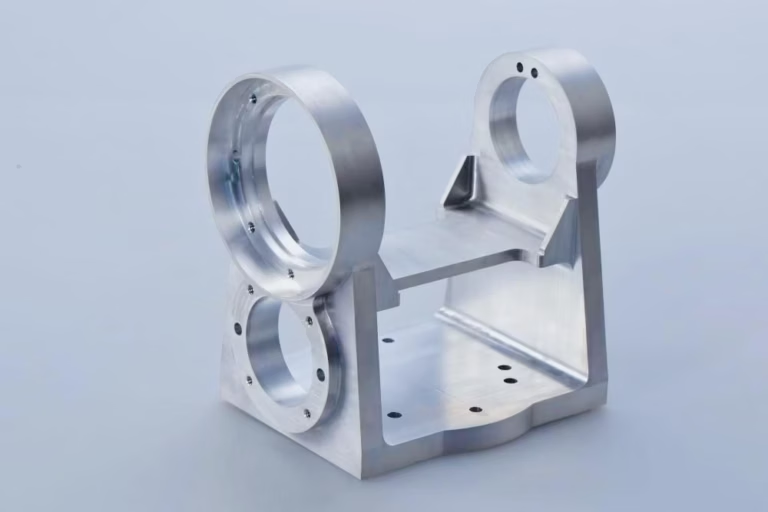
4-axis work suits cylindrical and prismatic parts with features on multiple faces: manifolds, valve bodies, drive shafts, brackets, and housings. It is less useful for deep 3D contouring on five faces at once, which is where simultaneous 5-axis earns its cost.
Tolerance, finish, and the numbers behind them
±0.005 mm is achievable on a 4-axis mill, but only inside a defined window. It depends on material, wall thickness, tool reach, and how much heat the cut puts into the part. Thin aluminium walls move after machining. Hardened steel moves during it. A factory that quotes one tolerance for every geometry is guessing.
Surface finish is a separate cost line. Ra 1.6–3.2 μm is as-machined and comes off the tool. Ra 0.8–1.6 μm needs a controlled finishing pass. Ra 0.2–0.8 μm usually means slower feeds, smaller stepovers, or a secondary operation. Tell the factory which surfaces actually need the fine callout, because polishing a whole part doubles the cycle.
Materials behave differently in bulk. Aluminium 6061 and 7075 cut clean at high spindle speeds. Stainless 316 and 17-4PH work-harden if the feed is too light. Titanium Ti-6Al-4V needs lower surface speed and more coolant. Inconel is slow on purpose. A supplier who lists these alloys should also be able to say what changes in the program for each one.
Inspection is the tie-breaker. A single CMM report on the first article proves the setup works once. Batch data proves the process holds. We run raw material checks, in-process monitoring, and final inspection on every order, and we send the dimensional report on request.
Capacity and certifications to verify
Machine count is a rough proxy for scheduling flexibility. We run 127 high-precision CNC machines across three wholly-owned plants, including 12 four-axis mills, 16 simultaneous 5-axis centers, and 16 mill-turn centers. That mix matters because 4-axis work is often paired with turning, and doing both under one roof keeps the datum chain short.
Certification scope is worth reading line by line. ISO 9001:2015 covers quality management. IATF 16949:2016 is what automotive and EV buyers need. ISO 13485:2016 applies to medical device work. ISO 27001:2022 covers information security, which is the one most buyers forget to check before sending CAD files.
Floor space and headcount tell you whether the factory can absorb a ramp. Our plants total 7,600 m² with 150 technicians, and we have run production since 2011. A factory that is 15 years old and still holds the same certifications has survived audits, not just one good quarter.
Ask about the handoff between prototype and series. If the prototype shop and the production floor are different buildings, the fixture may be rebuilt from scratch. In our case both sit on the same line, which is why we can take a part from one piece to 10,000+ without a second quote.
Lead time, MOQ, and quoting behavior
Quotation and free DFM analysis within 12 hours is a useful benchmark. A factory that needs a week to price a simple 4-axis part is either overloaded or not reading the drawing. The DFM notes matter more than the number, because they tell you whether anyone looked at the geometry.
Production start within 24 hours applies once the drawing and material are locked. Shipping in 3–5 days is our standard window for machined parts, and our historical late-delivery probability is below 2%. Treat those as planning inputs, not guarantees, and ask what happens when a batch fails inspection.
MOQ is the clearest signal of who a factory is built to serve. No minimum order quantity means the same team runs one prototype and a 10,000-part batch. That continuity is what keeps fixtures, programs, and inspection plans intact between phases.
Confidentiality belongs in the quote conversation. Uploads are secure and confidential, and we sign an NDA on request. If a supplier treats that as an unusual favor, the file handling process is probably informal.
How to qualify a bulk 4 axis CNC machining factory
Run these in order. Each step filters out suppliers before you spend engineering time.
- 1Send a drawing with real calloutsInclude GD&T, datum scheme, and which surfaces need fine finish. Vague drawings produce vague quotes and hide capability gaps.
- 2Ask for rotary travel and table sizeConfirm the part fits within Ø400 mm and the axis travel. Anything larger needs a different machine or a split operation.
- 3Request a tolerance window per featureDo not accept one global number. Ask what changes for thin walls, deep pockets, and hardened alloys.
- 4Demand batch inspection dataAsk for a sample dimensional report from a past run in the same material. Check that it covers the whole batch, not one part.
- 5Verify certification scopeAsk which certificate covers your industry: IATF 16949:2016 for automotive, ISO 13485:2016 for medical, ISO 27001:2022 for data.
- 6Test the quote turnaroundTime the response. A 12-hour quote with DFM notes is a working process. A fast number with no notes is a template.
- 7Run a pilot batch before the full releaseOrder 50 to 200 pieces, inspect them yourself, then release the balance. This catches fixture and program drift early.
Questions buyers ask before releasing a bulk order
Can a 4-axis mill hold ±0.005 mm on a 10,000-part run?
Yes, within limits. The tolerance depends on material, wall thickness, and tool reach more than on the machine. Aluminium housings with thick walls hold it easily. Thin stainless sections and long unsupported bores are harder.
Ask the factory to name the features where they would relax the callout. A supplier who says every feature holds ±0.005 mm on every alloy has not run that job.
When should I move from 4-axis to 5-axis?
Move to 5-axis when the part needs simultaneous motion on five faces, deep contoured pockets, or a single-setup finish on an impeller or blade. If your features sit on four sides and can be reached with the table tilting, 4-axis is cheaper per part.
The cost gap is real. Five-axis cycle times are longer and programming is heavier, so only pay for it when the geometry demands it.
What does no MOQ actually mean for tooling cost?
It means we do not charge a separate setup or fixture fee just to start. Fixture cost is folded into the unit price, and it drops as quantity rises.
For a single prototype you pay a higher unit rate. At 10,000 pieces the same line runs the same program, so the rate falls without a re-qualification step.
How do you handle data security for CAD files?
Uploads are secure and confidential, and we hold ISO 27001:2022 for information security. We sign an NDA on request, before drawings are shared if that is your process.
If your program requires file deletion after production, put it in the PO. It is easier to enforce when it is written down.
What materials are available for 4-axis bulk work?
Aluminium 6061, 7075, 2024, 5052, 6082 and ADC12; stainless 303, 304, 316L, 17-4PH and 440C; steel 1018, 1045, 4140 and 4340; copper and brass C110 and C36000; titanium TA2 and Ti-6Al-4V; plus ABS, POM, PEEK and carbon fibre.
Alloy choice changes feeds and speeds, so the same part in 6061 and 17-4PH will not price the same.
How is surface finish specified on a bulk order?
Call out finish per surface, not per drawing. Mark the sealing faces and sliding fits at Ra 0.8–1.6 μm and leave the rest as-machined at Ra 1.6–3.2 μm.
If you need Ra 0.2–0.8 μm, expect a secondary operation or a slower finishing pass, and budget cycle time for it.
Send your drawing and get a 4-axis quote in 12 hours
We review the geometry, flag DFM risks, and quote from one piece to 10,000+. No minimum order quantity.
12-hour quote100% inspectionNDA on request
More from the shop floor
We publish setup notes, tooling trials and inspection data from the factory floor.











