
How 5 Rapid Prototyping Companies Work
A sourcing guide for engineers who need prototype parts, not a sales pitch. We compare how five well-known rapid prototyping companies work across quoting, tolerance, MOQ, certifications and finishing. Read this and you can tell which model fits your part before you upload a single file.
In this article
- 1
- 2
- 3
- 4
- 5
- 6
- 7
- 8
Key takeaways
How the five companies work, side by side
How each rapid prototyping company works, by sourcing model and capability.
| Company model | How quoting works | Best fit | Watch out for |
|---|---|---|---|
| In-house precision shop | Engineer reviews DFM, quote in 12 hours | Tight tolerance metal parts | Fewer plastic processes than a network |
| Digital manufacturer network | Automated quote from uploaded CAD | Simple geometry, fast price check | Partner shop changes job to job |
| Broker platform at scale | Instant algorithm pricing, manual review later | Large spread of processes | Tolerance depends on the chosen partner |
| Shenzhen online manufacturer | Online quote plus engineering follow-up | Prototype to low-volume bridge | Finishing options vary by line |
| Distributed ecosystem | Quote with supplier matching | Assembly-level sourcing | Lead time quoted per supplier, not per order |
Pick the model, then the shop
If the part is simple and you need a price now, a network is fine. If the drawing has tight tolerance, a critical finish or a regulated industry behind it, choose a shop that owns the machine and answers with an engineer.
What rapid prototyping companies work means in practice
The phrase covers two very different businesses. One owns the machines and controls the schedule. The other owns a website and routes your file to a partner shop. Both can deliver a good part, but the risk sits in different places, and that is what you need to price before you commit.
An in-house shop quotes from a manufacturability review. Someone opens your STEP file, checks wall thickness, tool access and tolerance stack-up, then sends a quote with notes. At GreatLight this happens within 12 hours, and production can start within 24 hours once the drawing is agreed.
A network quotes from a cost model. Upload the file, get a number in minutes. That speed is real. What the number does not tell you is which shop will run the job, on which machine, with which inspection routine. That gets decided after you pay.
Neither model is wrong. But if your part has a 0.4 mm wall, a ±0.005 mm bore, or a cosmetic surface, the difference between the two models shows up in the first article, not in the quote.
Tolerance, finish and the machine list behind the quote
Tolerance is where marketing language gets vague. Any shop can say 'precision'. Ask what the machine can hold across the full travel of the part, not in a 20 mm test coupon. GreatLight works to ±0.005 mm (±0.0002 in) and finishes down to Ra 0.2–0.8 μm when the drawing calls for it.
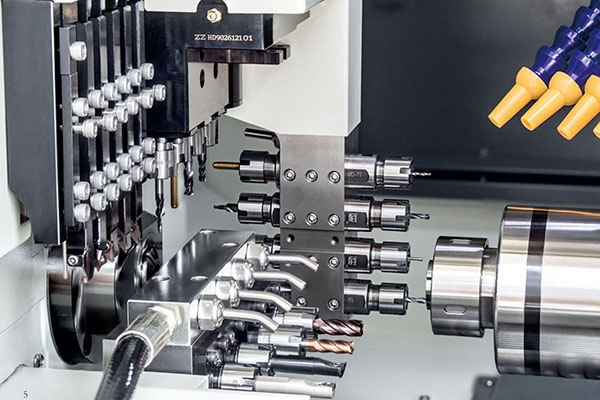
The machine list matters because geometry decides the process. A deep pocket in a 5-axis part needs a tilting head and a short tool. A long shaft needs a mill-turn center so the part is not re-chucked three times. GreatLight runs 127 high-precision CNC machines, including 16 simultaneous 5-axis centers, 12 four-axis mills, 27 three-axis machines and 16 mill-turn centers.
Size is the second filter. Maximum processing size reaches 4,000 mm, with travels of 4,000 × 400 × 150 mm for long parts and 750 × 1,150 × 550 mm for plate work. If your prototype is larger than a benchtop, say so in the RFQ. It changes the shop, not just the price.
Surface finish is often quoted as a single line item. In practice, anodizing hides tool marks, polishing reveals them. On a prototype, ask for the as-machined finish value first (Ra 1.6–3.2 μm is typical), then decide whether the cosmetic step is worth the extra days.
- 1±0.005 mmTolerance to state in the RFQ for mating features.
- 2Ra 0.2–0.8 μmFine finish for sealing faces and bearing bores.
- 34,000 mmMaximum processing size for long parts.
- 4Ø400 mmRotary table capacity for turned features.
Lead time, MOQ and what the quote actually includes
A 3-day lead time means nothing if the clock starts after a two-week DFM thread. Ask when production starts, not when the quote arrives. For a clean file, GreatLight can start cutting within 24 hours and ship in 3–5 days. Historical late-delivery probability sits below 2%.
MOQ is the quiet cost driver. Networks often price one piece aggressively because it wins the account, then the price per part barely moves at 200 pieces. An in-house shop with no minimum order quantity can run one prototype, then scale the same process to 10,000+ parts without re-quoting the tooling.
Read what is inside the price. Material, machining, inspection and basic deburring should be listed. Plating, anodizing, laser marking and bead blasting are usually separate. Laser marking has a minimum character height of 1.5 mm, so a 0.8 mm serial number will not survive the process.
For prototypes that must pass a customer review, 100% inspection before shipment matters more than a low unit price. Ask for raw material certificates, in-process checks and a final dimensional report. Reports are available on request, and that request should be in the first email.
Certifications: match the scope, not the logo
Certificates are a filter, not a score. ISO 9001:2015 covers general quality management. IATF 16949:2016 is the automotive standard and matters if the prototype feeds a PPAP later. ISO 13485:2016 applies to medical devices. ISO 27001:2022 covers information security, which is what protects your CAD files.
A network may hold a certificate at the platform level while the partner shop that runs your job holds none. Ask who is certified and for what scope. If your part is a surgical instrument housing, the answer changes the shortlist immediately.
Confidentiality is part of the same question. Uploads should be encrypted and access-limited. If the project is under NDA, sign it before the first file transfer, not after the first quote. GreatLight offers an NDA on request and treats uploads as confidential by default.
For regulated industries, plan the paper trail from the prototype. Material certificates, inspection records and revision control on the drawing are easier to set up on day one than to reconstruct three months later.
Matching the process to the part, not the brochure
CNC is the right first choice when the prototype must behave like the production part. Metal brackets, housings, manifolds and fixtures with real loads belong on a mill or a lathe. Aluminum 6061-T6, 7075, 304 stainless and 17-4PH cover most of what we see.
3D printing wins when geometry is the question, not strength. SLM handles dense metal parts in stainless steel, aluminum, titanium and mold steel. SLA holds fine features in polymer. SLS makes functional nylon parts that survive a fit check. Use them to answer 'does it fit', then move to CNC for 'does it hold'.
Vacuum casting and sheet metal fill the gap between one-off and production. Vacuum casting gives you 20 to 50 polyurethane parts from a silicone tool, useful for a sales sample run. Sheet metal covers enclosures and brackets where the final part will be stamped or bent anyway.
The mistake we see most often is choosing the process before the tolerance. Decide the critical dimension first. Then pick the process that can hold it, and the finishing step that does not destroy it.
How to evaluate a rapid prototyping company in 6 steps
Run this before you send the PO, not after.
- 1Write the RFQ around the critical dimensionState tolerance, finish and material on the drawing. Mark the 3–5 features that actually matter. A generic 'precision part' RFQ gets a generic quote.
- 2Ask who owns the machineFor a network, ask which partner will run the job and whether you can see their machine list. For an in-house shop, ask for the machine that will cut your part.
- 3Confirm the lead time start pointAsk: does the 3–5 day clock start at PO, at drawing approval, or at material arrival? Get it in writing.
- 4Check MOQ against your real quantitiesQuote 1 pc, 50 pcs and 500 pcs. If the curve is flat, the shop is routing the work. If it drops, you are paying for setup once.
- 5Match certification scope to your industryIATF 16949 for automotive, ISO 13485 for medical, ISO 9001 as the baseline. Ask for the certificate number and the scope statement.
- 6Agree inspection and reporting up frontRequest 100% inspection, a dimensional report and material certificates in the first email. Retrofitting inspection after shipment is not possible.
Questions engineers ask before choosing
How do rapid prototyping companies work when the part needs two processes?
A single shop with both CNC and additive capacity moves the part between processes without a new supplier onboarding. A network has to hand the job to a second partner, which adds a shipment and a new quality record.
For a metal prototype that starts as a print and finishes as a machined part, the simpler path is one supplier. GreatLight runs 3D printing, CNC, vacuum casting and sheet metal under one roof.
Is an instant online quote reliable for tight-tolerance parts?
It is a starting number. Automated pricing reads geometry, not intent. It cannot see a thin wall that will chatter or a bore that needs a reamer.
Use it for budget range, then ask for a human DFM review. At GreatLight the quote and DFM analysis come back within 12 hours.
What is a realistic MOQ for a prototype run?
One piece is a realistic MOQ for CNC. There is no minimum order quantity at GreatLight, from a single prototype to 10,000+ part runs.
Additive processes have practical minimums tied to build volume, not order quantity. You may pay for a full build plate even if you need two parts.
Which materials should I specify for a functional prototype?
Aluminum 6061-T6 and 7075 for structural parts, 304 or 316L stainless for corrosion resistance, 17-4PH when you need strength plus machinability. Titanium TC4 (Ti-6Al-4V) for weight-critical aerospace work.
On the plastic side, ABS and PC for housings, POM for sliding parts, PEEK when temperature and chemical resistance matter.
How do I protect my design before sending files?
Sign an NDA before the first upload. Check that the shop holds ISO 27001:2022 for information security and that uploads are access-limited.
GreatLight offers an NDA on request and keeps uploads secure and confidential. Ask for the document before you send the STEP file, not after.
What causes a prototype to fail first article inspection?
Most failures come from an ambiguous drawing, not a bad machine. Missing datums, tolerance callouts on non-functional surfaces, and finish notes that conflict with the process are the usual causes.
Send a marked-up drawing with the critical features identified. It costs ten minutes and removes most of the back-and-forth.
Send your prototype file, get a reviewed quote
Upload a STEP file and drawing. An engineer reviews manufacturability and sends a quote with DFM notes within 12 hours.
Quote in 12 hoursNo MOQ100% inspectionNDA on request
More from the shop floor
We publish setup notes, tooling trials and inspection data from the factory floor.











