
1
Tips for Using Coolant
Correct use of coolant is crucial to achieving good drilling performance. It will directly affect chip removal during processing, tool life and the quality of machined holes.
(1) How to use coolant
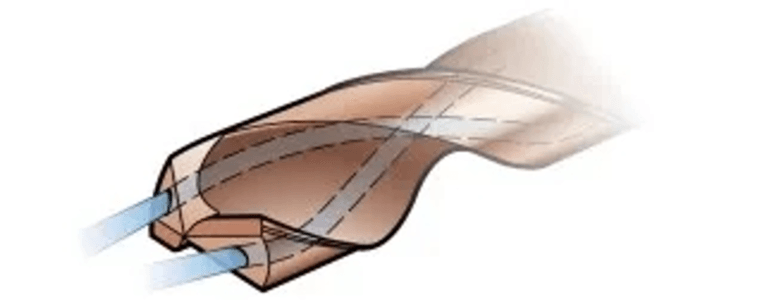
1) Internal cooling design
Internal coolant design is always the first choice to avoid chip blocking, especially when machining long chip materials and drilling deeper holes (more than 3 times the hole diameter). For horizontal drills, when the coolant flows from the drill, there should be no cutting fluid underflow for a length of at least 30 cm.
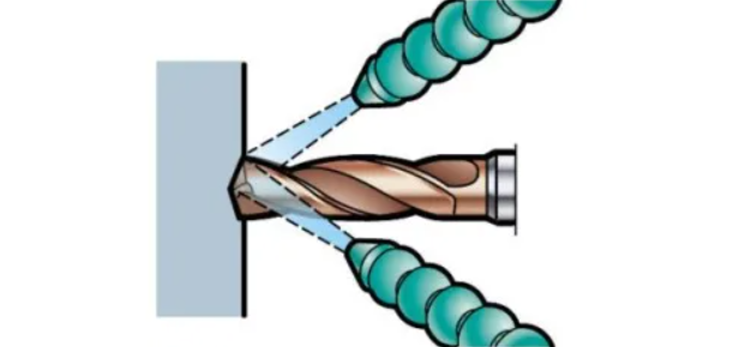
2) External cooling design
Using an external coolant is useful when chip formation is good and hole depth is shallow. To improve chip evacuation, at least one cooling nozzle (or two if non-rotating applications) should be located close to the tool axis.
3) Dry drilling techniques without using coolant
Dry drilling is generally not recommended.
a) Can be used in applications with short chip materials and hole depths up to 3 times the diameter
b) Suitable for horizontal machine tools
c) It is recommended to reduce the cutting speed
d) Tool life will be reduced
It is recommended to never use dry drilling for:
a) Stainless steel material (ISO M and S)
b) Drill with replaceable head
4) High pressure cooling (HPC) (~70 bar)
The advantages of using high pressure coolant are:
a) Longer tool life due to improved cooling effect
b) Improves chip evacuation effect when processing long chip materials such as stainless steel and can extend tool life.
c) Better chip evacuation performance and therefore greater safety
d) Provide sufficient flow for a given pressure and hole size to maintain coolant supply
(2) Tips on using coolant
Be sure to use soluble cutting oil (emulsion) containing EP (extreme pressure) additives. To ensure optimum tool life, the oil content of the oil-water mixture should be between 5 and 12% (10 to 15% when machining stainless steel and high alloy materials). temperature). When increasing the oil content of the cutting fluid, be sure to check with an oil separator to ensure that the recommended oil content is not exceeded.
When conditions permit, internal coolant is always preferred over external coolant.
Pure oil improves lubrication, which can be beneficial when drilling stainless steel applications. Be sure to use it with EP additives. Solid carbide drills and indexable insert drills can use pure oil and achieve good results.
Compressed air, mist cutting fluid, or MQL (minimum lubrication) can be effective under steady-state conditions, especially when machining certain cast irons and aluminum alloys. As increased temperatures can have a negative impact on tool life, it is recommended to reduce cutting speeds.
2
Tips for chip control
Chip jamming can cause the drill bit to move radially, affecting hole quality, drill life and reliability, or causing the drill/insert to break.
Chip shaping is acceptable when the chips can flow easily from the drill bit. The best way to identify it is to listen during the drilling process. A continuous sound indicates good chip removal and an intermittent sound indicates chip blocking. Check the feed force or power monitor. If there are abnormalities, the cause may be a chip blockage. Discover the chips. If the chips are long and curved, but not curled, this indicates a chip jam. Look at the hole. After chip jamming, a rough surface will appear.
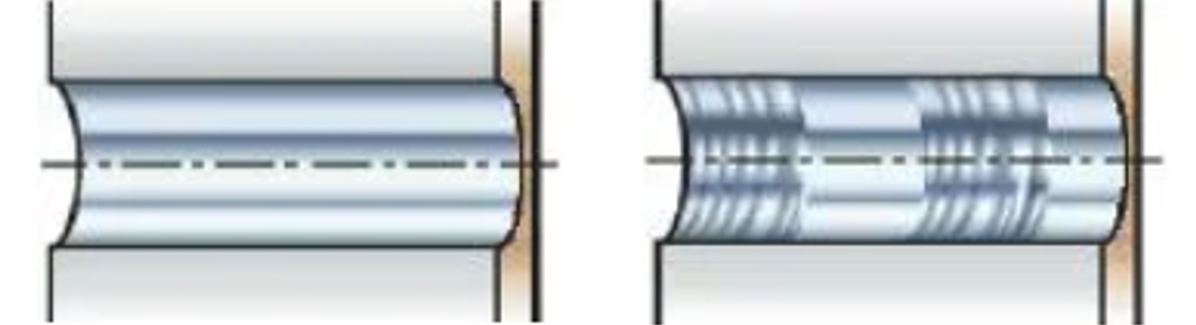
Good chip evacuation (left) and hole affected by chip blockage (right)
Tips to avoid chip jamming:
1) Make sure you are using the correct cutting parameters and drill/tip geometries.
2) Check chip shape – adjust feed and speed
3) Check the flow rate and pressure of the cutting fluid
4) Check the sharpness. When the chipbreaker assembly is not working, damage to the cutting edges can result in long chips.
5) Check if the machinability has changed due to the new batch of parts – adjust the cutting parameters
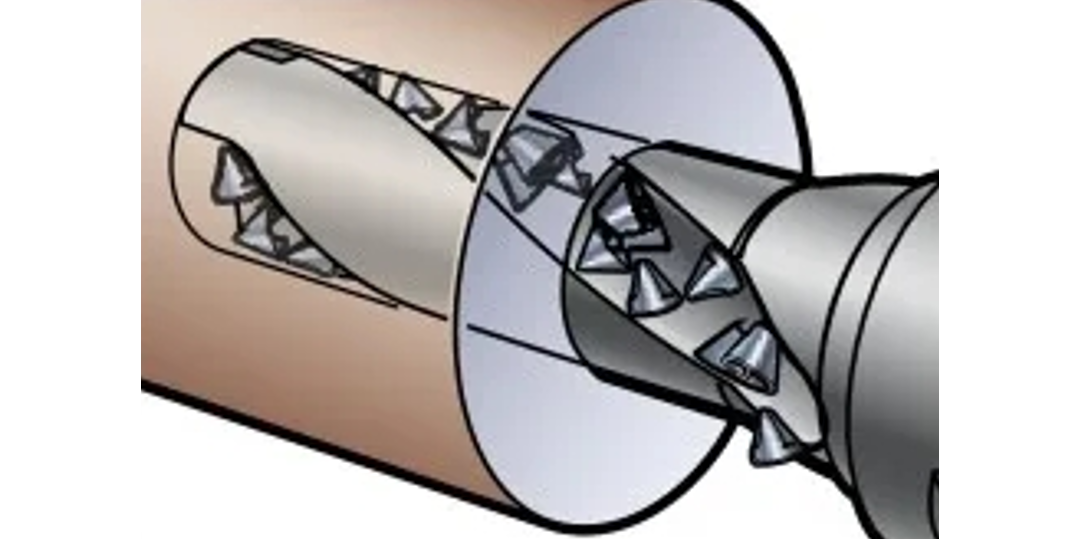
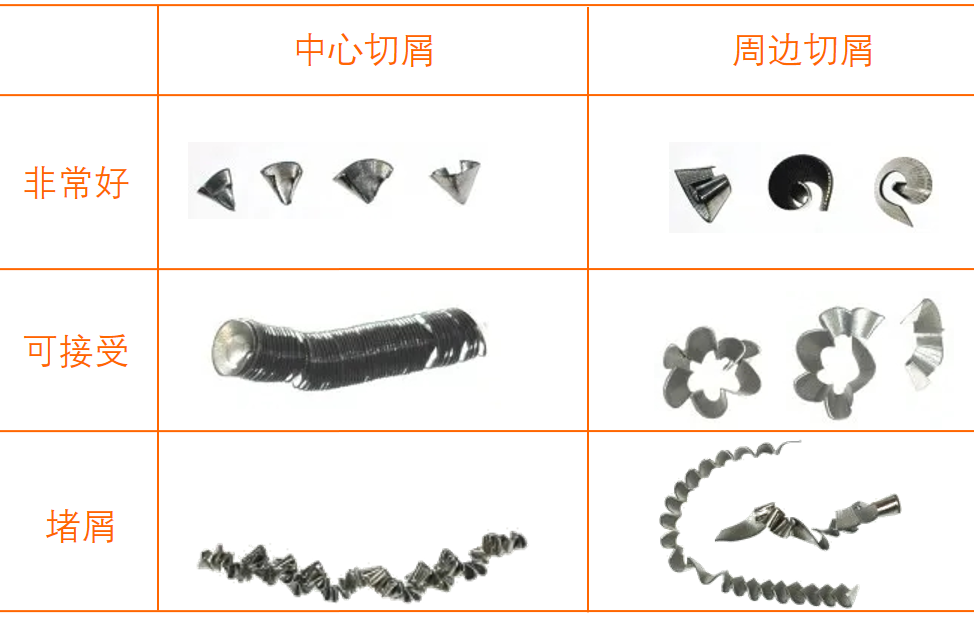
(1) Chips from indexable insert drills
The conical chips formed by the central insert are easily identifiable. The chips formed by the peripheral insert are similar to turning.
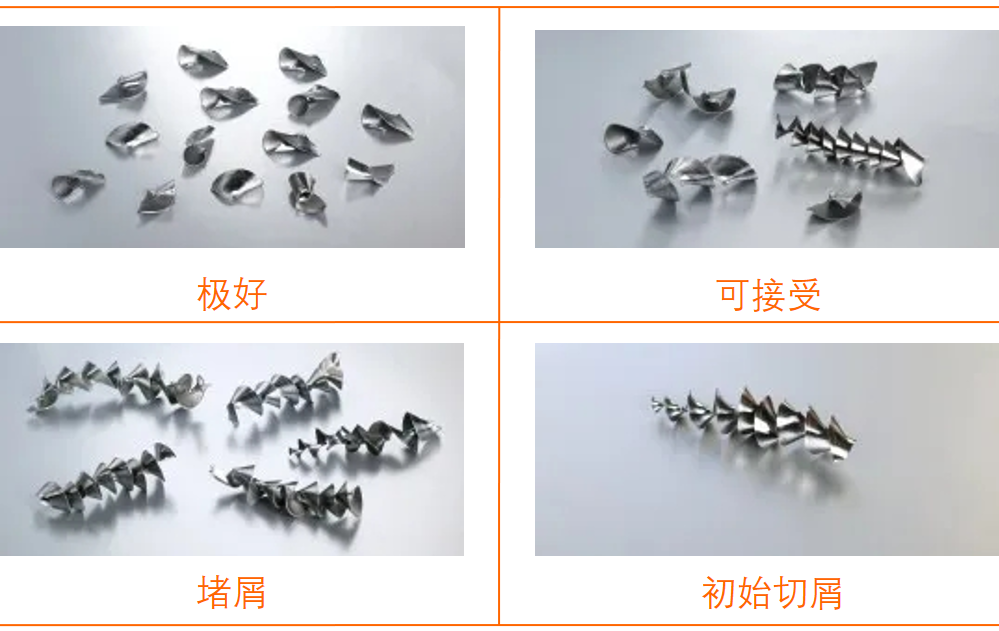
(2) Chips from solid carbide drills
A chip can be formed from the center of the cutting edge towards the periphery. It should be noted that the initial chips produced when first drilling the workpiece are always very long, but this is not a problem.
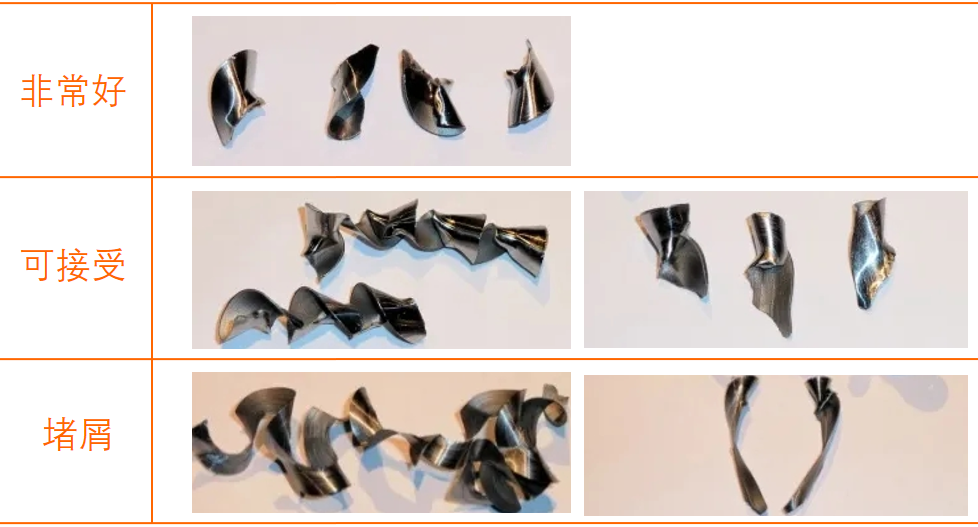
(3) Chips from replaceable drill bits
3
Feed and cutting speed control
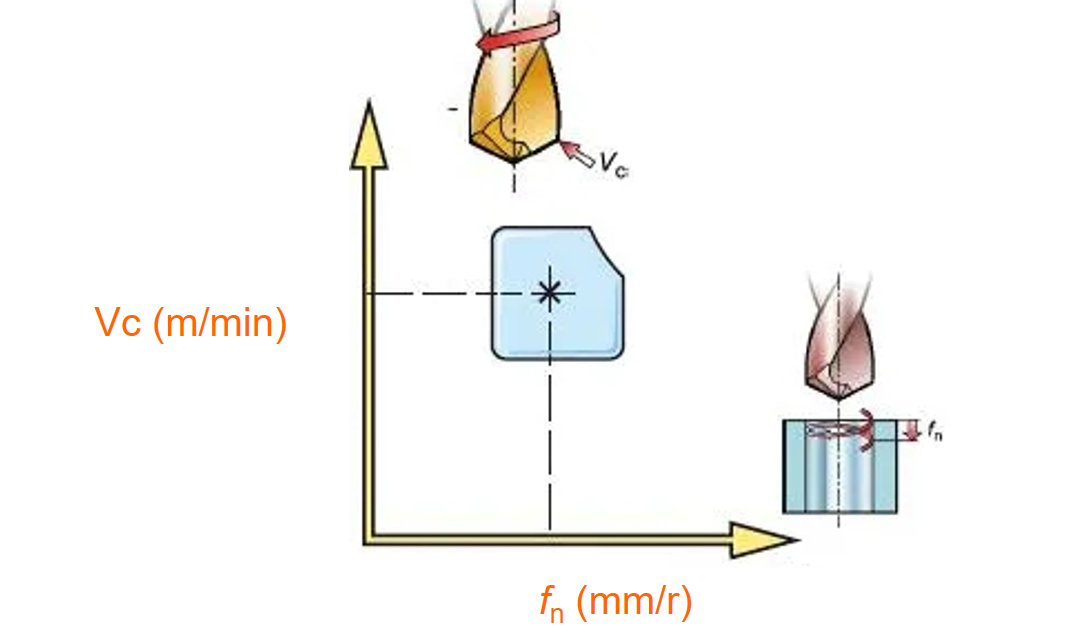
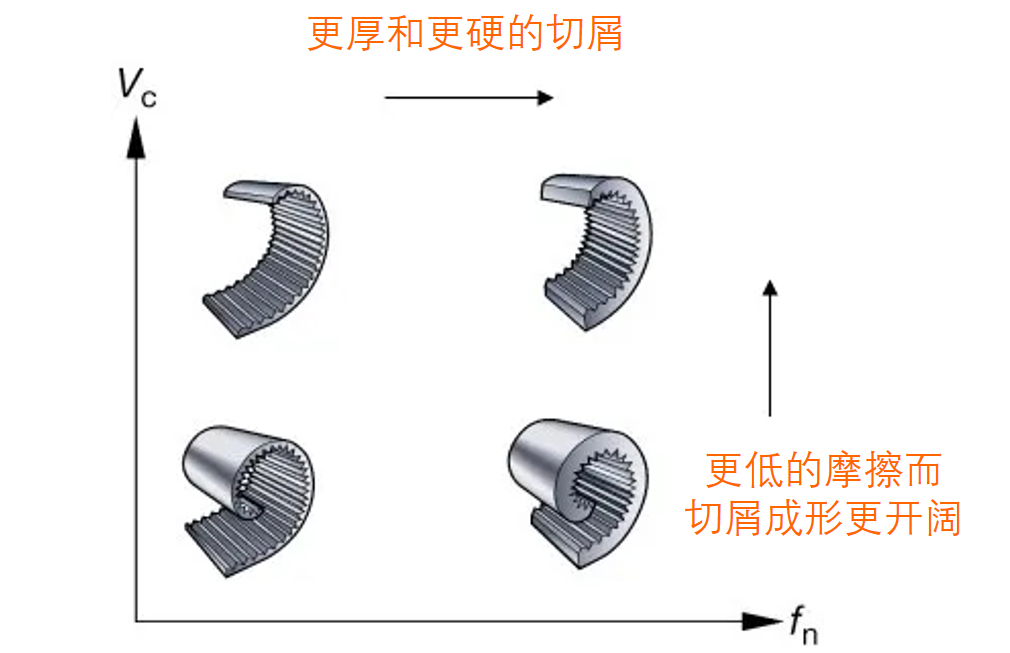
(1) Influence of cutting speed Vc (m/min)
Besides material hardness, cutting speed is also a major factor affecting tool life and power consumption.
1) Cutting speed is the most important factor in determining tool life.
2) Cutting speed will affect power Pc (kW) and torque Mc (Nm)
3) Higher cutting speeds will produce higher temperatures and increase flank wear, especially at the peripheral tip of the tool.
4) When processing some softer, long-chip materials (i.e., low-carbon steel), higher cutting speeds promote chip formation.
The cutting speed is too high:
a) The sidewall surface wears too quickly
b) Plastic deformation
c) Poor hole quality and excessive hole diameter
The cutting speed is too low:
a) A rising edge occurs
b) Poor chip evacuation
c) Longer cutting time
(2) Influence of feed fn (mm/r)
1) Affects chip formation, surface quality and hole quality
2) Affects power Pc (kW) and torque Mc (Nm)
3) High feed will affect the feed force Ff (N). This factor must be taken into account when working conditions are unstable.
4) Affects mechanical stresses and thermal stresses
High feed:
a) Chip breakage is more difficult
b) Shorter cutting time
c) Tool wear is less but the risk of chipping of drilling edges increases
d) Reduced hole quality
Low feed speed:
a) The chips are longer and thinner
b) Quality improvement
c) Tool wear accelerates
d) Longer cutting time
e) When drilling thin and not very rigid parts, the feed must remain low.
4
Tips for Getting High Quality Holes
(1) Chip removal
Ensure chip evacuation performance meets requirements. Chip clogging affects hole quality, reliability and tool life. Drill/insert geometry and cutting parameters are crucial.
(2) Stability and tightening of the tool
Use the shortest drill bit possible. Use refined rigid tool holders with minimal runout. Make sure the machine tool spindle is in good condition and accurately aligned. Make sure the parts are secure and stable. Use correct feed rates for irregular surfaces, bevels and cross holes.
(3) Tool life
Check blade wear and preset tool life management programs. The most effective method is to monitor drilling using a feed force monitor.
(4) Maintenance
Replace the blade retaining screw regularly. Clean the tool holder before replacing the blade, making sure to use a torque wrench. Do not exceed maximum wear before resharpening a solid carbide bit.
5
Drilling techniques for different materials
(1) Low carbon steel drilling skills
Chip formation can be a problem with mild steel, which is often used for welded parts. The lower the hardness, carbon and sulfur content of the steel, the longer the chips produced.
1) If the problem is chip formation, increase the cutting speed vc and reduce the feed rate fn (please note that when processing ordinary steel, the feed rate should be increased).
2) Use a high pressure, internal coolant supply.
(2) Drilling techniques for austenitic and duplex stainless steels
Austenitic, duplex and super-duplex materials can cause problems related to chip formation and evacuation.
1) Correct geometry is crucial as it allows correct chip formation and facilitates chip evacuation. Generally speaking, it is best to use a sharp cutting edge. If the problem is chip formation, increasing the feed rate fn will make the chips more likely to break.
2) Internal cooling design, high pressure.
(3) CGI drilling techniques (compacted graphite iron)
CGI generally does not require special attention. It produces larger chips than gray cast iron, but the chips break easily. Cutting forces are higher, which affects tool life. Requires the use of super wear-resistant materials. Tip wear will occur as it does with all cast irons.
1) If the problem is related to chip formation, increase the cutting speed Vc and reduce the feed rate fn.
2) Internal cooling design.
(4) Aluminum alloy drilling skills
Burr formation and chip evacuation can become problematic. Short tool life can also occur due to sticking.
1) To ensure optimal chip formation, use low feeds and high cutting speeds.
2) To avoid short tool life, it may be necessary to test different coatings to minimize adhesion. These coatings may include diamond coatings or no coatings (depending on the substrate).
3) Use high pressure emulsion or mist coolant.
(5) Titanium alloy and high temperature alloy skills
The work hardening of the hole surface has an impact on subsequent processes. It is difficult to achieve good chip evacuation performance.
1) When choosing a geometry for processing titanium alloy, it is best to have a sharp cutting edge. When machining nickel-based alloys, robust geometry is crucial. If work hardening is a problem, try increasing the feed rate.
2) High pressure coolant up to 70 bar improves performance.
(5) Hardened Steel Drilling Techniques
Obtain acceptable tool life.
1) Reduce cutting speed to reduce heat. Adjust the feed speed to obtain acceptable and easily ejected chips.
2) High concentration mixed emulsion.
Daguang focuses on providing solutions such as precision CNC machining services (3-axis, 4-axis, 5-axis machining), CNC milling, 3D printing and rapid prototyping services.



















