
Supply CNC Machining Parts Services: What Engineers Should Check
This guide is for engineers and procurement teams evaluating a supplier for supply CNC machining parts services. It covers the checks that decide whether parts arrive to print: tolerance capability, machine mix, lead time, MOQ, certification, and how a shop quotes.
In this article
- 1
- 2
- 3
- 4
- 5
- 6
- 7
- 8
- 9
Key takeaways
Supplier checks by part type
Match the check to what the part actually needs.
| Part situation | What to verify first | What usually goes wrong |
|---|---|---|
| Tight-tolerance features | Which machines hold ±0.005 mm | Capability claimed for the whole part |
| Hardened steel or deep pockets | In-house EDM and grinding | Subcontracted EDM adds days |
| Single prototype | No-MOQ policy and setup charge | Setup fee buried in unit price |
| 10,000+ part run | Fixture plan and in-process checks | First-article data only, no SPC |
| Medical or automotive | ISO 13485 or IATF 16949 scope | Certificate held by a sister plant |
| Large frame or housing | Travel up to 4,000 mm | Part split into welded sections |
| Cosmetic anodized surface | Finish sample before full run | Batch color mismatch on clear anodize |
| Confidential design | NDA and upload handling | Files sent over open email |
Pick the supplier that answers technical questions
Price matters, but the deciding factor is whether the shop can explain how it will hold your tolerance, inspect the part, and handle a design change. That conversation tells you more than the quote.
What supply CNC machining parts services actually cover
Supply CNC machining parts services means the supplier takes a CAD file and a drawing and returns finished parts: material purchased, machined, finished, inspected, and packed. The depth of that service varies a lot. Some shops only cut metal. Others quote the part, flag features that are hard to hold, order the material, run the job, and ship with an inspection report.
For most engineering teams, the second model is worth paying for. Manufacturability feedback at quote stage is cheaper than a scrapped batch. If a 2 mm deep slot has a 1 mm corner radius and the drawing calls for a square corner, an experienced shop will tell you before cutting. That single note can save a week.
The scope you should confirm in writing: material grade and condition, machining operations, heat treatment, surface finish, inspection level, and packaging. If any of those sit outside the quote, they become your problem later.
- 1In scopeMaterial, machining, finishing, inspection, packing
- 2Often out of scopeHeat treatment, plating, freight, tariffs
- 3Ask for it explicitlyFirst article inspection report and material certs
Tolerance and finish: what the numbers mean
A tolerance of ±0.005 mm is roughly ±0.0002 in. That is a real capability, but it does not apply to every feature on every part. It applies to features the shop can reach with the right machine, a stable setup, and a controlled temperature. Ask which operations hold that number and how they measure it.
Surface finish is the other number engineers under-specify. As-machined finish runs Ra 1.6–3.2 μm. A high-quality finish runs Ra 0.8–1.6 μm. Fine finish, Ra 0.2–0.8 μm, usually needs a secondary operation such as grinding, lapping, or polishing. Specifying fine finish on a non-functional face adds cost for no benefit.
The practical rule: put tight tolerance and fine finish only on features that need them. Datum faces, bearing bores, sealing surfaces, and mating pilots earn it. Clearance holes and cosmetic faces usually do not.
- 1As-machinedRa 1.6–3.2 μm, standard milling and turning
- 2High-qualityRa 0.8–1.6 μm, controlled feeds and sharp tooling
- 3FineRa 0.2–0.8 μm, secondary operation required
Machine mix and part size limits
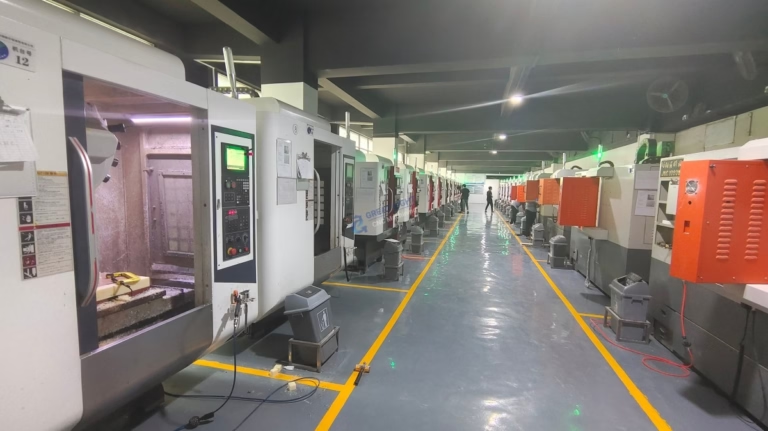
The machine list tells you what a shop can do without subcontracting. Turning centers handle shafts and fittings. Three-axis mills handle prismatic parts with features on one or two faces. Four-axis and five-axis centers reach angled faces and complex geometry in fewer setups, which matters when each setup adds error.
Size limits matter as much as axis count. A shop with 4,000 mm travel can machine a long frame or housing in one piece. A shop limited to 600 mm will split it, bolt it, or weld it, and that changes stiffness and tolerance stack-up. Check the travel against your largest dimension before you send the file.
For hardened steel or sharp internal corners, EDM is the deciding capability. If the shop sends EDM out, you inherit the queue time and lose visibility on quality. In-house EDM and grinding keep the schedule and the inspection record under one roof.
- 1Shafts and fittingsCNC lathes and Swiss-type turning
- 2Complex geometrySimultaneous 5-axis, fewer setups
- 3Long partsTravel up to 4,000 × 400 × 150 mm
- 4Hardened or sharp cornersIn-house EDM and grinding
Lead time, MOQ, and quote structure
Lead time claims are only useful if you know what starts the clock. A quote and DFM analysis in 12 hours, production start within 24 hours, and parts shipping in 3–5 days is a fast cycle. It assumes the material is in stock and the drawing is frozen. Any change after setup restarts part of that clock.
MOQ is a common deal-breaker. A supplier that runs from one prototype to a 10,000+ part run does not need to bundle your order with someone else's to make it worthwhile. That flexibility matters during design iterations, when you need three parts next week and 500 parts next quarter.
Read the quote structure carefully. Material, machining time, setup, finishing, inspection, and freight should each be visible. A single blended unit price hides where the cost sits and makes it hard to compare suppliers or to negotiate a design change.
- 1Quote turnaroundDFM feedback within 12 hours
- 2Production startWithin 24 hours of approval
- 3ShippingParts ship in 3–5 days
- 4Order rangeOne prototype to 10,000+ parts
Certification and inspection: reading the paperwork
Certifications are only meaningful if they cover the plant that will run your part. ISO 9001:2015 covers general quality management. IATF 16949:2016 applies to automotive production. ISO 13485:2016 applies to medical devices. ISO 27001:2022 covers information security, which matters when you send proprietary CAD files.
Ask for the certificate scope and the site address. A group holding a certificate at one plant does not automatically extend it to another. If your part is medical or automotive, the audit trail has to point at the actual production floor.
Inspection is the second half. 100% inspection before shipment, with raw material checks, in-process monitoring, and final inspection, is a reasonable baseline. Reports are usually available on request. For critical features, ask which gauge or CMM was used and whether the report includes the actual measured values, not just pass or fail.
- 1ISO 9001:2015Baseline quality management
- 2IATF 16949:2016Automotive production parts
- 3ISO 13485:2016Medical device components
- 4ISO 27001:2022Design file and data security
Materials and finishing: where cost creeps in
Material choice drives machinability, and machinability drives cost. Aluminum grades such as 6061, 7075, and 2024 cut fast and hold tight tolerance well. Stainless 303 and 304 machine cleanly; 316L and 17-4PH are tougher and slower. Titanium Ti-6Al-4V and Inconel cut slow, wear tooling, and need rigid setups.
Finishing is where quotes diverge. Anodizing, plating, powder coating, black oxide, bead blasting, and laser marking are all separate operations with their own lead time. Laser marking has a practical limit: minimum character height around 1.5 mm. Smaller text may not be legible after the finish.
Specify the finish that the function requires and no more. Hardcoat anodize on a wear surface earns its cost. Decorative clear anodize on a hidden bracket does not. When several parts share a cosmetic finish, ask for a sample before the full run to check color and sheen.
- 1Fast to machine6061, 7075, 303, 304, brass C36000
- 2Slow but necessaryTi-6Al-4V, Inconel, 17-4PH
- 3Common finishesAnodize, plating, powder coat, black oxide
- 4Laser marking limitMinimum character height 1.5 mm
Step by step
- 1Send a drawing with GD&T, not just a STEP fileInclude datum callouts, tolerance blocks, and surface finish notes. A bare model forces the shop to guess, and guesses turn into disputes.
- 2Ask for the DFM feedback in writingLook for notes on thin walls, deep pockets, sharp internal corners, and features below tool reach. Good feedback arrives with the quote.
- 3Match the tolerance callout to the featureTighten only what functions need. A ±0.005 mm callout on a clearance hole adds cost and inspection time for no gain.
- 4Confirm the machine that will run the partAsk which center handles your largest dimension and which one holds the tightest tolerance. Travel and axis count should match the part.
- 5Check certification scope and siteRequest the certificate and confirm the plant address. Verify that the standard applies to your industry, not just the group.
- 6Agree on inspection level before productionDecide whether you need a first article report, full dimensional report, or measured values on critical features. Put it in the PO.
- 7Run a small batch firstOrder one or a few parts, check fit and finish, then scale. This tests communication and quality before you commit to volume.
- 8Set up the NDA and file handling earlySign the NDA before sending CAD. Confirm how uploads are stored and who inside the shop can open them.
Frequently asked questions
How do I know a shop can actually hold ±0.005 mm?
Ask which features and which machines the tolerance applies to, and what measurement method they use. A shop that answers with specific operations and gauge types is more credible than one that repeats the number.
You can also test it. Send a part with a few tight features and a mix of looser ones, then compare the inspection report against your own measurements.
Is a low unit price a warning sign?
Sometimes. A very low price often means the quote excludes finishing, inspection, or freight, or that the shop plans to subcontract a critical operation.
Compare quotes line by line: material, machining, setup, finish, inspection, and freight. The cheapest total is not always the cheapest delivered part.
What should I check before sending CAD files?
Confirm the confidentiality terms and whether an NDA is in place. Ask how uploads are stored and who can access them.
Also confirm the file format the shop prefers. STEP is common for geometry; the drawing still carries tolerance and finish requirements.
When does five-axis machining make sense?
When the part has features on multiple faces, angled holes, or contoured surfaces that would otherwise need several setups. Fewer setups reduce stack-up error and handling time.
For simple prismatic parts with features on one or two faces, three-axis or four-axis work is usually faster and cheaper.
How tight should I specify surface finish?
Specify finish only where it matters. Sealing surfaces, bearing fits, and sliding contacts justify Ra 0.8–1.6 μm or finer. Cosmetic and clearance faces are fine at Ra 1.6–3.2 μm.
Over-specifying finish adds a secondary operation and can add days to the schedule.
What happens if the drawing changes after the order starts?
Any change after setup affects material, tooling, and inspection. The earlier you raise it, the less rework. Send the revision in writing and ask for an updated quote before the shop restarts.
For prototype orders, changes are normal. For production runs, freeze the drawing and log revisions so both sides work from the same version.
Send your drawing and get a technical quote
We review your files, flag manufacturability issues, and return a line-item quote with DFM notes. Uploads stay confidential, and an NDA is available on request.
12-hour quoteNo MOQ100% inspection
More from GreatLight
We publish setup notes, tooling trials and inspection data from the factory floor.











