
Specialized CNC Machining Services: How to Choose a Shop That Fits the Part
Most RFQs fail for reasons that have nothing to do with the drawing. This guide is for engineers and buyers comparing specialized cnc machining services, and it lists the checks that decide whether a shop can hold your tolerance on a real production run. Read it before you send the next quote request.
In this article
- 1
- 2
- 3
- 4
- 5
- 6
- 7
- 8
Key takeaways
What to Compare Before You Award the Job
Use this table as a quote-review checklist. Each row is a claim a supplier makes, and the right column is what actually protects your program.
| Criterion | Weak answer | What to look for |
|---|---|---|
| Tolerance | "We hold ±0.01 mm" | Feature-level numbers for bores, flatness, true position |
| Machine fit | "We have CNC machines" | Named machine class and travels for your envelope |
| Certifications | Logos on the homepage | Copy of the certificate with scope and expiry date |
| MOQ | "Minimum 500 pieces" | No MOQ, or a prototype price you can afford to iterate on |
| Lead time | "Fast turnaround" | Quote in 12 hours, production start within 24 hours |
| Inspection | "We check quality" | 100% inspection before shipment, reports on request |
| Materials | Aluminum and steel only | Titanium, Inconel, copper alloys, engineering plastics |
| Confidentiality | Verbal promise | Signed NDA and secure upload handling |
The Short Version
Pick the shop whose machines, certificates and inspection routine match your part, not the one with the lowest lump-sum number. If the fit is wrong, the cheap quote gets expensive at the first revision.
What Makes Specialized CNC Machining Services Different
A general machine shop makes parts. A specialized shop makes a defined class of parts, and it has bought the machines, tooling and inspection gear for that class. The difference shows up when your geometry stops being a block with holes. Deep pockets, thin walls, compound angles and tolerances under ±0.01 mm all push a generalist out of its comfort zone.
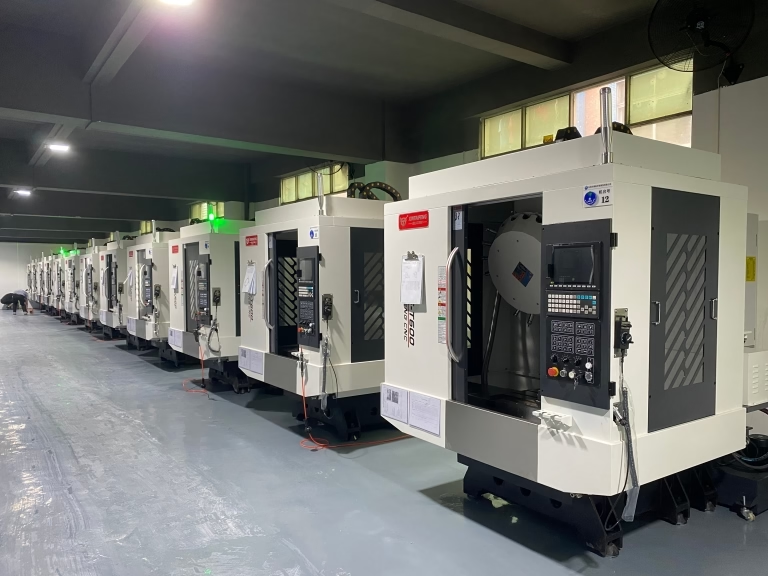
At GreatLight we run 127 high-precision CNC machines across 3 wholly-owned plants, in 7,600 m² of floor space. That includes 16 simultaneous 5-axis machining centers, 12 four-axis mills, 27 three-axis machines and 16 mill-turn centers. The machine list matters because it decides how many setups your part needs. Every extra setup adds stack-up error and adds days.
The largest travel we hold is 4,000 × 400 × 150 mm, with medium platforms at 750 × 1,150 × 550 mm and 600 × 600 × 600 mm, plus a Ø400 mm rotary table for round work. If your part fits one of those envelopes and needs 3 to 5 axes, it belongs on this list. If it needs a 6 m weldment, it does not, and we will say so.
Specialization is not a slogan. It is a set of limits the shop will admit to. A supplier that claims every material, every size and every tolerance at the same price is telling you it has not thought about your part yet.
- 116 five-axis centersComplex geometry in one setup, fewer fixtures, tighter true position.
- 216 mill-turn centersTurned parts with milled features, no second operation.
- 34,000 mm max lengthLong shafts and rails on the large-travel platform.
- 4150 techniciansProgrammers, machinists and inspectors on staff since 2011.
Reading a Tolerance Claim the Right Way
A shop that says it holds ±0.005 mm is stating a best case on a well-behaved feature. That number is achievable, and we quote it, but it does not apply to every surface on the drawing. A 300 mm aluminum plate will move with heat and with the release of residual stress. A 5 mm deep slot will not.
So ask a second question: which features actually need the tight number? Most parts carry a handful of critical dimensions and a large set of cosmetic or clearance ones. Quoting everything to ±0.005 mm raises cost and lead time for no benefit. Quoting nothing to that level is worse.
Surface finish follows the same rule. We work to Ra 0.2–0.8 μm on fine finishes, Ra 0.8–1.6 μm on standard machined surfaces, and Ra 1.6–3.2 μm as-machined. A sealing face, a bearing bore and a housing exterior do not need the same callout. Name the function and the finish follows.
One practical test: send a drawing with a deliberately loose non-critical dimension and see whether the quote flags it. A shop that reads the drawing will ask. A shop that prices by weight will not.
Materials and Finishes That Decide the Shop
Aluminum and mild steel are table stakes. They cut fast, they are forgiving, and almost any shop can quote them. The list gets shorter as you move up. We machine 6061, 6061-T6, 2024, 5052, 5083, 6063, 6082, 7075 and ADC12 in aluminum, and stainless 303, 304, 316, 316L, 420, 430, 431, 440C and 17-4PH.
Harder work changes the tooling and the schedule. Tool steel, 4130, 4140 and 4340 are routine here. Titanium TA1, TA2 and TC4 (Ti-6Al-4V), Inconel, and magnesium AZ31B or AZ91D need slower speeds, more coolant discipline and sharper attention to chip evacuation. If a supplier cannot tell you how it controls heat on Inconel, it does not run Inconel.
Finishing decides whether the part arrives usable. We offer anodizing in clear, color, hardcoat and conductive grades, electroless nickel, zinc, silver and gold plating, powder coating, black oxide, bead blasting, tumbling, brushing and polishing. Laser marking and engraving go down to a minimum character height of 1.5 mm.
One trap: a tight tolerance plus a coating is not the same as a tight tolerance. Hard anodizing and plating add thickness, so the machined dimension has to be adjusted before the finish goes on. Tell the shop the finish at quoting time, not after.
Certifications, Inspection and Lead Time Claims
Certificates only count when the scope covers your part. GreatLight holds ISO 9001:2015, IATF 16949:2016, ISO 13485:2016 and ISO 27001:2022. If you build automotive parts and need PPAP, IATF 16949 is the relevant one. If you build surgical instruments, ISO 13485 is. Ask for the certificate copy and check the scope line.
Inspection is where most quality arguments start. Our routine is a raw material check, in-process monitoring and a final inspection, with 100% inspection before shipment and reports on request. That inspection rate supports a qualification rate of 99.99%. Ask any supplier what happens between the first article and the last box.
Lead time claims deserve the same skepticism. Our standard flow is a quotation and free DFM analysis within 12 hours, production start within 24 hours, and parts shipping in 3–5 days. Our historical late-delivery probability is below 2%. Those numbers assume a released drawing and available material, not a drawing that is still moving.
Note what is missing from that paragraph: a guaranteed date. No honest shop guarantees a date before the drawing is frozen and the material is booked. Treat a hard promise on day one as a warning sign.
Common Buyer Mistakes and How to Avoid Them
The most expensive mistake is quoting a prototype to a tolerance the part does not need. Engineers under pressure add tight callouts as insurance. The shop prices every one of them, and you pay for inspection time on surfaces nobody will measure.
The second is splitting a program across too many suppliers to save a few percent. Every new shop repeats the setup, the first article and the inspection plan. On complex parts that overhead is larger than the price gap.
The third is hiding the finish until the end. Anodizing, plating and powder coating change dimensions, and some processes change them unevenly on sharp edges. A part designed to ±0.005 mm and then hardcoat anodized has to be machined undersize on purpose.
Finally, watch for the shop that quotes everything. If a supplier offers tight-tolerance five-axis work, large weldments, injection molding and sheet metal at the same tier of expertise, ask which one is the core business. A specialist will decline work that does not fit its machines. That refusal is a good sign.
Step by Step: Screening a Supplier in One Week
- 1Send the same RFQ pack to three shopsInclude the 3D model, a 2D drawing with GD&T, material, finish, quantity and target date. A shop that cannot read the pack will reply with questions you already answered.
- 2Compare the quote structure, not just the totalLook for a separate NRE or programming line, a material line and a per-piece price. A single lump number hides where the cost sits and makes re-quoting slow.
- 3Check the DFM feedbackA useful reply names wall thickness, tool reach, corner radii and datum choices. Expect it within 12 hours. Silence for three days means the shop is guessing.
- 4Ask which machine will run the partGet a machine class and a travel envelope. If the answer is a five-axis center, confirm the number of setups. One setup beats three on tolerance stack-up.
- 5Verify the certificate scopeRequest the ISO 9001, IATF 16949, ISO 13485 or ISO 27001 certificate that matches your industry. Check the scope and the expiry date, not the logo.
- 6Run a paid prototype before the production orderOne or two pieces expose programming errors, fixture problems and finish issues at low cost. There is no minimum order quantity here, so a one-piece run is normal.
- 7Agree on inspection and paperworkState which dimensions need reported values and whether you want material certs. Confirm 100% inspection before shipment in writing.
- 8Sign the NDA before releasing sensitive geometryUploads are handled as secure and confidential, and an NDA is available on request. Do this before you send the full model, not after.
Frequently Asked Questions
What tolerance can specialized cnc machining services actually hold?
We quote ±0.005 mm (±0.0002 in) as a general capability on rigid setups and stable materials. On long or thin parts, thermal movement and stress relief widen that number.
Tell us which features are critical and we will assign tolerance where it pays off instead of pricing the whole drawing to the tightest callout.
Is there a minimum order quantity?
No. We run from one prototype to 10,000+ part runs on the same process and the same machines.
That keeps design iteration affordable, since a one-piece revision does not trigger a new tooling charge.
How fast can I get a quote and a first part?
Quotation and free DFM analysis come back within 12 hours. Production can start within 24 hours of a released drawing, and parts ship in 3–5 days.
Our historical late-delivery probability is below 2%. These timelines assume the drawing is frozen and the material is available.
Which certifications should I ask for?
Match the certificate to your industry: IATF 16949:2016 for automotive, ISO 13485:2016 for medical devices, ISO 27001:2022 where data security is in scope, and ISO 9001:2015 as the baseline.
Always check the scope statement and the expiry date on the certificate copy, not just the logo on the website.
Can you machine titanium and Inconel?
Yes. We machine titanium TA1, TA2 and TC4 (Ti-6Al-4V), Inconel, and magnesium AZ31B and AZ91D alongside aluminum, stainless, tool steel and copper alloys.
These materials need reduced cutting speeds, controlled coolant and frequent tool changes, so expect a longer quote review than an aluminum job.
How is my design kept confidential?
Uploads are handled as secure and confidential, and we sign an NDA on request before you send sensitive geometry.
Our ISO 27001:2022 certificate covers information security management, which is relevant if your drawings sit under a customer NDA of your own.
Send the Drawing and Get a Real Answer
Upload your model and 2D drawing. You get a quotation with free DFM analysis within 12 hours, and an engineer reviews the part before the price is set.
12-hour quote100% inspectionNo MOQNDA on request
More from GreatLight
We publish setup notes, tooling trials and inspection data from the factory floor.











