
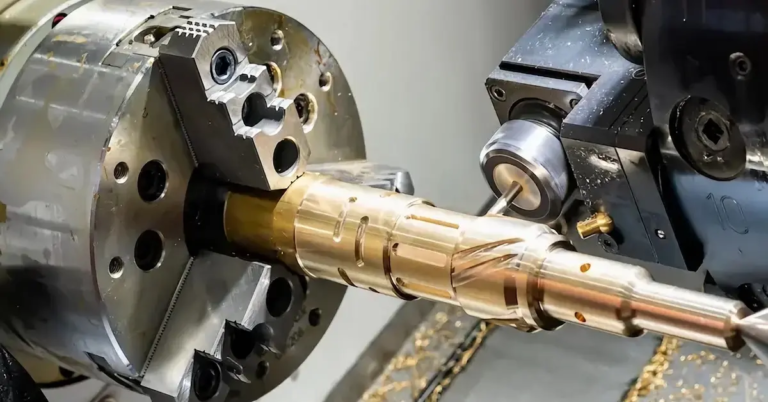
Precision Engineering Perfect: Revealing the Power of Spanish Five-Axis CNC Machining
In a highly competitive landscape of manufacturing, accuracy is not only necessary, but it is absolutely an urgent task. The accuracy of complex aerospace components, medical implants or high-performance automotive parts is required in microns. This is Five-axis CNC machining Appearing as an undisputed champion allows engineers to transform complex digital designs into flawless physical reality. When unlocking the full potential of this technology, Great Represents a beacon of excellence, blending cutting-edge machinery with unparalleled technical mastery.
The evolution of precision: Why five axes are important
Traditional three-axis machining limits the complexity of parts due to fixed tool angles. Enter Five-axis CNC: A system, cutting tools dynamically move on linear X, Y and Z axes Rotate simultaneously Along two additional axes (A and B). This kinematic freedom allows:
- Complex geometric processing: Undercut, contoured surface and organic shapes are processed in a single setting.
- Uncompromising accuracy: Minimum repositioning reduces cumulative errors and reduces tolerances to ±0.01mm.
- Improve efficiency: Production is 60-70% faster by eliminating manual adjustments between operations.
result? Components that were once considered "Unable to shoot" Become achievable, innovations can be accelerated in robotics, aerospace and energy sectors.
Greglime: Where technology fits craftsmanship
From Spain’s vibrant industrial ecosystem, Great The machinery of German engineering is precisely integrated with the Mediterranean. Their facilities houses have improved the five-axis center from industry leaders such as DMG Mori and Hermle, equipped with real-time monitoring sensors and adaptive machining software. However, hardware alone does not define excellence – Greatlight’s engineers have deep metallurgical expertise to decode material behavior to optimize tool paths, speeds, and feeds for each unique project.
Key Products
- Metal Proficiency: From titanium alloys and stainless steel to aluminum-containing and aluminum-containing, Greatlight can handle iron and non-productive materials including foreign drugs. Their knowledge of heat treatment prevents distortion and internal stress.
- End-to-end solution: In addition to processing, customers can access full post-processing under one roof – EDM, grinding, anodizing, powder coating and laser etching.
- Agile customization: Prototypes that are powered by AI-powered production planning, with high-volume production runs within 5-15 days.
Why industry leaders choose Greatlime
- Zero-promoting accuracy: Each section undergoes multi-stage quality inspection, including CMM (coordinate measuring machine) verification for the ASME Y14.5 standard.
- Cost transparency: Digital dual analog predicts waste of materials and processing time, thereby achieving competitive fixed price tags.
- Sustainability: SWARF recycling systems and high-efficiency coolant reduce environmental impact by 30% compared to traditional stores.
Conclusion: The future is five axes
In a world where complexity and speed define market success, five-axis CNC machining has transformed from luxury to necessity. Greglight embodies this evolution – creating Spanish engineering heritage with Industry 4.0 innovation to achieve perfection that others think is impossible. For engineers struggling with intricate designs or active deadlines, working with Greatlime is not only practical; it is strategic.
Ready to turn your vision into precise reality?
Customize your precision parts now
FAQ: Your five-axis machining question, answer
Q1: What is the difference between five-axis and three-axis CNC machining?
one: Three-axis machine linear movement tool; five-axis increase rotation axis so that complex angles and contours do not need to be repositioned. This minimizes error and reduces cycle time.
Q2: Can Greatlight machines harden materials like titanium?
one: Absolutely. We specialize in aviation grade metals (TI-6AL-4V, Inconel 718) and hardened steels (up to 60 hrc).
Q3: Which file format do you accept?
one: We support steps, IGES, SOLIDWORKS, FUSION 360 and other industry standards. Our engineers do not need to review the manufacturability of the design.
Q4: How to save time in one-stop post-processing?
one: Combining machining with decorative (e.g., polishing, coating) ensures consistent quality control with one roof cutting logistics delay.
Question 5: Which industries benefit the most from your services?
one: We offer aerospace (turbo blades), medical (implant), automotive (custom gears) and energy sectors (valve bodies).
Question 6: How do you ensure on-time delivery?
one: Real-time production tracking and buffering capabilities in our workflow ensure 98%+ compliance with deadlines, even in urgent need of orders.
Q7: Is small batch order feasible?
one: Yes – Our agile setup excels in low capacity/high hybrid production, making small batches feasible and economical.



















