
Robot Titanium Components for Lightweight Design
This page explains how titanium changes the mass budget of a robot arm, what Ti-6Al-4V and other grades actually deliver, and where the machining process sets hard limits. It is written for design engineers and procurement leads who need to judge whether titanium is the right call for a given axis, joint or housing before committing to a drawing.
In this article
- 1
- 2
- 3
- 4
- 5
- 6
- 7
Key takeaways
Why titanium changes a robot arm's mass budget
Mass at the end of a robot arm is expensive. Every kilogram carried by the wrist needs a larger motor, a stiffer gearbox and a heavier structure to support it. That extra structure then needs its own motor, and the loop repeats. Designers call this the mass compounding effect, and it is the reason a 15% weight cut at the wrist can remove far more than 15% from the total system.
Titanium addresses this at the material level. Ti-6Al-4V, also written TC4 or Grade 5, has a density around 4.43 g/cm³. Steel sits near 7.85 g/cm³ and aluminium near 2.70 g/cm³. Against steel, titanium saves roughly 40% of the mass while keeping comparable tensile strength, which lands between 895 and 1,000 MPa for annealed Grade 5 bar stock.
The comparison with aluminium is less comfortable. Aluminium is lighter, but its tensile strength in common alloys like 6061-T6 is closer to 310 MPa. To match a titanium bracket in load capacity, an aluminium version usually needs more cross-section, and that added volume eats much of the density advantage. Titanium also holds stiffness at elevated temperature, which matters near motor housings.
There is a second effect that rarely appears in brochures. Titanium parts resist corrosion without plating. In a sterilization cycle, a wash-down environment or a marine test cell, a bare Ti-6Al-4V bracket keeps its dimensions. An aluminium part needs anodizing or coating, and a damaged coating becomes a corrosion site.
- 1DensityTi-6Al-4V ≈ 4.43 g/cm³, about 56% of steel and 1.6× aluminium.
- 2Tensile strengthGrade 5 annealed typically 895–1,000 MPa; 6061-T6 near 310 MPa.
- 3CorrosionPassive oxide layer forms on its own; no plating needed in most robot cells.
Where titanium loses, and when to pick something else
Titanium is not the stiffest option per unit of mass. Its elastic modulus is about 114 GPa, roughly half of steel's 200 GPa. A titanium beam and a steel beam of identical geometry deflect differently: the titanium beam bends nearly twice as much under the same load. When deflection, not strength, sets your accuracy target, geometry has to compensate.
That compensation usually means taller ribs, larger section depth or a shorter unsupported span. On a robot joint, the alternative is to keep steel in the load path and use titanium only where mass is most costly, near the wrist or the end effector. Mixed-material assemblies are common for exactly this reason, and they need careful attention to galvanic contact.
Cost is the other boundary. Titanium bar stock runs several times the price of 6061 aluminium, and the machining time is longer because cutting speeds must stay low. For a static base plate that never moves, titanium buys little. For a forearm link that swings 2,000 times per shift, the arithmetic changes completely.
Thermal expansion also matters. Titanium expands at roughly 8.6 × 10⁻⁶ /°C, close to steel and much lower than aluminium at 23 × 10⁻⁶ /°C. In a metrology frame or a laser-aligned tool head, that difference across a 500 mm link is measurable, and a titanium-steel pairing tracks better than aluminium-steel over a shift.
- 1Deflection-limited designsCheck modulus before choosing; titanium is not a stiffness upgrade over steel.
- 2Static or slow-moving partsAluminium usually wins on cost with no penalty in a fixed base.
- 3Galvanic riskIsolate titanium from aluminium with coatings or non-metallic bushings.
Why titanium is hard to machine, and what that means for your drawing
Three material properties make titanium difficult. Thermal conductivity is low, around 7 W/m·K, so cutting heat cannot escape into the chip. It stays at the tool edge. The result is edge temperatures that shorten carbide life fast, often by a factor of three or four compared with steel at the same removal rate.
Chemical reactivity adds a second problem. At cutting temperatures above roughly 500 °C, titanium tends to weld to the tool material. That built-up edge breaks off and takes tool substrate with it. Machinists counter this with lower surface speeds, generous coolant flow and sharp, uncoated or lightly coated carbide grades.
The third issue is work hardening and chatter. Titanium's low modulus means slender tools and thin webs deflect under load. Once the tool rubs rather than cuts, a hardened layer forms on the surface, and the next pass cuts through a harder skin. Light radial engagement with high feed per tooth is the usual answer, not a heavier cut.
For your drawing, this translates into specific design choices. Deep pockets with tall thin walls are expensive. Sharp internal corners force small-diameter tools that must run slowly. Tolerances tighter than needed add cost with no functional gain. We review each part for these three patterns before quoting, and a short DFM note with the quote usually saves more than it costs.
- 1Keep wall thicknessAim for at least 1.5 mm on unsupported walls to limit chatter.
- 2Round internal cornersCorner radius ≥ 0.5 × pocket depth lets a larger tool reach the floor.
- 3Specify only what mattersTighten tolerance on datum and fit features, not on every surface.
Five-axis machining and how it holds joint geometry
A robot joint is rarely a simple shape. It carries compound angles, a bearing bore, a mounting flange and often an internal cavity for cable routing. On a three-axis machine, each of those features may need its own fixture, and every refixturing step adds a small positional error. Stack five setups and the error adds up in ways that are hard to predict.
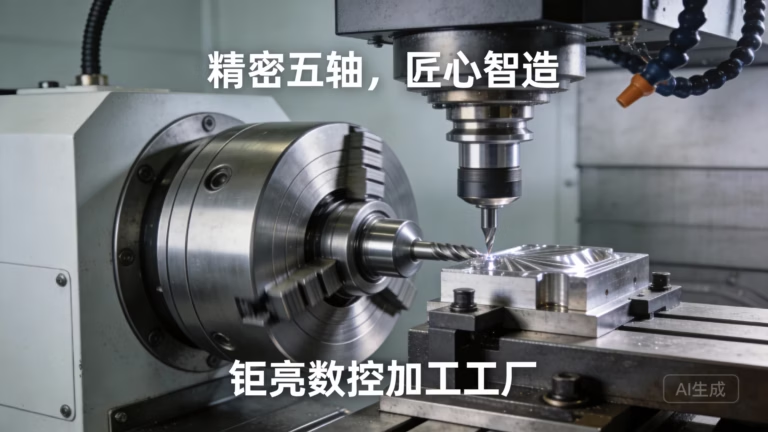
Five-axis simultaneous machining changes the arithmetic. The part stays in one fixture while the tool approaches from the angles the geometry demands. Datum relationships are established once, at the start, and carried through the whole operation. We run 16 simultaneous five-axis machining centers, with travels that cover parts from 500 × 500 × 450 mm up to 4,000 × 400 × 150 mm.
For titanium specifically, five-axis also helps tool life. Shorter, stiffer tool assemblies can be used when the machine orients the workpiece rather than the tool reaching around a corner. That reduces deflection and keeps the cutting edge in the sweet spot for surface speed.
Hollow structural members are a good example. A titanium forearm with an internal rib pattern removes mass where the bending moment is low and keeps material where it is high. Doing that on a three-axis machine means long slender tools and multiple setups. On five-axis, the same part is machined with better access and one datum chain.
Not every part needs five axes. A simple mounting bracket with parallel faces is faster and cheaper on a three-axis machine, and we quote it that way. The decision should follow the geometry, not the machine list.
- 1One setup, one datum chainCompound angles and bores held in a single fixturing, no stacked error.
- 2Stiffer tool assembliesMachine orientation lets shorter tools reach deep features, reducing chatter.
- 3Right machine for the jobParallel-face brackets stay on three-axis machines to keep cost down.
Machining a titanium robot link: the working sequence
How a Ti-6Al-4V link moves from stock to inspected part.
- 1Confirm the alloy and conditionGrade 5 annealed bar or plate to a certified mill spec. Check the heat number against the drawing before cutting.
- 2Plan the datum chainPick the primary datum from a functional surface, such as the bearing bore or mounting face, not from a convenient edge.
- 3Rough with light radial engagementHigh feed per tooth, modest radial depth, flood coolant to move heat away from the edge.
- 4Stress-relieve before finishingFor thin links, an intermediate relief step between rough and finish limits movement after the final passes.
- 5Finish critical features in one setupBores, fits and angular faces machined without refixturing to hold their relative position.
- 6Deburr and control the edgeBreak sharp edges on titanium carefully; a rolled edge can become a crack start under vibration.
- 7Inspect against the drawingCMM check on datum-referenced features, plus surface finish verification on bearing and sealing surfaces.
Titanium grades and process routes for robot parts
Compare the common options before locking a drawing.
| Option | Best for | Watch out for |
|---|---|---|
| Ti-6Al-4V (TC4, Grade 5) | Load-bearing links, joint housings, brackets | Low thermal conductivity; needs slow speeds and sharp tools |
| Commercially pure TA1 / TA2 | Covers, guards, non-structural housings | Lower strength; not for primary load paths |
| 6061-T6 aluminium | Static bases, slow axes, cost-driven parts | Needs coating; galvanic risk against titanium |
| 17-4PH stainless | High-stiffness shafts and pins | Denser than titanium; adds wrist mass |
| Three-axis milling | Flat brackets, parallel faces, simple pockets | Multiple setups add positional error on angled features |
| Five-axis simultaneous | Joints, hollow links, compound-angle ports | Higher hourly rate; justified by geometry, not by default |
| Mill-turn | Shaft-and-flange parts in one cycle | Bar size limits; check the blank envelope early |
When titanium is the right call
If mass sits at the end of a moving arm and the part carries real load, titanium usually pays for itself through smaller motors and lighter supporting structure. If the part is static, deflection-limited or cost-driven, aluminium or steel will do the job with less machining risk. Match the material to the load path, not to the spec sheet.
Questions engineers ask about titanium robot parts
Is titanium always lighter than aluminium for the same part?
No. Titanium is denser than aluminium, about 4.43 g/cm³ against 2.70 g/cm³. It becomes lighter only when its higher strength lets you remove section that an aluminium part would need.
On a stiffness-limited part where geometry is fixed by deflection, aluminium can be the lighter choice. Run the numbers on the actual load case before deciding.
What tolerance can you hold on titanium robot components?
We work to ±0.005 mm on critical features where the drawing calls for it, with surface finish between Ra 0.2 and 0.8 μm on fine-finished surfaces.
Tighter tolerance is not free on titanium. Every extra decimal adds machining time and inspection, so it should be reserved for fits, datums and sealing surfaces.
Can titanium and aluminium parts share a bolted joint?
They can, but the pair forms a galvanic couple. In a wet or humid environment, the aluminium side corrodes preferentially.
Separate the metals with anodizing, a coated washer or a non-metallic bushing, and keep the joint dry where possible. Titanium-to-steel pairs are less of a concern.
Why is titanium machining more expensive than aluminium?
Three reasons: lower cutting speeds, shorter tool life and more careful fixturing. Titanium's low thermal conductivity keeps heat at the cutting edge, so tools wear faster.
The material cost is also higher, and scrap from a failed roughing pass is expensive. Good DFM on the drawing reduces all three cost drivers.
Do you provide material certificates and inspection reports?
Yes. Raw material is checked on receipt against the mill certificate, and we inspect 100% of parts before shipment.
Inspection reports covering dimensional results and surface finish are available on request. We hold ISO 9001:2015, IATF 16949:2016, ISO 13485:2016 and ISO 27001:2022.
What order quantities make sense for titanium parts?
There is no minimum order quantity, so a single prototype is workable. That matters because titanium designs often need two or three iterations before the mass and stiffness targets line up.
Once the design is settled, the same process scales to runs of 10,000 or more without a tooling change.
Send your titanium robot part for review
Upload a STEP file and get a quotation plus a free DFM analysis within 12 hours. We machine Ti-6Al-4V and other titanium grades on 127 CNC machines, and uploads stay confidential under NDA on request.
12-hour quoteFree DFM analysisNo minimum order quantity100% inspection
More titanium and robotics machining notes
We publish setup notes, tooling trials and inspection data from the factory floor.











