
Professional CNC Machining Parts Service: How to Pick One That Ships Good Parts
This guide is for engineers and sourcing managers who need to judge a professional CNC machining parts service before issuing a PO. It covers what to verify on tolerance, machine capacity, material competence, inspection paperwork, and lead time. Read it and you can tell a real machining partner from a shop that only forwards your file.
In this article
- 1
- 2
- 3
- 4
- 5
- 6
- 7
- 8
- 9
Key takeaways
What to check before you send a PO
Use this as a checklist when you compare two or three suppliers.
| Check | Weak answer | Strong answer |
|---|---|---|
| Achievable tolerance | ±0.05 mm on all parts | ±0.005 mm on stated sizes |
| Machine capacity | One 3-axis mill | 16 five-axis centers, 127 machines |
| Max part size | Vague or unknown | 4,000 mm maximum processing size |
| Material range | Aluminum only | Titanium, Inconel, PEEK, 17-4PH |
| Inspection | Visual check only | 100% inspection, reports on request |
| Quality system | No certificates | ISO 9001, IATF 16949, ISO 13485 |
| Minimum order | 500-piece minimum | No MOQ, one prototype up |
| Quote turnaround | A week of email | Quote and DFM within 12 hours |
Check one: what tolerance can the professional CNC machining parts service actually hold
Every shop quotes a tolerance. Few explain how they reach it. A working figure for a professional CNC machining parts service is ±0.005 mm (±0.0002 in), and that number means nothing without two qualifiers: the machine and the feature size. Grinding or fine boring on a rigid setup can reach it. A long, thin wall in a flexible fixture cannot, no matter what the brochure says.
So ask the question in a way that produces a useful answer. Which feature holds the tight tolerance, and what is the datum scheme? If the reply is a single number with no reference to datums or fixturing, expect to see the tolerance drift once the parts are measured on a CMM.
Surface finish is the second half of the story. As-machined surfaces typically land at Ra 1.6–3.2 μm. Finer work gets to Ra 0.8–1.6 μm, and polishing or specific tool paths can reach Ra 0.2–0.8 μm. Define the finish on the drawing, because chasing it later means rework or a second operation.
One useful sanity test: send a part with one tight bore, one thin wall, and one cosmetic face. See which of the three the shop asks about first. A process engineer will ask about the wall and the datum. A salesperson will ask about quantity.
- 1±0.005 mmRealistic on rigid, well-datumed features; confirm per feature.
- 2Ra 1.6–3.2 μmNormal as-machined finish on most alloys.
- 3Ra 0.2–0.8 μmFine finish, usually adds a finishing operation.
Check two: machine capacity and the maximum part envelope
Capacity decides whether your part is easy or awkward. A shop with 16 simultaneous 5-axis machining centers, 16 mill-turn centers, 12 four-axis mills, and 27 three-axis machines can route a job to the right spindle instead of forcing it onto whatever is free. That routing is what keeps a schedule stable when one machine goes down.
Part envelope matters just as much. A large travel of 4,000 × 400 × 150 mm suits long structural parts and extrusion profiles. Mid-size travels of 750 × 1,150 × 550 mm and 600 × 600 × 600 mm cover most housings and brackets. Compact travels of 500 × 500 × 450 mm and 500 × 310 × 200 mm handle small, high-feature-density parts. A Ø400 mm rotary table lets 4-axis work run without re-fixturing.
When you review a supplier, match your parts to their envelope. If half your work is 900 mm long and the shop tops out at 600 mm, you will get subcontracted parts and split responsibility. That is where tolerance stack-up and delivery promises quietly break.
Ask how many shifts run per day and whether lights-out machining is used. Answers here tell you more about lead time than any published schedule.
- 14,000 mmMaximum processing size for long parts.
- 216 five-axis centersComplex geometry in fewer setups.
- 3Ø400 mm rotary table4-axis work without re-fixturing.
Check three: material competence beyond aluminum
Aluminum 6061 and brass C36000 cut easily and forgive small mistakes. Titanium, Inconel, and hardened tool steel do not. They work-harden, they hold heat, and they wear tools fast. A shop that lists these materials should be able to talk about tool coating, coolant strategy, and cutting parameters without looking them up.
The material list itself is a signal. A supplier covering 6061-T6, 2024, 5052, 5083, 6082, and 7075 aluminum, plus 303, 304, 316L, 17-4PH stainless, 4130, 4140, and 4340 steel, has a stocked supply chain. Add TA2, TC4 (Ti-6Al-4V), Inconel, and PEEK and you are looking at a shop that serves aerospace and medical work, not just brackets.
The trap is a supplier who quotes every material at the same price and lead time. Titanium and PEEK do not machine like 6061. If the quote shows no difference in cycle time or tooling cost, the number was guessed.
For plastics, heat and chip evacuation drive the process. POM and ABS are straightforward. PEEK and carbon fiber need sharp tooling and controlled feeds to avoid delamination and burned edges.
- 1Aluminum and brassLow risk, wide supplier base, fast cycle times.
- 2Titanium and InconelTool wear and heat control decide cost.
- 3PEEK and carbon fiberSharp tooling and feed control protect the edge.
Check four: inspection, certificates, and the paperwork you will need
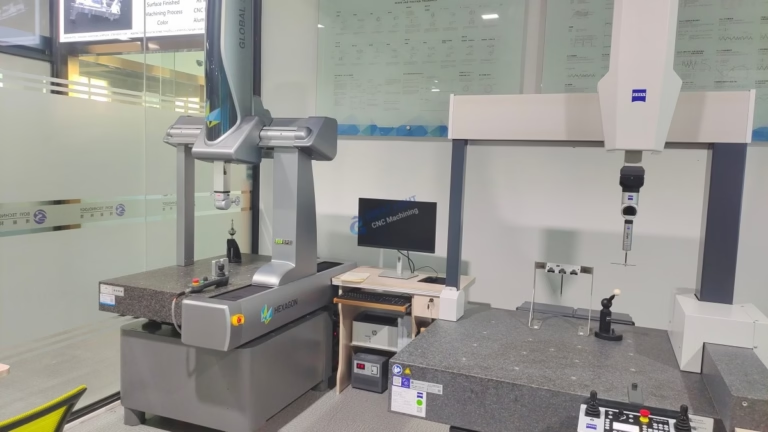
A precise machine with no measurement system is a guess. Look for a metrology setup that matches or exceeds the tolerance you are buying: CMMs, optical comparators, surface roughness testers, and calibrated gauges in a temperature-controlled room. Then ask what happens to the data. A First Article Inspection Report with dimensional results and material certificates is a standard deliverable, not a favor.
Certification scope matters more than the logo. ISO 9001:2015 covers general quality management. IATF 16949:2016 is what automotive and EV programs expect. ISO 13485:2016 applies to medical devices. ISO 27001:2022 covers information security, which matters if your drawings are sensitive IP.
Process control is the other half. 100% inspection before shipment, with raw material checks at receiving, in-process monitoring, and a final inspection, is what keeps a qualified rate at 99.99%. Anything less and defects are found by your incoming inspection instead of theirs.
Ask for a sample inspection report before you order. If the shop hesitates, that tells you how the first real order will go.
- 1FAIRDimensional report plus material certs.
- 2IATF 16949:2016Required for automotive and EV programs.
- 3ISO 27001:2022Covers drawings and other sensitive IP.
Check five: lead time, MOQ, and how the quote is built
Lead time has two parts: the quoting loop and the production run. A quote with free DFM analysis inside 12 hours lets you find design problems before tooling is cut. Production that starts within 24 hours and ships in 3–5 days is realistic for standard parts when material is in stock.
Late delivery is a schedule risk you can price. A historical late-delivery probability below 2% is a claim worth asking about, because it comes from tracking, not optimism. Ask how the shop reports delays and whether you get a heads-up before the ship date, not after.
MOQ is where small programs get squeezed. A supplier that runs from one prototype to 10,000+ part runs without a minimum order quantity will take your pilot build seriously. That matters when you need three parts to prove a design and 5,000 next quarter.
Confidentiality belongs in this section too. Secure uploads and an NDA available on request are the baseline for any program with real IP. If you are sending aerospace or medical geometry, settle this before the first file transfer.
- 112 hoursQuote and free DFM analysis turnaround.
- 23–5 daysTypical shipping window after production starts.
- 3No MOQFrom one prototype to 10,000+ part runs.
Check six: red flags that show up before the first shipment
Some signals appear during quoting. A price with no assumptions listed, no material grade, and no finish note is a number that will move later. A shop that cannot say which machine will run your part is likely to sub it out.
Others appear in the drawing review. If the DFM feedback only points out missing dimensions and never mentions a feature that is hard to hold or a wall that will deflect, the review was shallow. Good feedback suggests a change: increase a corner radius, relax a cosmetic surface, split a part that cannot be machined in one setup.
Communication style is a signal too. Long silent gaps during quoting usually repeat during production. A named engineer who answers questions about datums and fixturing is worth more than a faster email reply from a sales desk.
Finally, watch the sample. If the first article arrives with tool marks on a cosmetic face or a burr on a sealing surface, the process was not planned around function. That pattern rarely improves at volume.
- 1No assumptionsThe price will change once details are clarified.
- 2Shallow DFMOnly missing dimensions, no process suggestions.
- 3Silent quotingSlow answers now mean slow answers later.
Step by step: qualifying a professional CNC machining parts service
Seven steps you can run in about two weeks, using one representative part.
- 1Pick a representative partChoose one part with a tight bore, a thin wall, and a cosmetic face. Avoid a simple block, which hides process weaknesses.
- 2Send drawings and ask for DFMRequest feedback, not just a price. A useful reply names the hard features and suggests changes within 12 hours.
- 3Confirm tolerance per featureAsk which feature holds ±0.005 mm and what the datum scheme is. Reject a blanket tolerance claim.
- 4Match part size to machine envelopeCompare your largest part to the 4,000 mm maximum and to the mid-size travels. Confirm which machine will run it.
- 5Ask for a sample inspection reportRequest a FAIR with dimensional data and material certs. Review how the data is presented, not just the pass result.
- 6Verify certificates and scopeCheck ISO 9001:2015, IATF 16949:2016, ISO 13485:2016, and ISO 27001:2022 against your industry requirement.
- 7Run a pilot order and time itOrder a small batch, no MOQ required. Track quote time, first-article quality, and days to ship against the 3–5 day window.
Questions buyers ask before choosing a supplier
How do I know if a supplier can really hold ±0.005 mm?
Ask which machine and which feature. Tight tolerance comes from a rigid setup, correct datums, and a machine in good condition, not from a general claim.
Then ask for a FAIR on a similar part. The dimensional data shows what the shop actually achieves, feature by feature.
Does a low MOQ mean higher unit cost?
Setup and programming dominate small orders, so unit price is naturally higher. That is normal and not a warning sign.
The warning sign is a supplier who refuses small orders entirely, or one who quotes a low MOQ and then adds tooling charges later.
Which certifications should I require?
Match the certificate to the industry. ISO 9001:2015 is the general baseline. Add IATF 16949:2016 for automotive, ISO 13485:2016 for medical, and ISO 27001:2022 when your drawings are sensitive.
What surface finish can I expect without extra processing?
As-machined parts usually land at Ra 1.6–3.2 μm. If the drawing calls for Ra 0.8–1.6 μm, expect a finer finishing pass.
Ra 0.2–0.8 μm generally needs polishing or a dedicated finishing operation, which affects lead time and cost.
How should lead time be quoted?
Split it into the quote loop and the production run. Ask for the DFM turnaround, the production start, and the shipping window separately.
A reply of 12 hours for quoting, 24 hours to start, and 3–5 days to ship is a concrete answer you can plan around.
Is it safe to send proprietary drawings?
Only with secure uploads and a signed NDA. Confirm the confidentiality process before the first file transfer.
Ask who can access the files internally and whether the shop holds ISO 27001:2022 for information security.
Send your part and get a real answer, not a brochure
Upload your drawings and get a quote with free DFM analysis within 12 hours. No minimum order quantity, from one prototype to 10,000+ part runs.
12-hour quote100% inspectionNo MOQNDA on request
More from GreatLight
We publish setup notes, tooling trials and inspection data from the factory floor.











