

1
Preface
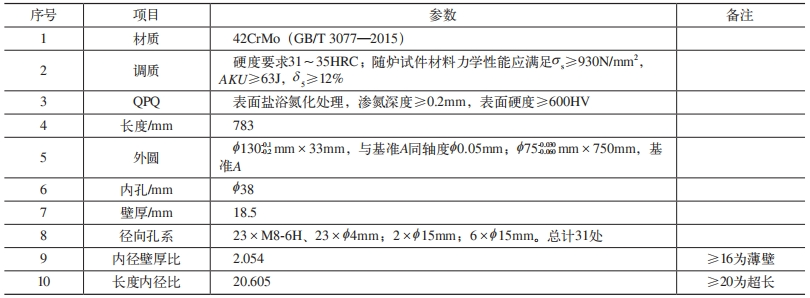
The structure of a typical radially porous QPQ (anti-corrosion nitrided) ultra-long deep hole system pipe body is shown in Figure 1. The parameters of the pipe body are shown in Table 1. It can be seen that the typical ultra-long and deep QPQ pipe body The pipe body of radial hole porous system is a weakly rigid structure, easy to deform during heat treatment.[1,2]. This paper takes the pipe body of typical QPQ ultra-long deep hole radial porous system as the research object to study its processing technology.
a) Axonometric drawing

b) Sectional view
Figure 1 Three-dimensional structure of a typical QPQ ultra-long deep hole radial porous system pipe body
Table 1 Typical pipe body parameters of QPQ ultra-long deep hole radial porous system
2
Process design
General machining[3-7]and heat treatment[8-10]Based on technology, the pipe body processing process of radially porous ultra-long hole QPQ system is initially designed as follows: outer circle rough turning → ultrasonic flaw detection → quenching and tempering treatment → correction shape → drilling the inner hole → fine turning of the inner and outer shapes → milling and reaming the radial of each hole → Magnetic particle inspection → Outer circle grinding → Chamfering → QPQ processing. It can be seen from the structural characteristics of the pipe body of the typical QPQ ultra-long deep hole radial porous system that the process plan has the following shortcomings.
1) The structural rigidity of the pipe body is insufficient, and it will deform after mechanical processing and heat treatment, affecting the accuracy of the size and shape of the part.
2) After the pipe body is processed by QPQ, the structural size will increase indefinitely and cannot be cut accurately, which will affect the final control of the part size and the matching accuracy of the matching kinematic pair.
3) After the pipe body is processed by QPQ, if the accuracy of the size or shape of the part exceeds the tolerance, it can only be accepted or scrapped without an effective repair way. When the above problems are coupled and superimposed, they lead to interference in product assembly and stagnation of movement, thereby becoming a technical bottleneck.
3
Process optimization
Considering the shortcomings of the process plan, composite processing measures such as steady-state structural processing of the ultra-long deep-hole radially porous system body, processing stress control and growth law determination of QPQ workpiece size were adopted to realize the processing of radially porous ultra-long deep hole QPQ system body. The purpose of stable and high precision processing. Based on the above technical analysis ideas, the final flow of the design process[3-5]For: outer circle rough turning → ultrasonic flaw detection → inner hole drilling → inner and outer shapes rough turning → quenching and tempering treatment → correction → axial deep hole reaming → high temperature quenching → shapes fine turning internal and external → milling and reaming of radial holes → aging → chamfering → axial hole thread turning → radial hole making → grinding of outer circle → magnetic particle inspection of outer circle → demagnetization → coloring or fluorescence inspection of inner hole → QPQ treatment → polishing.
(1) Stable structure processing ① Before semi-finishing, roughly machine the inner and outer circles of the semi-finished pipe, leaving a margin of 4-5mm/radius. Subject to sufficient semi-finishing and finishing tolerances, the tube body can form a shape structure close to the thread, and most of the cutting stress can be eliminated by chips. ②Before semi-finishing, leave a margin of 4-5mm/radius; before finishing, leave a margin of 0.2-0.3 mm/radius; after finishing, leave a margin of 0.010-0.015mm/radius. The deformation caused by residual stresses is enveloped and eliminated thanks to tolerances at all levels of the tolerance chain.
(2) Processing stress control adopts composite heat treatment measures such as quenching and tempering treatment after rough machining, high temperature tempering treatment before semi-finishing, aging treatment before finishing, etc., to maximize the release of various constraints at each stage of processing. through thermal fields at all levels, and achieve the workpiece is deformed to the maximum extent, laying the foundation for a stable stress field for processing stability.
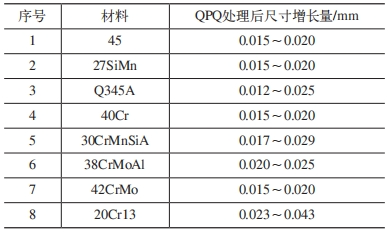
(3) The part size growth rule QPQ is determined. Samples of different materials are selected to study the dimensional changes of the samples before and after QPQ treatment after different nitriding temperatures and times (see Table 2), so as to leave a margin for the part before QPQ treatment. Provide advice and reference.
(4) Precautions ① Quenching and tempering, high temperature tempering, aging and QPQ treatment. Pieces should be hung vertically. ②Polishing. Remove only the oxide layer. If polishing leads to physical reduction, it is necessary to consider leaving a polishing allowance before QPQ treatment.
Table 2 Dimensional changes of commonly used materials before and after QPQ treatment
4
Implementation effect
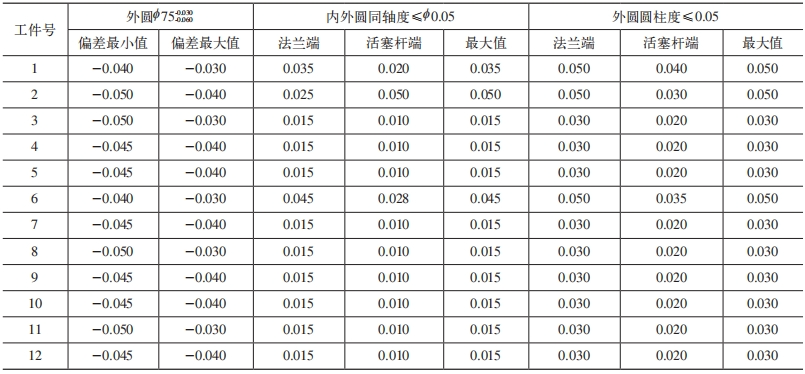
A typical finished product of an ultra-long deep hole radial porosity low rigidity pipe body is shown in Figure 2. The outer circle detection data after QPQ treatment is shown in Table 3. All data are qualified .
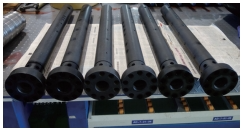
a) General appearance
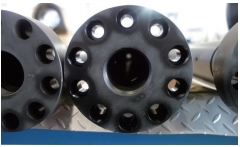
b) Flange end surface morphology
Figure 2 Typical ultra-long deep hole system, radially porous, low stiffness finished pipe body
Table 3 Detection data of outer circle of pipe body after QPQ treatment (unit: mm)
5
Analysis and discussion
5.1 Technical analysis
(1) The machining stability control process adopts the method of forming a near-thread shape structure before semi-finishing to eliminate most of the machining constraints; the method of leaving a reasonable margin warp is used to wrap and eliminate any heat treatment due to; the release of the remaining machining constraints. Deformation caused by internal stresses and strains of all materials. Through the above comprehensive measurements, a stable structure foundation is laid for the final forming of the workpiece, and the stable structure processing of the tube body of the ultra-long deep hole radial porous system is realized.
(2) The machining stress control process uses multiple, multiple, step-by-step composite heat treatment methods to maximize the release of machining stresses, heat treatment stresses and internal material stresses before finishing the workpiece, thereby laying the foundation of the thermal field for maximum workpiece deformation, enabling stress control in processing ultra-long deep-hole radially porous pipe bodies.
(3) Determination of dimensional changes before and after QPQ treatment of commonly used materials. Deformation of parts after QPQ is generally caused by two factors: shape and size. The deformation of parts with different structural shapes after QPQ is different. Through experiments, the dimensional changes of commonly used materials before and after QPQ processing were determined, which provided data support for the retention of processing allowances and the determination of the chain of processing allowances of processing bodies. QPQ ultra-long deep hole radial porous system pipelines.
5.2 Discussion and summary of process rules
1) In the process of controlling the stability of machining, methods such as forming a near-thread shape structure and maintaining a reasonable margin chain before semi-finishing can effectively release the stress internal material, machining and heat treatment, prevent significant deformation of the structure, and stabilize the structural parts before semi-finishing, it is an effective preparation method.
2) In the process of processing stress control, multiple, multiple and step-by-step composite heat treatment methods can maximally release various stresses of structural parts through heat treatment and prevent the structure from deforming more than slightly before the state of equilibrium. finishing of structural parts, An effective preparation and processing measure.
3) Determining the dimensional changes of commonly used materials before and after QPQ processing, based on providing deformation data of structural parts before and after QPQ processing, can further provide technical guidance for the processing of fine shaping of structural parts after QPQ. treatment.
6
Conclusion
This paper studies the processing technology of QPQ ultra-long deep hole radially porous pipe body, analyzes the shortcomings of general mechanical processing and heat treatment technology, and adopts composite processing measures after process optimization to solve the problem of pipe body deformation and achieve stability. and high-precision processing, and achieved the following results: through the process of machining stability control, the construction of a string of steady-state structural machining allowances for the pipe body has was carried out, which solved the problem of eliminating deformation of the pipe body; In the machining stress control process, a thermal field system for maximum deformation of the pipe body was realized. Built to solve the problem of deformation release in pipe body processing. Two process innovations can provide some guidance and references for processing such structural parts.
Daguang focuses on providing solutions such as precision CNC machining services (3-axis, 4-axis, 5-axis machining), CNC milling, 3D printing and rapid prototyping services.



















