
How to Choose an OEM Metal 3D Printing Manufacturer
This guide is for engineers and sourcing managers who need production metal parts, not a demo print. It covers the checks that decide whether an OEM metal 3D printing manufacturer can hold your tolerances, certify your alloy and ship on schedule.
In this article
- 1
- 2
- 3
- 4
- 5
- 6
- 7
- 8
- 9
What matters most
What to compare before you send a PO
Score each row against your own part, not against the marketing page.
| Criterion | Weak answer | Strong answer | Why it matters |
|---|---|---|---|
| Tolerance | One blanket ± number | Per-feature table, as-built vs machined | Overhangs distort more than bores |
| Alloy control | Generic Ti-6Al-4V claim | Powder lot, mill cert, reuse policy | Fatigue life depends on chemistry |
| Inspection | Final visual check only | In-process plus final reports | Catch drift before the last op |
| DFAM support | Upload and wait | Written orientation and support plan | Orientation sets distortion and cost |
| Post-processing | Outsourced, no schedule | In-house or fixed partners | Handoffs add days and risk |
| Lead time | Quote-only lead time | Build, heat treat and machine windows | Heat treat is often the bottleneck |
| Confidentiality | No NDA offered | NDA before files move | CAD files carry your IP |
| Batch repeatability | First article only | Coupons from each build | Batch two must match batch one |
Pick the supplier whose plan names the risks
If a quote lists orientation, powder lot, heat treat order and inspection scope, you are dealing with a production partner. If it lists only a price and a date, keep looking.
Tolerance claims vs what the machine actually holds
Every OEM metal 3D printing manufacturer will quote a tolerance. The useful question is which features that number applies to. On a laser powder bed part, the as-built condition is typically looser than a machined condition because thermal gradients pull thin walls and tall sections out of position during the build. A 2 mm wall on a 150 mm tall bracket moves differently from a 20 mm boss on the same plate.
So split the drawing. Mark features that must stay as-built, and mark features you will machine after the build. For as-built surfaces, expect the supplier to give a range rather than a single figure, and expect it to get wider as the part gets taller. For machined interfaces, the numbers are much tighter because the geometry is no longer thermal.
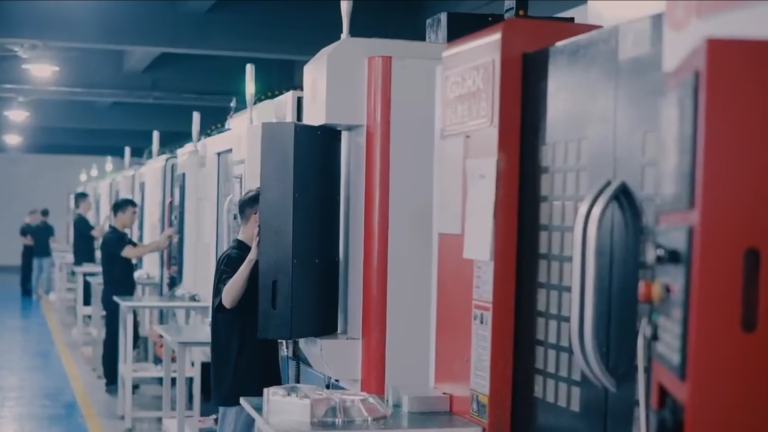
A shop that machines its own printed parts has an advantage here. At GreatLight, printed blanks move to 5-axis centers where critical bores, sealing faces and bearing seats can be brought to ±0.005 mm on the same site. That removes the tolerance argument between a printer and a machine shop, because it is one process plan.
If a supplier refuses to separate as-built from post-machined tolerances, treat that as a knowledge gap, not a negotiation tactic.
- 1As-builtBest for non-critical surfaces, flow paths and lightweight ribs.
- 2Post-machinedRequired for bores, threads, sealing faces and datum features.
- 3Hybrid buildsPrint near-net, then cut to final size on a 5-axis center.
Powder, traceability and mechanical properties
Metal powder is a consumable with a history. Particle size distribution shifts as powder is reused, and oxygen pickup changes tensile and fatigue behavior. Ask how many reuse cycles the supplier allows, how they sieve and blend, and whether they can provide a mill certificate for the melt along with the powder lot number.
For regulated work, this is not paperwork for its own sake. A medical device file or an automotive PPAP needs to link the finished part back to a known input. If the powder lot cannot be named, the chain is broken before the build starts.
Mechanical testing should come from coupons built with the part, not from a generic datasheet. Tensile, hardness and density data from the same build plate tells you what you actually received. Where fatigue or fracture-critical behavior matters, hot isostatic pressing and stress relief belong in the plan, not in a footnote.
GreatLight Metal runs controlled powder inventory and inspection under our ISO 9001:2015 system, with raw material checks, in-process monitoring and final inspection before shipment.
Design for additive manufacturing support
DFAM is where a good supplier earns their margin. Orientation decides build time, support volume, residual stress direction and the quality of downward-facing surfaces. Rotating a part 30° can remove an entire support forest and cut post-processing hours.
Ask for a written plan: build orientation, support strategy, expected distortion zones, and which faces will be machined after heat treat. A supplier who only sends a price and a lead time is asking you to absorb the risk.
Useful DFAM changes are often simple. Thicken a wall from 1.2 mm to 2 mm so it survives handling. Add a machining allowance on a sealing face. Replace a sharp internal corner with a radius so the recoater does not catch it. Move a channel so supports can be removed with a tool instead of by hand.
GreatLight provides quotation and free DFM analysis within 12 hours, so the feedback arrives while the design is still open.
- 1OrientationSets distortion direction and support volume.
- 2AllowancesLeave 0.3–0.5 mm on faces that will be machined.
- 3ChannelsKeep them drainable, or powder stays trapped inside.
Post-processing, surface finish and the hidden cost line
Support removal is manual work. So is blending, tumbling, bead blasting and polishing. On parts with internal channels or lattice regions, this is where quotes quietly diverge. Two shops can print the same file and deliver parts that differ by hours of hand work.
Surface finish also has a scale problem. As-built surfaces on metal powder bed parts are rough compared with machined surfaces. If your application needs Ra 0.8–1.6 μm on a sealing face, plan for machining, not for polishing. GreatLight reaches Ra 0.2–0.8 μm on finished surfaces where the geometry allows it.
Heat treatment is the other hidden line. Stress relief and HIP add days and change dimensions slightly, so any tight feature must be cut after heat treat, not before. Ask the supplier to state the order of operations in the quote.
Anodizing, plating, powder coating and laser marking are all available downstream. Laser marking minimum character height is 1.5 mm, so keep part numbers legible.
Repeatability across batches and volume ramp
A first article proves the design can be made once. It does not prove the process is stable. Batch two is where drift appears: a new powder blend, a different operator, a recoater blade near end of life.
Ask how the supplier controls that. Coupons from each build, dimensional reports on the same features every time, and a documented powder reuse limit are the usual answers. If the shop cannot describe its own control plan, assume none exists.
Volume ramp matters too. Printing 10 parts and printing 500 parts are different production systems. Fixture design, build nesting and machine scheduling all change. For a supplier with no minimum order quantity, the same process can carry a single prototype and a 10,000+ part run, but the plan should say how.
Historical late-delivery probability below 2% is a number worth asking about, because it forces the supplier to describe how they track it.
Certifications, data security and IP
Certifications tell you which management systems are already audited. ISO 9001:2015 covers general quality. IATF 16949:2016 is the automotive baseline. ISO 13485:2016 applies to medical devices. ISO 27001:2022 covers information security, which matters when your CAD files leave your network.
Ask which certificate applies to the site that will build your part, not to the group. Manufacturing sites differ, and a certificate on a sales office does not audit the shop floor.
On IP, the practical question is who can open your files and where copies live. Uploads should be secure and confidential, with an NDA available before the first STEP file moves. For defense, medical and high-volume consumer programs, this is usually a hard gate.
GreatLight holds ISO 9001:2015, IATF 16949:2016, ISO 13485:2016 and ISO 27001:2022, and offers an NDA on request.
How to qualify a supplier in six steps
Run these in order. Each step filters out a class of supplier before you spend engineering time.
- 1Send the real drawing, not a simplified oneInclude GD&T, datum callouts and the surfaces that must be machined. A simplified model produces an optimistic quote that will not survive the first article.
- 2Request a per-feature tolerance tableSeparate as-built from post-machined features. Push back if a single blanket figure is offered for a tall or thin-walled part.
- 3Ask for the powder lot and melt sourceMatch the alloy to what you specified. Confirm the reuse policy, sieving method and oxygen control before you accept a build slot.
- 4Demand a DFAM note with the quoteOrientation, support strategy, machining allowance of 0.3–0.5 mm on critical faces, and the order of heat treat versus machining.
- 5Confirm inspection and reporting scopeRaw material check, in-process monitoring, final inspection, and coupons from the same build. Reports should be listed in the quote, not promised verbally.
- 6Lock the IP path before files moveSign the NDA, confirm who can access the files, and check whether the site that quotes is the site that builds.
Questions buyers ask us
Can an OEM metal 3D printing manufacturer replace CNC machining entirely?
No, and any supplier who says otherwise is overselling. Printing is strong for internal channels, lattice structures, consolidated assemblies and low-volume complex geometry.
Machining is still better for tight bores, flat sealing faces, threads and any feature with a hard dimensional requirement. The practical answer is a hybrid plan: print near-net, then machine the critical interfaces.
What tolerance should we expect on as-built surfaces?
It depends on geometry, material and build height. Thin walls and tall sections move more than compact blocks, and the supplier should give you a range for your specific part.
If a feature is dimensionally critical, plan to machine it after heat treat and expect ±0.005 mm on that interface from a 5-axis center.
Is there a minimum order quantity for printed metal parts?
At GreatLight there is no minimum order quantity. The same process carries a single prototype and runs above 10,000 parts.
What changes with volume is the planning: nesting, fixtures, powder logistics and inspection frequency all scale up.
How do you protect our CAD files?
Uploads are secure and confidential, and an NDA is available before files are transferred. Information security is managed under ISO 27001:2022.
If your program requires it, we can restrict access to a named engineering group and confirm the build site in writing.
Which materials can you supply for printed and machined parts?
Titanium grades TA1, TA2 and TC4 (Ti-6Al-4V), Inconel, stainless grades including 316L and 17-4PH, aluminium grades such as 6061 and 7075, and magnesium AZ31B and AZ91D.
Printed parts often move to machining or finishing on the same site, which keeps the process chain short.
What lead time is realistic for a first order?
Quotation and free DFM analysis come back within 12 hours, and production can start within 24 hours of approval.
Parts typically ship in 3–5 days once the plan is fixed. Heat treatment and post-processing are the usual variables, so confirm them in the quote rather than assuming.
Send your drawing and get a DFAM-backed quote
We review the geometry, flag the risks and quote the full chain from powder to finished surface.
12-hour quoteNo MOQ100% inspectionNDA on request
More from GreatLight
We publish setup notes, tooling trials and inspection data from the factory floor.











