
Normal CNC Machining Service: What to Check Before You Order
A normal CNC machining service is 3-axis milling and 2-axis turning on standard stock. This guide is for engineers and buyers comparing quotes. Read it and you will know which parts fit a standard shop and which ones do not.
In this article
- 1
- 2
- 3
- 4
- 5
- 6
- 7
- 8
Key takeaways
When a normal CNC machining service is enough, and when it is not
Match the part geometry to the machine axis count before you compare price.
| Part feature | Normal CNC (3-axis) | 4-axis / 5-axis | Buyer note |
|---|---|---|---|
| Flat plate with holes on one face | Good fit | Overkill | Lowest cost per part |
| Pocket with straight walls | Good fit | Not needed | Watch depth-to-diameter ratio |
| Through holes on two opposite faces | Two setups | One setup | Adds cost and stack-up error |
| Undercuts and side holes | Not possible | Required | Angle heads are a workaround only |
| Curved surfaces and blended radii | Poor fit | Required | Ball-end step marks show at Ra 1.6 |
| Thin walls under 1 mm | Risky | Better | Vibration causes chatter |
| Tight position tolerance, ±0.01 mm | Possible | Easier | Fewer setups means less stack-up |
| One-off fixture or bracket | Good fit | Not needed | Ship in 3–5 days |
When to buy a normal CNC machining service
Buy it for prismatic parts with features on one or two faces, tolerance at ±0.005 mm or looser, and finish at Ra 0.8 μm or rougher. Move to 4-axis or 5-axis when the part has undercuts, blended surfaces or features on four or more sides. The axis count decides the shape. The process control decides the tolerance.
What a normal CNC machining service actually covers
A normal CNC machining service is the baseline offer at most job shops: 3-axis milling and 2-axis turning. The workpiece sits on a table or in a chuck, and a cutter moves along X, Y and Z. A lathe spins the part and feeds a single-point tool in X and Z. That is the whole machine envelope in most cases.
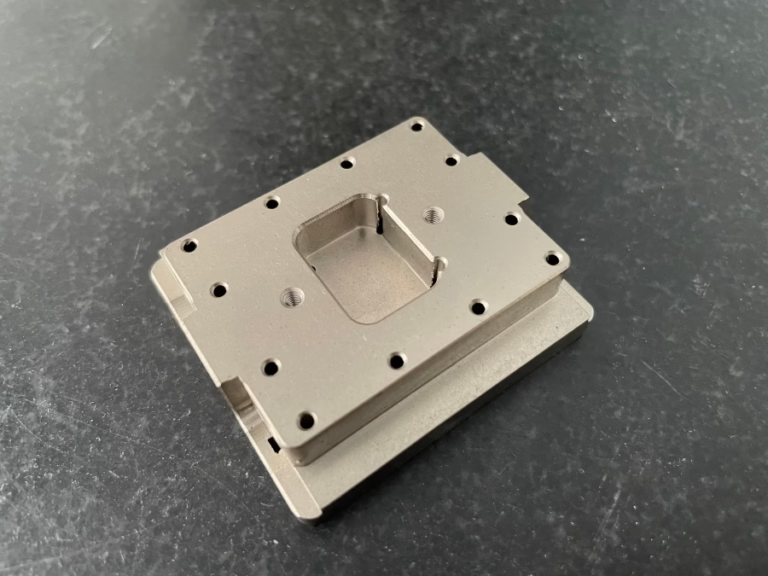
This setup handles prismatic parts. Blocks, plates, housings, shafts, bushings, flanges, spacers, brackets. If the part has features on one face or can be flipped once, a normal machine cuts it well. If the part is a turbine blade or a complex manifold with ports on five sides, it does not.
The word normal is not a quality grade. It describes the machine axis count and the number of setups, not the tolerance the shop can hold. A well-run 3-axis mill with ground tooling and a temperature-controlled room can hold ±0.005 mm. A poorly run 5-axis machine cannot. The axis count tells you what shapes are possible, not how accurate the shop is.
So when a buyer asks for a normal CNC machining service, the useful question is not whether the shop is good. It is whether your part geometry matches a 3-axis or 2-axis envelope, and whether the shop has the inspection and process control to hold the tolerance you put on the drawing.
- 13-axis millingOne spindle, three linear axes. Best for plates, pockets and drilled holes.
- 22-axis turningRound parts with diameters and faces. Fast for shafts and bushings.
- 3Multiple setupsEach extra face adds a fixture, a re-clamp and tolerance stack-up.
- 4Standard stockBar, plate and billet. No near-net forging or casting required.
How to judge a supplier for a normal CNC machining service
Start with the tolerance band on your drawing. If the tightest callout is ±0.05 mm, most shops can hit it. If it is ±0.005 mm, ask how they hold it. The answer should mention thermal control, tool wear offsets and in-process probing. A shop that says our machines are accurate is not answering the question.
Next, look at the finish callout. Ra 1.6–3.2 μm is as-machined and comes off the cutter. Ra 0.8–1.6 μm needs a finishing pass with light depth of cut and a sharp insert. Ra 0.2–0.8 μm usually means extra passes plus polishing, and the cost steps up sharply. Put the finish on the drawing only where the part needs it. A whole part at Ra 0.4 μm is rarely necessary.
Then check the setup count. Every time the part is unclamped and rotated, you add fixture error. A part that needs four faces machined on a 3-axis machine has four setups. On a 4-axis or 5-axis machine it may need one. Ask the shop how many setups they plan. If they cannot say, the quote is a guess.
Finally, match the certification to the industry. ISO 9001:2015 is the baseline. IATF 16949:2016 matters for automotive and EV parts. ISO 13485:2016 matters for medical devices. ISO 27001:2022 covers information security, which matters if you send CAD files under NDA. Do not pay for certifications your program does not need, and do not skip the ones your customer audits.
- 1ToleranceMatch the tightest callout to the shop's stated process control, not the machine spec sheet.
- 2FinishSpecify Ra only on functional surfaces. Cosmetic areas can run rougher.
- 3Setup countEach extra face adds cost and error. Ask for the plan before you approve.
- 4CertificationISO 9001 baseline; add IATF, ISO 13485 or ISO 27001 by industry.
Where the money goes on a standard machining quote
Machine hour rate is the number buyers compare first, and it is the least useful one on its own. A cheap hourly rate with four setups and a hand-polish step costs more than a higher rate with one setup and a clean finish off the cutter. Ask for the setup count and the operations list, not just the rate.
Material drives a large share of the price on small runs. Aluminium 6061 and 7075 cut fast. Stainless 316 and 17-4PH cut slowly and wear tooling. Titanium TC4 (Ti-6Al-4V) and Inconel cut very slowly and need rigid setups and low feed rates. The same geometry in 6061 and in Inconel can differ by a factor of three or more in cycle time.
Tolerance and finish are the next two levers. Going from ±0.05 mm to ±0.005 mm adds inspection time and may add a finishing pass. Going from Ra 3.2 to Ra 0.8 adds a separate light-cut pass. Both are real costs. Put them on the drawing only where the function requires them.
Quantity changes the picture. On one to ten parts, programming and fixturing dominate. On 1,000 parts, cycle time and material dominate. A normal CNC machining service with no minimum order quantity lets you buy one prototype and a 10,000-part run from the same process, so the first article and the production part come off the same machine.
- 1Setup countThe biggest hidden cost. Ask for the operations list.
- 2MaterialInconel and titanium can triple cycle time versus 6061.
- 3ToleranceTighter bands add inspection and finishing passes.
- 4QuantityLow volume pays for programming; high volume pays for cycle time.
Tolerance, finish and size limits to write into the RFQ
Put a tolerance band on the RFQ, not a single number. ±0.005 mm (±0.0002 in) is a practical floor for a well-controlled normal machining process on small features. On a 500 mm part, thermal expansion alone moves the dimension more than that over a 10 °C shop swing. If your callout is tighter than the part size supports, expect a conversation.
Finish should be split by surface. As-machined at Ra 1.6–3.2 μm is fine for brackets, covers and non-sealing faces. Ra 0.8–1.6 μm suits sealing faces and sliding contacts. Ra 0.2–0.8 μm suits bearing bores and optical mounts. Mark these on the drawing so the shop does not polish the whole part.
Size limits matter for the quote. Standard 3-axis machines at GreatLight cover travels of 500 × 500 × 450 mm, 500 × 310 × 200 mm, 600 × 600 × 600 mm and 750 × 1,150 × 550 mm. Larger work goes on a machine with 4,000 × 400 × 150 mm travel, up to 4,000 mm maximum processing size. If your part is over 1,150 mm, say so in the RFQ so the shop routes it correctly.
Add the material grade, the quantity, the finish, the tolerance and the certification requirement to the same document. That set of five items is what lets a shop return a real quote in 12 hours instead of a range.
- 1Tolerance±0.005 mm floor on small features; loosen as part size grows.
- 2FinishSplit by surface: Ra 3.2 cosmetic, Ra 1.6 sealing, Ra 0.4 bearing.
- 3SizeCompact travels start at 500 × 310 × 200 mm; large work up to 4,000 mm.
- 4RFQ setGrade, quantity, finish, tolerance, certification.
Common mistakes buyers make with a standard machining order
The first mistake is quoting a 3D model without a 2D drawing. The model shows nominal geometry. It does not show which faces are datums, which holes are press-fit, or which surface must seal. Without that, the shop guesses, and the guess shows up in the first article.
The second is putting a blanket tolerance in the title block. A ±0.01 mm general tolerance on every dimension makes the part expensive and hard to inspect. Call out tight tolerances only on the features that need them. Leave the rest at ±0.1 mm or looser.
The third is ignoring the setup plan. A part with features on four sides quoted on a 3-axis machine needs four fixtures. If the quote does not mention that, it is understated. Ask before you place the order.
The fourth is skipping the DFM review. A free DFM check catches deep pockets that need a long-reach cutter, thin floors that will chatter, and holes that break into a wall. Fixing it on the drawing costs nothing. Fixing it after the first article costs a week.
- 1Model onlyNo datums, no fit intent. Send a 2D drawing or a PDF with callouts.
- 2Blanket toleranceTight title-block tolerance inflates cost across the whole part.
- 3Missing setup planMulti-face parts cost more than the hourly rate suggests.
- 4No DFM checkCatch chatter and tool-reach problems before cutting metal.
Step by step: from RFQ to first article
A normal CNC machining service runs on this sequence. Skip a step and the schedule slips.
- 1Send the model, drawing and quantityInclude STEP or IGES plus a 2D PDF with datums, fits and finish callouts. State quantity from one to 10,000+. Add the material grade.
- 2Get the DFM review and quoteExpect a quotation and free DFM analysis within 12 hours. Read the DFM notes before you read the price. They flag thin walls, deep pockets and unreachable features.
- 3Confirm tolerance and finish by surfaceAgree the tightest callout in mm, the Ra value per face, and the inspection report format. Do not leave finish as general notes.
- 4Approve the setup and fixturing planAsk how many setups and which faces. A four-face part on 3-axis means four clamps. Confirm the datum scheme.
- 5Release to productionProduction can start within 24 hours of PO and material release. Standard parts ship in 3–5 days.
- 6Inspect the first articleCheck the critical dimensions against the drawing. Request the inspection report. Approve before the run continues.
- 7Approve finish and markingAnodizing, plating, powder coat or bead blast. Laser marking has a minimum character height of 1.5 mm.
- 8Release the balance and ship100% inspection before shipment. Raw material check, in-process monitoring and final inspection are standard.
Questions buyers ask before ordering
Is a normal CNC machining service accurate enough for tight-tolerance parts?
Yes, up to a point. A controlled 3-axis process can hold ±0.005 mm (±0.0002 in) on small features with ground tooling, thermal control and in-process probing.
The limit is part size. On a 500 mm part, a 10 °C shop swing moves the dimension more than the tolerance. If your callout is tighter than the part size supports, the shop will flag it.
What is the minimum order quantity?
There is no minimum order quantity at GreatLight. You can order one prototype or a 10,000+ part run.
The same process runs both, so the first article and the production parts come off the same machine and the same fixture family.
Which materials can a standard shop machine?
Aluminium 6061, 6061-T6, 2024, 5052, 5083, 6063, 6082, 7075 and ADC12. Stainless 303, 304, 316, 316L, 420, 430, 431, 440C and 17-4PH.
Steel 1018, 1045, 4130, 4140, 4340 and A36. Copper C101, C103, C110 and beryllium copper. Titanium TA1, TA2, TC4, plus Inconel and magnesium AZ31B / AZ91D. Plastics include ABS, PC, POM, PEEK and carbon fibre.
How fast can parts ship?
Quotation and free DFM analysis come back within 12 hours. Production can start within 24 hours after release.
Standard parts ship in 3–5 days. Historical late-delivery probability is below 2%. Complex multi-setup parts take longer, and the shop will tell you at quote stage.
What certifications should I check for my industry?
ISO 9001:2015 is the baseline for any supplier. IATF 16949:2016 applies to automotive and EV programs. ISO 13485:2016 applies to medical devices.
ISO 27001:2022 covers information security, which matters when you send CAD files under NDA. GreatLight holds all four.
How do I keep my design confidential?
Uploads are secure and confidential. An NDA is available on request before you send files.
If your program needs document control beyond an NDA, say so in the RFQ and the shop will confirm the process in writing.
Send your drawing and get a real number
Upload a STEP file and a 2D drawing. We return a quotation and a free DFM analysis within 12 hours. No minimum order quantity, from one prototype to a 10,000+ part run.
12-hour quoteFree DFM analysisNo MOQ100% inspection
More from the shop floor
We publish setup notes, tooling trials and inspection data from the factory floor.











