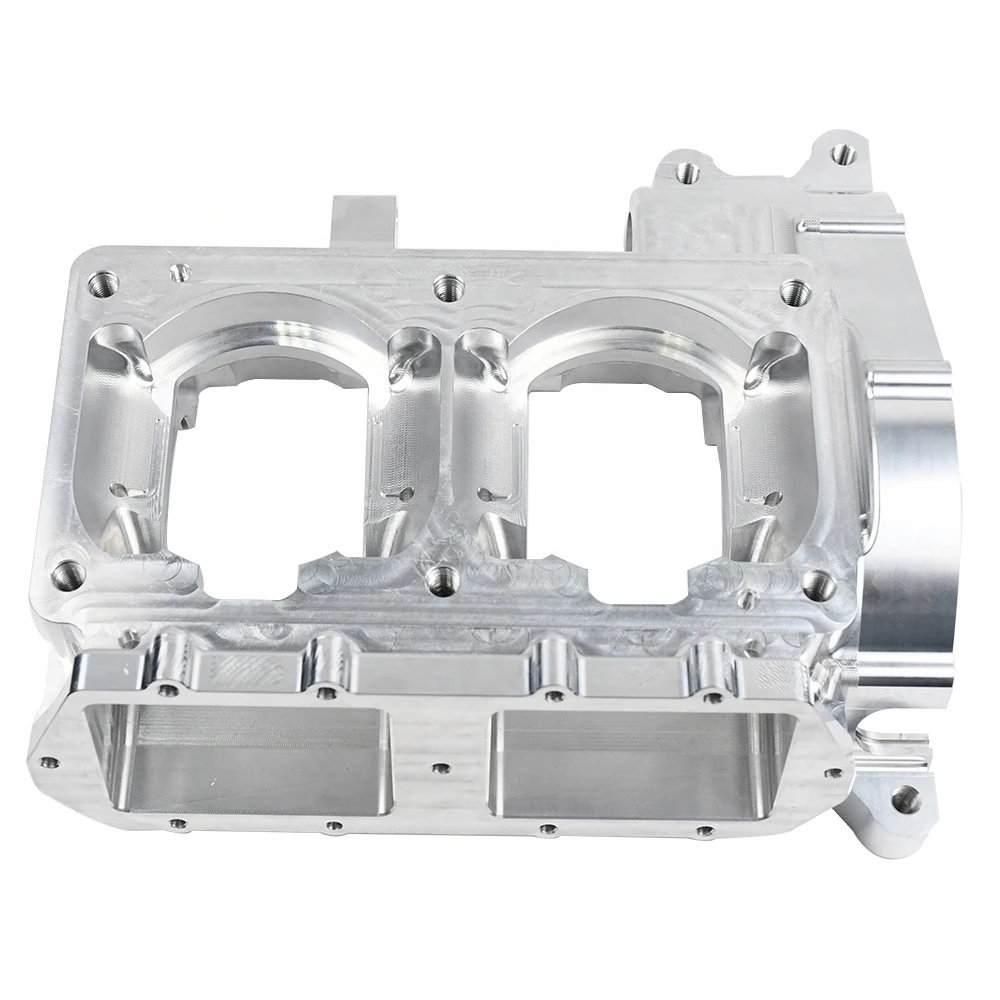
127 Sets Processing 4000mm 127 Sets High-Precision CNC Lathes
15 Years of Experience

CNC Knowledge: I understand all the complex machining drawings this time

1. Method for sizing current structures Common hole sizing methods (blind holes, threaded holes, countersunk holes, countersunk hole sizing methods for chamfers); ❖ Blind hole ❖ Threaded hole ❖ Counterbore ❖ Countersunk hole ❖ Chamfer 2. Mechanical processing structure on parts ❖ Undercut groove and wheel overhang groove When cutting workpieces, in order to facilitate […]

cnc knowledge: i understand all the complex machining drawings this

1. Method for sizing current structures

Common hole sizing methods (blind holes, threaded holes, countersunk holes, countersunk hole sizing methods for chamfers);

❖ Blind hole

❖ Threaded hole

Image WeChat_20240102094356.png

❖ Counterbore

Photo WeChat_20240102094359.jpg

❖ Countersunk hole

Image WeChat_20240102094402.png

❖ Chamfer

Image WeChat_20240102094405.png

2. Mechanical processing structure on parts

❖ Undercut groove and wheel overhang groove

When cutting workpieces, in order to facilitate tool removal and ensure that the mating surfaces of related workpieces are narrow during assembly, an undercut groove or grinding wheel overtravel groove should be pre-treated at the surface to be treated. .

The size of the undercut when turning the outer circle can generally be marked as “groove width ×; diameter” or “groove width × groove depth”. The protruding groove of the grinding wheel when grinding the outer circle or grinding the outer circle and end face.

Image WeChat_20240102094408.png

❖ Drilling structure

The blind hole drilled with a drill bit has a taper angle of 120° at the bottom. Drilling depth refers to the depth of the cylindrical part, excluding the conical pit. At the step borehole transition, there is also a 120° angle cone, its drawing method and sizing method.

When drilling with a drill bit, the axis of the drill bit should be as perpendicular as possible to the end face to be drilled to ensure accurate drilling and avoid breakage of the drill bit. Correct construction of three drill end faces.

Image WeChat_20240102094411.png

❖ Bosses and dimples

Contact surfaces between parts and other parts generally need to be treated. To reduce the processing area and ensure good contact between part surfaces, bosses and recesses are often designed on castings. Bolted bearing surface bosses or bearing surface pits in order to reduce the processing area, a groove structure is made.

Image WeChat_20240102094414.png

3. Structure of common areas

❖ Shaft Sleeve Parts

These parts usually include shafts, bushings and other parts. When expressing views, as long as a basic view is drawn and the appropriate cross sections and dimensions are drawn, its main shape features and local structure can be expressed. To make it easier to view the drawing during processing, the axis is usually placed horizontally for projection. It is best to choose a position where the axis is a side vertical line.

When marking the dimensions of bushing parts, its axis is often used as a radial dimension reference. From there are taken φ14, φ11 (see section AA), etc. shown in the figure. This unifies the design requirements and process reference during processing (when shaft parts are processed on a lathe, use lugs on both ends to push against the center hole of the shaft). The large end face, mating surface (shoulder), or machined surface are often used as a lengthwise reference.

Photo WeChat_20240102094417.jpg

As shown in the figure, the straight shoulder with a surface roughness of Ra6.3 is selected as the main dimensional reference in the length direction, and sizes such as 13, 28, 1.5 and 26.5 are in it. pulled, then the right end of the axis; is used as an auxiliary base length direction, thus marking the total length of shaft 96.

❖ Disk cover parts

The basic shape of this type of parts is a flat disk, usually including end covers, valve covers, gears and other parts. Their main structure usually has a rotating body, usually with flanges of various shapes and uniformly distributed round holes and local structures. like the ribs. When selecting views, generally choose a section view through the plane of symmetry or axis of rotation as the primary view. At the same time, you need to add other suitable views (such as left view, right view or top view) to express the shape. and a uniform structure of the room. As shown in the figure, a left view is added to express the square flange with rounded corners and four evenly distributed through-holes.

Photo WeChat_20240102094420.jpg

When marking the dimensions of the disc cover parts, the axis passing through the shaft hole is generally selected as the radial dimension data, and the important end face is often selected as the main dimension data in the direction of length.

❖ Fork parts

These parts usually include shift forks, connecting rods, brackets and other parts. Due to their variable processing positions, the working position and shape characteristics are mainly taken into account when selecting the main view. The selection of other views often requires two or more basic views, and partial views, section views and other suitable expression methods are also used to express the local structure of the part. The view selection expression diagram shown in the foot seat parts diagram is concise and clear. To express the width of the bearing and rib, the right view is not necessary, but for the T-shaped rib, it is more appropriate to use a cross. -section.

Image WeChat_20240102094424.png

When marking the dimensions of fork-type parts, the surface of the mounting base or the plane of symmetry of the part is generally used as the dimensional data. See figure for sizing methods.

❖ Box Parts

Generally speaking, the shape and structure of this type of parts are more complex than the previous three types of parts, and the processing positions change more. These parts generally include valve bodies, pump bodies, reducer housings and other parts. When choosing a main view, the main considerations are working location and form characteristics. When selecting other views, appropriate auxiliary views such as sections, sections, partial views and oblique views should be used according to the actual situation to clearly express the internal and external structure of the part.

Photo WeChat_20240102094426.jpg

In terms of sizing, the axis required by the design, the large mounting surface, the contact surface (or processing surface), the symmetry surface (width, length) of certain main structures of the case, etc. are generally used as dimensions. reference. For those parts of the box that require cutting processing, the dimensions should be marked as much as possible to facilitate processing and inspection.

4. Surface roughness

❖ Concept of surface roughness

Microscopic geometric shape features composed of closely spaced peaks and valleys on the surface of the part are called surface roughness. This is mainly due to the tool marks left on the workpiece surface during workpiece processing and the plastic deformation of the surface metal during cutting and splitting.

The surface roughness of parts is also a technical indicator to evaluate the surface quality of parts. It has an impact on fitting properties, working precision, wear resistance, corrosion resistance, sealing, appearance, etc.

❖ Surface roughness codes, symbols and markings

GB/T 131-1993 specifies the surface roughness code and its rating method. Symbols indicating the surface roughness of parts in the drawing are shown in the table below.

Photo WeChat_20240102094429.jpg

❖ Main parameters for evaluating surface roughness

The parameters for evaluating the surface roughness of the part are:

1) Arithmetic mean deviation of the contour (Ra)

Arithmetic mean of the absolute value of the contour offset in the sampling length. The value of Ra and the sampling length l are shown in the table.

Photo WeChat_20240102094432.jpg

2) Maximum profile height (Rz)

In the sample length, the distance between the upper line of the contour peak and the lower line of the contour peak.

Image WeChat_20240102094435.png

Note: The Ra setting is preferred when using.

❖ Labeling requirements for surface roughness

1) Example of coded labeling for surface roughness

When the surface roughness height parameters Ra, Rz and Ry are marked with numerical values ​​in the code, except that the parameter code Ra may be omitted, the corresponding parameter code Rz or Ry shall be marked before the value of the setting. table for labeling examples.

Photo WeChat_20240102094438.jpg

2) Marking surface roughness. Surface roughness numbers and symbols.

Photo WeChat_20240102094441.jpg

❖ How to mark surface roughness symbols on drawings

1) The surface roughness code (symbol) should generally be marked on visible contour lines, dimension lines or their extension lines. The tip of the symbol should point from the outside of the material toward the surface.

2) The direction of numbers and symbols in the surface texture code shall be marked according to regulations.

Photo WeChat_20240102094444.jpg

Surface Roughness Labeling Example

On the same drawing, each surface is generally marked with a single generation (symbol) and as close as possible to the dimension line concerned. When the space is small or it is inconvenient to mark, you can draw the mark. When all surfaces in a part have the same surface roughness requirements, they can be marked uniformly in the upper right corner of the drawing. When most surfaces in the part have the same surface roughness requirements, the most commonly used code (symbol) may be. At the same time, write it down in the upper right corner of the drawing and add the word “rest”. The height of all uniformly marked surface roughness symbols (symbols) and explanatory text should be 1.4 times higher than that of the drawing markings.

Image WeChat_20240102094447.png

The surface roughness code (symbol) of the continuous surface of the part, the surface of repeated elements (such as holes, teeth, grooves, etc.) and the discontinuous surface connected by thin solid lines is not noted only once.

Image WeChat_20240102094450.png

When there are different surface roughness requirements on the same surface, a thin continuous line should be used to draw the dividing line, and the corresponding surface roughness code and size should be noted.

Image WeChat_20240102094453.png

When the tooth shape (tooth) is not drawn on the working surface of gears, threads, etc., the surface roughness code (symbol) is displayed in the figure.

Image WeChat_20240102094456.png

Surface roughness codes for center hole working surface, keyway working surface, chamfers and fillets can simplify labeling.

Image WeChat_20240102094458.png

When parts are to be partially heat treated or partially plated (coated), the range should be drawn with thick dotted lines and the corresponding dimensions should be marked on the horizontal line on the long side of the surface roughness. symbol.

5. Standard tolerances and fundamental deviations

In order to facilitate production, realize the interchangeability of parts and meet different usage requirements, the national standard “Limits and adjustments” stipulates that the tolerance zone consists of two elements: standard tolerance and deviation basic. The standard tolerance determines the size of the tolerance box, while the base deviation determines the location of the tolerance box.

1) Standard Tolerance (IT)

The standard tolerance value is determined by the base size and tolerance class. The tolerance level is a mark that determines the accuracy of dimensions. The standard tolerance is divided into 20 levels, namely IT01, IT0, IT1,…, IT18. Dimensional accuracy decreases from IT01 to IT18. For specific values ​​of standard tolerances, see the relevant standards.

Photo WeChat_20240102094502.jpg

2) Baseline Gap

Baseline deviation refers to the upper or lower deviation of the tolerance zone from the zero line within the standard limits and coordination, generally referring to the deviation close to the zero line. When the tolerance zone is above the zero line, the base deviation is a lower deviation, otherwise it is an upper deviation. There are a total of 28 fundamental deviations and the codes are expressed in Latin letters, with uppercase letters for holes and lowercase letters for trees.

This can be seen from the base gap series diagram: the hole base gap A~H and the shaft base gap k~zc are the hole base gap K~ZC and the base gap of the hole; the tree a~h are the upper gap, JS. The tolerance zones de and js are distributed symmetrically on both sides of the zero line. The upper and lower gaps of the hole and the shaft are +IT/2 and -IT/2 respectively. The basic deviation series chart only shows the position of the tolerance zone, not the size of the tolerance. Therefore, one end of the tolerance zone is an opening and the other end of the opening is defined by the standard tolerance.

Image WeChat_20240102094504.png

The basic deviation and the standard tolerance, according to the definition of the dimensional tolerance, have the following calculation formula: ES=EI+IT or EI=ES-IT ei=es-IT or es=ei+IT The code of tolerance zone of the hole. and the tree uses the base gap code. It consists of the tolerance zone quality code.

6. Cooperation

The relationship between the tolerance zones of holes and shafts having the same basic dimensions and combined with each other is called fit. Depending on the usage requirements, the fit between the hole and the shaft can be loose or tight, so the national standard stipulates the fit type.

1) Clearance fit: When the hole and shaft are assembled, there is a fit (including the minimum clearance equal to zero). The tolerance zone of the hole is above the tolerance zone of the shaft.

2) Transition fit: When the hole and shaft are assembled, there may be a gap or interference fit. The tolerance zone of the hole overlaps the tolerance zone of the shaft.

3) Fit with interference: There is interference (including the minimum interference equal to zero) when the hole and the shaft are assembled. The tolerance zone of the hole is less than the tolerance zone of the shaft.

Photo WeChat_20240102094507.jpg

❖ In the reference system, when manufacturing matching parts, one of the parts is used as the reference part and its base deviation is certain. The system that achieves different types of adjustments with different properties by changing the base deviation of another non-standard part. This part is called the reference system. Depending on actual production needs, national standards provide for two reference systems.

1) Basic hole system: This is a system in which the tolerance area of ​​a hole with a certain basic deviation and the tolerance area of ​​a shaft with different basic deviations form various fits. See photo below left. The hole consisting of the base hole is called the reference hole, its base deviation code is H, and its lower deviation is zero.

Photo WeChat_20240102094510.jpg

2) Basis shaft system: This is a system in which the tolerance area of ​​a shaft with a certain base deviation and the tolerance area of ​​a hole with different base deviations form various fits . See the image below on the right. The axis of the base axis system is called the reference axis, its base deviation code is h, and the upper deviation is zero.

Photo WeChat_20240102094510.jpg

❖ Cooperation code

The fit code consists of the hole and shaft tolerance zone codes and is written as a fraction. The numerator is the tolerance zone code of the hole and the denominator is the tolerance zone code of the shaft. Any combination containing H in the numerator is a basic hole system, and any combination containing h in the denominator is a basic axis system.

For example 1: φ25H7/g6 means the base size of the fit is φ25, the clearance fit of the base hole system, the tolerance area of ​​the reference hole is H7 (the base gap is H , the tolerance level is level 7 ), and the tolerance zone of the shaft is g6 (the basic deviation is g, the tolerance level is level 6).

For example 2: φ25N7/h6 means the basic adjustment size is φ25, the transition adjustment of the basic axis, the tolerance zone of the reference axis is h6 (the basic deviation is h, the tolerance level is level 6), and the tolerance area of ​​the hole is N7 (the basic deviation is N, the tolerance level is level 7).

❖ Marking of tolerances and adjustments on plans

1) Mark tolerances and fits on the assembly drawing, using the combined marking method.

2) There are three forms of marking methods on part drawings.

Photo WeChat_20240102094515.jpg

7. Geometric tolerance

After the parts are processed, there are not only dimensional errors, but also errors in geometric shape and mutual position. Even if the cylinder is of suitable size, it may be large at one end and small at the other end, or thin in the middle and thick at both ends, etc., and its cross section may not be round, which is a problem. form error. For stepped shafts, each shaft segment may have different axes after processing, which constitutes a position error. Therefore, shape tolerance refers to the allowable variation of the actual shape from the ideal shape. Position tolerance refers to the allowable variation of the actual position from the ideal position. Both are called geometric tolerances.

Image WeChat_20240102094518.png

Geometric tolerance chips

Image WeChat_20240102094523.png

❖ Shape and position tolerance codes

The national standard GB/T 1182-1996 stipulates the use of codes to mark shape and position tolerances. In actual production, when the geometric tolerance cannot be marked by a code, it is permitted to use a textual description in the technical requirements.

Geometric tolerance codes include: symbols for each geometric tolerance element, geometric tolerance frames and guidelines, geometric tolerance values ​​and other associated symbols, and reference codes, etc. The height h of the font in the frame is the same as the size number in the design.

Image WeChat_20240102094526.png

❖ Example of geometric tolerance marking

For a valve stem, text added near the geometric tolerance marked in the figure is repeated for the purpose of explanation to the reader only and need not be repeated in the drawing itself.

Photo WeChat_20240102094529.jpg

Daguang focuses on providing solutions such as precision CNC machining services (3-axis, 4-axis, 5-axis machining), CNC milling, 3D printing and rapid prototyping services.

CNC Experts

Picture of JinShui Chen

JinShui Chen

Rapid Prototyping & Rapid Manufacturing Expert

Specialize in CNC machining, 3D printing, urethane casting, rapid tooling, injection molding, metal casting, sheet metal and extrusion

CNC Recent Posts

CNC News

Welcome to GreatLight Metal,Maximum Processing Size 4,000 mm

Precision Machining CNC Quote Online

Loading file

Upload Click here to upload or drag and drop your model to the canvas.

The model is too large and has been resized to fit in the printer's build tray. [Hide]

The model is too large to fit in the printer's build tray. [Hide]

The model is too large, a fitting printer is selected. [Hide]

The model is too small and has been upscaled. [Hide]

Warning: The selected printer can not print in full color [Hide]

Warning: obj models with multiple meshes are not yet supported [Hide]

Warning: Unsupported DXF entity  [Hide]

Warning: could not arrange models [Hide]

[Hide]


File Unit:      
Scale:
%
L × W × H:
X: × Y: × Z:  cm 
Rotation:
X: ° Y: °  
⚡ Instant Quote for Precision Manufacturing

Submit your design files (STEP/IGES/DWG) and receive a competitive quote within 1 hour, backed by ISO 9001-certified quality assurance.

📋 How It Works

  1. Upload & SpecifyShare your 3D model and select materials (Aluminum/Stainless Steel/Titanium/PEEK), tolerances (±0.002mm), and surface treatments.

  2. AI-Powered AnalysisOur system calculates optimal machining strategy and cost based on 10+ years of automotive/aerospace data.

  3. Review & ConfirmGet a detailed breakdown including:
    - Volume pricing tiers (1-10,000+ units)
    - Lead time (3-7 days standard)
    - DFM feedback for cost optimization

Unit Price: 

Loading price
5 Axis CNC Machining Equipment
4 Axis CNC Machining Equipment
3 Axis CNC Machining Equipment
CNC Milling & Turning Equipment
Prototype and Short-Run Injection Moldings Exact plastic material as final design
Volume Metal Die Casting Services - Precision Cast Parts
Bridge the Gap From Prototype to Production – Global delivery in 10 days or less
Custom high-precision sheet metal prototypes and parts, as fast as 5 days.
Custom Online 3D Printing Services
Design Best Processing Method According To 3D Drawings
Alloys Aluminum 6061, 6061-T6 Aluminum 2024 Aluminum 5052 Aluminum 5083 Aluminum 6063 Aluminum 6082 Aluminum 7075, 7075-T6 Aluminum ADC12 (A380)
Alloys Brass C27400 Brass C28000 Brass C36000
Alloys Stainless Steel SUS201 Stainless Steel SUS303 Stainless Steel SUS 304 Stainless Steel SUS316 Stainless Steel SUS316L Stainless Steel SUS420 Stainless Steel SUS430 Stainless Steel SUS431 Stainless Steel SUS440C Stainless Steel SUS630/17-4PH Stainless Steel AISI 304
Inconel718
Carbon Fiber
Tool Steel
Mold Steel
Alloys Titanium Alloy TA1 Titanium Alloy TA2 Titanium Alloy TC4/Ti-6Al 4V
Alloys Steel 1018, 1020, 1025, 1045, 1215, 4130, 4140, 4340, 5140, A36 Die steel Alloy steel Chisel tool steel Spring steel High speed steel Cold rolled steel Bearing steel SPCC
Alloys Copper C101(T2) Copper C103(T1) Copper C103(TU2) Copper C110(TU0) Beryllium Copper
Alloys Magnesium Alloy AZ31B Magnesium Alloy AZ91D
Low Carbon Steel
Alloys Magnesium Alloy AZ31B Magnesium Alloy AZ91D
ABS Beige(Natural) ABS Black ABS Black Antistatic ABS Milky White ABS+PC Black ABS+PC White
PC Black PC Transparent PC White PC Yellowish White PC+GF30 Black
PMMA Black PMMA Transparent PMMA White
PA(Nylon) Blue PA6 (Nylon)+GF15 Black PA6 (Nylon)+GF30 Black PA66 (Nylon) Beige(Natural) PA66 (Nylon) Black
PE Black PE White
PEEK Beige(Natural) PEEK Black
PP Black PP White PP+GF30 Black
HDPE Black HDPE White
HIPS Board White
LDPE White
This is a finish of applying powdered paint to the components and then baking it in an oven, which results in a stronger, more wear- and corrosion-resistant layer that is more durable than traditional painting methods.
No coating required, product’s natural color!
This is a finish of applying powdered paint to the components and then baking it in an oven, which results in a stronger, more wear- and corrosion-resistant layer that is more durable than traditional painting methods.
This finishing option with the shortest turnaround time. Parts have visible tool marks and potentially sharp edges and burrs, which can be removed upon request.
Sand blasting uses pressurized sand or other media to clean and texture the surface, creating a uniform, matte finish.
Polishing is the process of creating a smooth and shiny surface by rubbing it or by applying a chemical treatmen
A brushed finish creates a unidirectional satin texture, reducing the visibility of marks and scratches on the surface.
Anodizing increases corrosion resistance and wear properties, while allowing for color dyeing, ideal for aluminum parts.
Black oxide is a conversion coating that is used on steels to improve corrosion resistance and minimize light reflection.
Electroplating bonds a thin metal layer onto parts, improving wear resistance, corrosion resistance, and surface conductivity.
This is a finish of applying powdered paint to the components and then baking it in an oven, which results in a stronger, more wear- and corrosion-resistant layer that is more durable than traditional painting methods.
Please provide additional text description for other surface treatment requirements!
Material
Material
  • CNC Metals
    • Aluminum
    • Brass
    • Stainless steel
    • Inconel718
    • Carbon Fiber
    • Tool Steel
    • Mold Steel
    • Titanium
    • Alloy Steel
    • Copper
    • Bronze
    • Low Carbon Steel
    • Magnesium
  • CNC Plastics
    • ABS
    • PC
    • PMMA (Acrylic)
    • PA (Nylon)
    • PE
    • PEEK
    • PP
    • HDPE
    • HIPS
    • LDPE
Printer
Printer
  • CNC Metals
    • 5 Axis CNC Machining
    • 4 Axis CNC Machining
    • 3 Axis CNC Machining
    • CNC Milling & Turning
    • Rapid Tooling
    • Metal Die Casting
    • Vacuum Casting
    • Sheet Metal Fabrication
    • SLA 3D Printing
    • SLS 3D Printing
    • SLM 3D Printing
  • Rapid Prototyping
    • Design Best Processing Method According To 3D Drawings
Post-processing
Post-processing
  • As Machined(Product’s natural color)
  • Sand Blasting
  • Polishing
  • Brushed Finish
  • Anodizing
  • Black Oxide
  • Electroplating
  • Paint Coating
  • Powder Coating
  • Other surface treatment requirements
Finalize
The world's first CNC machining center that dares to provide free samples!

Free for first product valued at less than $200. (Background check required)

precision machining cnc quote online

15 Years CNC Machining Services

When you’re ready to start your next project, simply upload your 3D CAD design files, and our engineers will get back to you with a quote as soon as possible.
Scroll to Top

ISO 9001 Certificate

ISO 9001 is defined as the internationally recognized standard for Quality Management Systems (QMS). It is by far the most mature quality framework in the world. More than 1 million certificates were issued to organizations in 178 countries. ISO 9001 sets standards not only for the quality management system, but also for the overall management system. It helps organizations achieve success by improving customer satisfaction, employee motivation, and continuous improvement. * The ISO certificate is issued in the name of FS.com LIMITED and applied to all the products sold on FS website.

greatlight metal iso 9001 certification successfully renewed
GB T 19001-2016 IS09001-2015
✅ iso 9001:2015
greatlight metal iso 9001 certification successfully renewed zh

IATF 16949 certificate

IATF 16949 is an internationally recognized Quality Management System (QMS) standard specifically for the automotive industry and engine hardware parts production quality management system certification. It is based on ISO 9001 and adds specific requirements related to the production and service of automotive and engine hardware parts. Its goal is to improve quality, streamline processes, and reduce variation and waste in the automotive and engine hardware parts supply chain.

automotive industry quality management system certification 01
Certification of Production Quality Management System for Engine Hardware Parts Engine Hardware Associated Parts
automotive industry quality management system certification 00
发动机五金零配件的生产质量管理体系认证

ISO 27001 certificate

ISO/IEC 27001 is an international standard for managing and processing information security. This standard is jointly developed by the International Organization for Standardization (ISO) and the International Electrotechnical Commission (IEC). It sets out requirements for establishing, implementing, maintaining, and continually improving an information security management system (ISMS). Ensuring the confidentiality, integrity, and availability of organizational information assets, obtaining an ISO 27001 certificate means that the enterprise has passed the audit conducted by a certification body, proving that its information security management system has met the requirements of the international standard.

greatlight metal technology co., ltd has obtained multiple certifications (1)
greatlight metal technology co., ltd has obtained multiple certifications (2)

ISO 13485 certificate

ISO 13485 is an internationally recognized standard for Quality Management Systems (QMS) specifically tailored for the medical device industry. It outlines the requirements for organizations involved in the design, development, production, installation, and servicing of medical devices, ensuring they consistently meet regulatory requirements and customer needs. Essentially, it's a framework for medical device companies to build and maintain robust QMS processes, ultimately enhancing patient safety and device quality.

greatlight metal technology co., ltd has obtained multiple certifications (3)
greatlight metal technology co., ltd has obtained multiple certifications (4)

Get The Best Price

Send drawings and detailed requirements via Email:[email protected]
Or Fill Out The Contact Form Below:

All uploads are secure and confidential.