
Build CNC Machine 2: From Frame Design to First Test Cut
A second-generation build is different from a first attempt. You already know the machine moves, so the goal now is stiffness, repeatability and clean cutting. To build CNC machine 2 properly you need a build order, real parameter ranges and a list of mistakes that quietly cost accuracy.
Key takeaways
What changes when you build CNC machine 2
A first build usually proves the concept: the axes move, the spindle spins, the controller reads G-code. A second machine is about removing the errors you learned to live with. That means a stiffer frame, better bearings and a motion system sized from measured cutting forces rather than guesswork.
Start by writing down the target. Aluminum at 3 mm depth of cut needs a different machine than balsa at 0.5 mm. A router cutting plywood at 6,000 mm/min has little in common with a mill cutting 6061. Decide the hardest material and the smallest feature you must hold before ordering a single part.
Then measure what your first machine actually achieved. Put a dial indicator on the spindle nose, push the gantry by hand and watch the needle. If it moves 0.05 mm with light hand pressure, the cutting tool will deflect far more. That number tells you where the rebuild has to focus.
Budget follows the target. Precision linear rails, ground ballscrews and a matched spindle usually cost more than the electronics. Spend there first. Motors and drivers are easier to upgrade later, but a flexible frame is a permanent limit.
Frame and motion sizing for the second build
For a benchtop machine up to about 600 mm of travel, welded steel or thick epoxy-granite plate works well. Aluminum extrusion is quick to assemble but deflects under load. If you keep extrusion, use the largest profile available and add diagonal bracing in both planes.
Rail selection follows cutting force. For light routing, 15 mm profile rails are usually enough. For steel or stainless work on a small mill, 20 mm or 25 mm rails hold preload better and resist moment loads. Two rails per axis, four blocks per rail, spaced as widely as the geometry allows.
Ballscrews are the default choice for positioning. A C7 rolled screw is fine for wood and plastic, while C5 ground screws give the repeatability needed for metal. Match the screw pitch to the motor: a 5 mm pitch gives more force, a 10 mm pitch gives more speed at the same RPM.
Check the numbers before buying. A 1,000 mm gantry with a 4 kg spindle and 6 kg of rails typically needs around 3 N·m of holding torque per motor at a 5 mm pitch to accelerate at 1,000 mm/s². If your calculation lands above 6 N·m, reduce moving mass instead of buying a bigger motor.
- 1Measure deflection firstPush the gantry with a dial indicator on the spindle nose. Record the number before designing changes.
- 2Widen the block spacingMore distance between bearing blocks reduces rocking under side load far more than thicker plate.
Spindle, motors and the drive train
Spindle choice sets the surface finish and the tool sizes you can run. A 1.5 kW to 2.2 kW air-cooled spindle with an ER20 collet covers most benchtop work. Water-cooled units run quieter and hold speed better over long cuts, which matters if you run 4,000 mm programs.
Runout matters more than headline power. Check with a dial indicator on a test bar: 0.01 mm of runout at the collet shows up as chatter and poor finish. Replace the collet nut or the spindle if it exceeds that.
Stepper motors with closed-loop drivers handle most hobby and light-production builds. They are simple, cheap and hold position well. Servos cost more but give higher torque at speed and fault feedback, which helps on machines that run unattended.
Couple the motor to the screw with a flexible jaw coupling or a belt reduction. Direct rigid coupling transmits every misalignment into the screw bearing. A 2:1 belt reduction doubles resolution and torque at the cost of top speed. Pick based on whether you cut aluminum or foam.
Wiring, control and tuning
Keep the control cabinet separate from the spindle and drivers where possible. Route motor cables away from limit switch and encoder wiring, and use shielded cable with the shield grounded at one end only. Most intermittent faults on a home-built machine trace back to noise on signal lines.
Set steps per mm by calculation first, then verify by commanding a 100 mm move and measuring with a dial indicator or calipers. Adjust the value until the error is under 0.02 mm over the full travel. Repeat for every axis, including the rotary if you have one.
Tune acceleration conservatively. Start at 10 percent of the motor's rated acceleration and raise it in steps of 10 percent while cutting a test pocket. If you hear a knock on direction changes, back off. Lost steps usually appear as a gradual position shift, not an alarm.
Add homing and soft limits before the first real part. Run the machine to each limit switch at low speed and confirm the trigger point repeats within 0.01 mm. Soft limits prevent crashes that bend screws and break tools.
Step by step: how to build CNC machine 2
- 1Measure the old machineMount a dial indicator on the spindle nose. Push the gantry with about 50 N of hand force and record deflection on X, Y and Z. Write down the worst number. That is your baseline.
- 2Lock the target specificationWrite the hardest material, the smallest feature and the required tolerance. Typical benchtop metal work needs ±0.05 mm; precision work needs ±0.01 mm or better. The number drives every later choice.
- 3Build a stiff frameWeld or bolt a steel or epoxy-granite base with cross bracing in both planes. Let welded frames stress-relieve before final machining of the mounting faces.
- 4Install rails and screwsMount rails on machined pads, not shims. Align to 0.02 mm over the full travel with a dial indicator on a carriage block. Preload ballscrew nuts to remove axial play.
- 5Mount the spindle and check runoutSquare the spindle to the table within 0.02 mm over 200 mm. Measure runout on a test bar; keep it under 0.01 mm at the collet.
- 6Wire the cabinetSeparate high-voltage and signal cables. Shield limit and encoder lines, ground at one end. Label every wire before closing the cabinet.
- 7Tune and verifyCalibrate steps per mm, measure backlash, raise acceleration until chatter appears, then back off 20 percent. Home the machine and check repeatability at 0.01 mm.
- 8Cut a test partMachine a circle-diamond-square test in scrap. Measure the circle for roundness, the square for squareness and the pocket for size. Fix the largest error before production.
Build options at a glance
Pick the row that matches your target material and budget.
| Option | Best for | Accuracy you can expect | Main trade-off |
|---|---|---|---|
| Aluminum extrusion frame | Wood, plastic, light foam | ±0.1 to ±0.3 mm | Fast to assemble, flexes under load |
| Welded steel frame | Aluminum, brass, mild steel | ±0.02 to ±0.05 mm | Heavy, needs stress relief |
| Epoxy granite base | Small precision mills | ±0.01 to ±0.02 mm | Casting time, limited size |
| Stepper motors | Hobby and light production | Holds steps within torque curve | Loses position if overloaded |
| Closed-loop servos | Unattended metal cutting | Fault feedback, high speed torque | Higher cost and setup |
| C7 rolled ballscrew | Wood and plastic routing | ±0.05 mm over 300 mm | Lead error grows with length |
| C5 ground ballscrew | Metal milling | ±0.01 mm over 300 mm | Higher price, careful mounting |
Stiffness first, electronics later
If your deflection test shows more than 0.03 mm under hand pressure, fix the frame before touching the controller. A rigid structure with modest motors beats a flexible one with expensive drives every time.
Questions readers ask about a second build
How much does it cost to build CNC machine 2?
Cost depends almost entirely on the frame and motion hardware. Rails, ballscrews and a matched spindle usually take the largest share of the budget.
Spend on stiffness before electronics. Motors and drivers are the easiest parts to upgrade later, so a frame that is already rigid keeps its value across two or three rebuilds.
Can I reuse parts from my first machine?
Reuse the controller, drivers, power supply and spindle if they still meet the target. Reuse rails and screws only after measuring wear and backlash.
A ballscrew with more than 0.05 mm of axial play will limit the new machine no matter how good the frame is. Measure before you bolt it back on.
What tolerance can a well-built benchtop machine hold?
A rigid steel frame with C5 screws, 20 mm rails and a dialed-in spindle can hold around ±0.02 mm on aluminum under light cuts.
Expect ±0.05 mm for general work and ±0.1 mm on larger travel machines where thermal growth and screw lead error start to show.
Do I need a 5-axis machine for a second build?
No. Most second builds should stay 3-axis and get the basics right. Add a rotary table as a fourth axis when you need to cut multiple faces in one setup.
Full 5-axis adds cost, calibration work and collision risk. Move there only when the part geometry actually demands it.
Why does my machine lose position on long programs?
Lost steps from over-aggressive acceleration are the usual cause. Lower acceleration by 20 percent and re-test.
Check for binding rails and loose couplings as well. A coupling that slips under load shifts position gradually and looks like a controller fault.
When should I buy machined parts instead of making them?
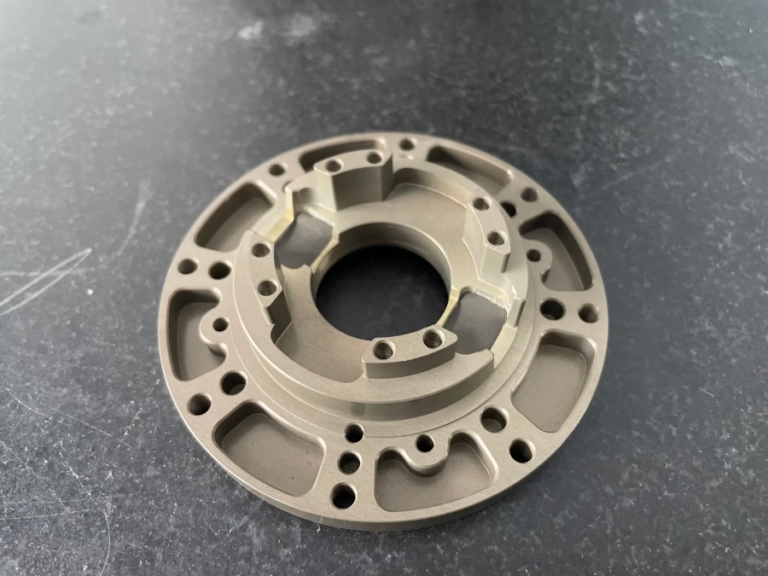
Buy brackets, spindle mounts and bearing housings if you cannot machine them square within 0.02 mm on your own machine.
Outsourced machining is also the faster route for one-off precision parts, especially when you need tolerances tighter than ±0.01 mm.
Need precision parts for your build?
Send your spindle mounts, bearing housings and brackets. We machine them to ±0.005 mm and ship in 3–5 days, from one prototype to 10,000+ parts.
12-hour quote100% inspectionNo minimum order
More build and machining notes
We publish setup notes, tooling trials and inspection data from the factory floor.











