
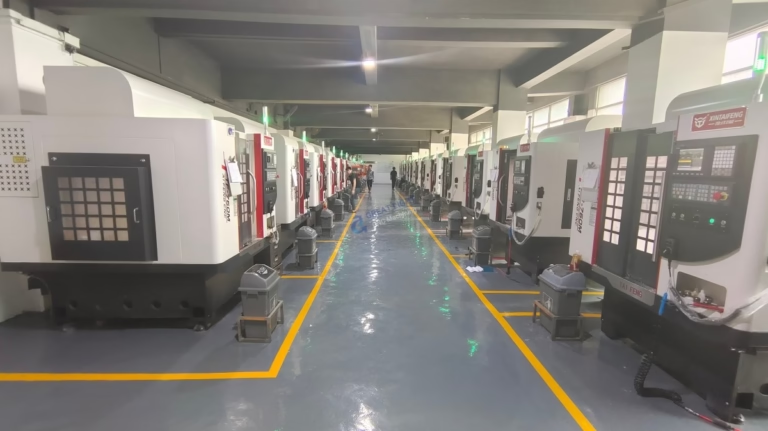
The question of how much a CNC machine costs is deceptively simple, yet the answer is nuanced and multi-layered. Whether you are a startup engineering firm budgeting for capital equipment or a procurement manager evaluating the cost structure of outsourced machining, understanding the financial landscape of CNC technology is crucial. The cost isn’t a single number; it’s a spectrum defined by capability, precision, and long-term value. From purchasing a machine for in-house use to engaging a professional service provider, the investment logic differs significantly.
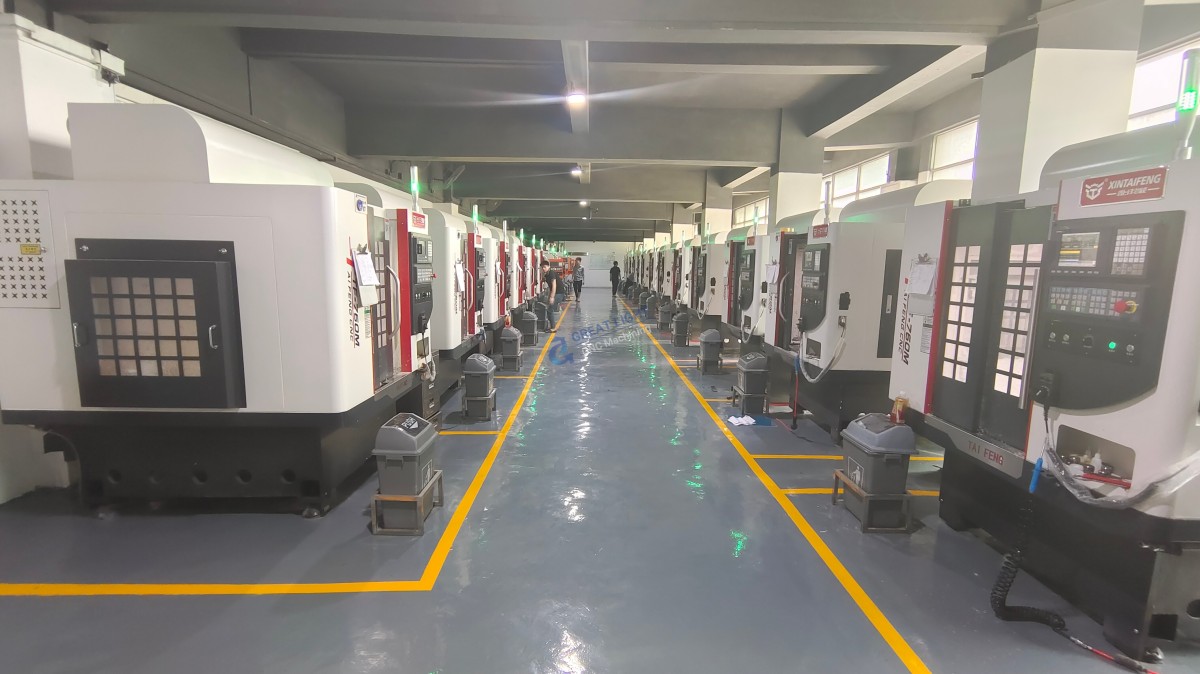
This article will dissect the costs associated with CNC machining from two primary perspectives: the capital expenditure (CAPEX) of buying and operating your own CNC equipment, and the operational expenditure (OPEX) of partnering with a specialized manufacturer like GreatLight Metal. We will explore the factors that drive pricing, provide realistic cost ranges, and offer guidance on making the most cost-effective decision for your business.
H2: Breaking Down the Cost of Owning a CNC Machine
For companies considering bringing machining capability in-house, the purchase price of the machine is merely the entry ticket. The total cost of ownership (TCO) encompasses a much broader range of expenses.
H3: 1. Machine Purchase Price: The Initial Investment
The price varies astronomically based on type, size, brand, and capabilities.
Entry-Level/Desktop 3-Axis Mills: Suitable for prototyping and very light production in softer materials like plastics and aluminum. Prices can range from \$5,000 to \$50,000.
Industrial 3-Axis CNC Machining Centers: The workhorses of job shops, capable of handling steel, titanium, and complex geometries. Expect to invest \$80,000 to \$250,000+.
5-Axis CNC Machining Centers: The pinnacle for complex, monolithic part manufacturing, essential for aerospace, medical, and automotive components. These machines start around \$200,000 and can easily exceed \$1,000,000 for large-format, high-precision models from top-tier manufacturers.
CNC Lathes (Turning Centers): Prices for standard 2-axis lathes start around \$50,000, while multi-axis mill-turn centers with live tooling and Y-axis capability can cost \$150,000 to \$500,000.
H3: 2. The Hidden and Recurring Costs of Ownership
This is where the true financial commitment becomes clear.
Installation & Foundation: Industrial machines require specific power (often 3-phase), compressed air, coolant systems, and a reinforced concrete foundation, costing thousands.
Tooling & Workholding: A basic tool library of end mills, drills, inserts, and collets can cost \$10,000-\$30,000. High-performance tooling for difficult materials costs much more. Vises, chucks, and custom fixtures add to this.
CAD/CAM Software: Professional-grade software licenses for programming complex parts can be a significant annual subscription fee or a large one-time purchase (\$5,000 to \$15,000+ per seat).
Skilled Labor: The largest recurring cost. A proficient CNC programmer/operator commands a substantial salary, benefits, and requires ongoing training.
Maintenance & Repairs: Annual maintenance contracts typically cost 5-10% of the machine’s purchase price. Unexpected breakdowns and part replacements can be extremely costly and cause production halts.
Floor Space & Utilities: Industrial machines consume significant electricity and generate heat, requiring climate control.
H4: Cost-Benefit Analysis: When Does In-House CNC Make Sense?
Owning a CNC machine is justified when:
You have extremely high, consistent production volumes of similar parts.
Your IP is so sensitive it cannot leave your facility.
You require immediate, 24/7 control over prototype iterations.
The long-term cost per part, amortized over years, is lower than outsourcing.
For most businesses, especially those with fluctuating demand, diverse part geometries, and a need for the latest technology without capital lock-in, outsourcing is the more agile and financially prudent path.
H2: Understanding the Cost of CNC Machining Services
When you outsource to a manufacturer like GreatLight Metal, you are not paying for machine time alone. You are investing in a complete solution that bundles equipment, expertise, quality assurance, and risk mitigation.
H3: The Primary Drivers of Machining Service Quotes
A professional manufacturer’s quote is calculated based on these core factors:
Part Design & Complexity: This is the most significant cost driver. A simple bracket is far less expensive than an intricate, thin-walled aerospace component with deep pockets and tight tolerances. Complex designs require advanced 5-axis CNC machining, more programming time, specialized tooling, and longer machining cycles.
Material Cost: The raw material blank (billet) price varies widely. Common aluminum alloys are relatively economical, while materials like titanium, Inconel, or specialty tool steels are exponentially more expensive. The manufacturer also factors in material waste (scrap) from the machining process.
Quantity & Volume: Unit cost decreases with quantity due to economies of scale. Setup time, programming, and first-article inspection are amortized over more parts. However, for true mass production (10,000+ units), processes like die casting or stamping may become more cost-effective than CNC machining.
Precision & Tolerances: Holding a tolerance of ±0.001mm is vastly more demanding than ±0.1mm. Tighter tolerances require slower machining speeds, more precise equipment, in-process measurement, and a higher level of operator skill, all increasing cost.
Post-Processing & Finishing: The “as-machined” part is rarely the final product. Costs add up for processes like:
Deburring & Edge-Breaking: Manual or automated.
Surface Finishes: Bead blasting, polishing, brushing.
Coatings & Treatments: Anodizing (Type II/III), powder coating, plating, heat treatment.
Special Processes: Laser engraving, assembly, quality inspection reports.
H3: Typical Cost Ranges for Machined Parts
It’s impossible to give a universal price, but here are illustrative examples:
Small, Simple Aluminum Prototype (e.g., a mounting plate, 100mm x 50mm x 10mm, ±0.1mm tolerance, as-machined finish): \$50 – \$200 per part (for 1-5 pieces).
Medium-Complexity Stainless Steel Component (e.g., a sensor housing with threads and pockets, ±0.05mm tolerance, bead blasted): \$200 – \$800 per part (for 1-10 pieces).
High-Complexity Titanium Aerospace Bracket (5-axis machining, thin walls, ±0.025mm tolerances, stress-relieved): \$1,000 – \$5,000+ per part (for low volumes).
H4: The Value Equation: Why Partnering with GreatLight Metal is Cost-Effective
Choosing a partner like GreatLight Metal transforms a CAPEX-heavy, risky investment into a predictable, scalable OPEX. The value extends beyond the price-per-part:
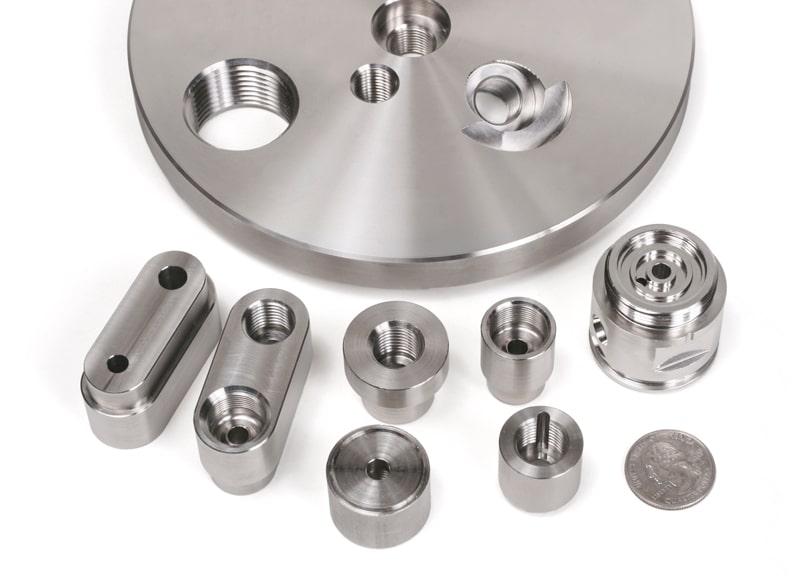
Zero Capital Investment: You access millions of dollars worth of advanced 5-axis CNC machining, EDM, and metrology equipment without buying them.
Absorbed Overhead & Expertise: Our ISO-certified systems, skilled engineers, and proven workflows are built into our service. You pay only for the output, not the infrastructure.
Supply Chain & Material Optimization: We have established relationships with material suppliers and can often source raw materials at better rates. Our engineers can also suggest Design for Manufacturability (DFM) adjustments that dramatically reduce cost without compromising function.
Risk Mitigation: We assume the risks of machine maintenance, operator training, and quality non-conformance. Our guarantees, like free rework for quality issues, provide financial peace of mind.
Speed & Agility: For projects requiring fast turnaround, our one-stop-shop model—from 3D printing prototypes to CNC machining final parts and applying finishes—saves weeks of coordination with multiple vendors, getting your product to market faster.
Conclusion
So, how much does a CNC machine cost? If buying, it’s a significant capital outlay followed by substantial ongoing operational costs, a commitment best suited for stable, high-volume production. For the vast majority of innovators, developers, and businesses, the smarter “cost” is that of a professional CNC machining service.
This service cost is an investment in precision, flexibility, and expertise. It allows you to leverage world-class capabilities, like those at GreatLight Metal, to turn your designs into reality with high efficiency and controlled budgets. By focusing on your core competencies and outsourcing complex manufacturing to specialists, you optimize your resources and accelerate innovation. The true cost of CNC machining, therefore, is not just a line item on a quote, but a strategic decision that impacts your product’s quality, timeline, and ultimate success in the market.
Frequently Asked Questions (FAQ)
H3: Q1: Can I get a free quote for my CNC machining project?
A: Reputable manufacturers like GreatLight Metal almost always provide free quotations. To get an accurate and fast quote, you should provide a 3D CAD file (STEP or IGES preferred), drawings with critical tolerances, material specification, desired quantity, and any post-processing requirements.
H3: Q2: What’s the minimum order quantity (MOQ) for CNC machined parts?
A: For true CNC machining services, the MOQ is often 1 piece, making it ideal for prototyping and low-volume production. There is no tooling cost as with injection molding, so you pay primarily for programming and machine time.
H3: Q3: Why is 5-axis machining sometimes more expensive than 3-axis?
A: While 5-axis CNC machining can be more efficient for complex parts by completing them in one setup, the machines themselves are far more expensive to purchase and maintain. The programming is also more complex and requires higher-level expertise, which is reflected in the cost. However, for suitable geometries, it can reduce total cost by eliminating multiple setups and fixtures.
H3: Q4: How can I reduce the cost of my CNC machined parts?
A: Engage in early DFM consultation with your manufacturer. Consider:
Relaxing non-critical tolerances.
Choosing a more readily available, machinable material.
Designing with standard tool sizes in mind (e.g., corner radii).
Consolidating multiple parts into one machined assembly.
Ordering in larger quantities to amortize setup costs.
H3: Q5: Does a higher price always guarantee better quality in CNC machining?
A: Not necessarily, but an abnormally low price is a major red flag. High quality is assured by a manufacturer’s systems—certifications like ISO 9001:2015, in-house precision measurement labs, and robust process controls. A fair price from a certified supplier like GreatLight Metal reflects investment in these quality assurance systems, ensuring you receive parts that meet spec reliably, saving you money on rejects and rework in the long run. For more insights into our industry engagement, you can connect with us on LinkedIn.



















