
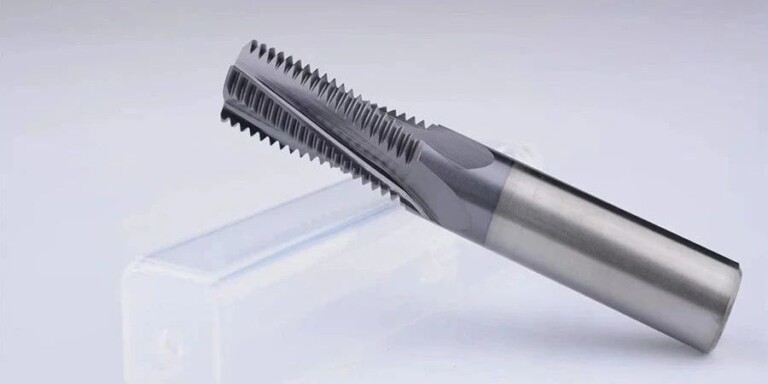
Revolutionizing Precision: 9 Game-Changing Advantages of Thread Milling in Modern Machining
Thread milling has emerged as a transformational alternative to traditional thread production methods like tapping and thread turning. This advanced technique employs rotating multi-edge milling cutters guided by precision CNC programming to create accurate internal or external threads across diverse materials and geometries. Let’s explore the multifaceted advantages that make thread milling the go-to choice for precision-driven industries.
1. Micron-Level Precision Through Digital Control
The marriage of advanced CNC systems with specialized thread milling cutters enables tolerances within ±0.005 mm – unattainable with conventional tapping. This digital orchestration controls the cutter’s helical interpolation path, accounting for variables like material spring-back and thermal expansion. The result? Perfect thread forms ideal for mission-critical applications in aerospace fasteners, medical implants, and precision instrumentation where thread geometry directly impacts performance and safety.
2. Unmatched Versatility Across Thread Standards
One tooling system masters countless thread configurations:
- International standards: Metric, UN, Whitworth, and ACME threads
- Specialized profiles: Buttress threads for heavy loads, trapezoidal threads for power transmission
- Geometry variations: Internal/external threads, tapered pipe threads, right/left-hand orientations
This flexibility eliminates the need for dedicated tooling inventories. Machinists simply adjust CNC parameters to instantly switch between thread specifications, dramatically reducing setup times and enabling mixed-production runs.
3. Material Agnostic Machining Performance
Thread milling conquers material challenges that devastate conventional tapping:
- Exotic alloys: Titanium, Inconel, and Hastelloy
- Hardened materials: 60+ HRC tool steels
- Problematic grades: Gummy austenitic stainless steels
- Non-ferrous: Aluminum, copper, and composites
The intermittent cutting action reduces heat buildup compared to continuous thread turning, while CNC-controlled chip evacuation prevents recutting—critical when machining superalloys in jet engine components or corrosion-resistant alloys in marine systems.
4. Zero Tap Breakage in High-Risk Applications

Unlike rigid taps that shatter under load, thread milling’s shear-based cutting distributes forces radially. This proves revolutionary when machining deep holes (L:D ratios > 3:1) and blinde holes chip evacuation challenge. The reduced axial force also enables stable threading of thin-walled components in satellite housings and precision manifolds where traditional methods risk catastrophic failure.
5. Delicate Part Preservation Through Low-Stress Machining
In applications involving thin-walled structures (≤1mm wall thickness) or thermoplastic components, thread milling’s favorable force distribution prevents:
- Micro-deformation affecting mating surfaces
- Thread distortion causing gasket seal failures
- Surface tear-out in composites
Radial force control permits direct threading of assembled components, as demonstrated in optical mounting systems where traditional methods would compromise alignment.
6. Cutting Tool Economics Redefined

Thread mills leverage multi-point engagement where wear distributes evenly across all cutting edges versus concentrated pressure points in taps. Combined with modern PVD coatings (TiAlN, AlCrN), tool life increases 300-500% compared to HSS taps. For large production runs in automotive manufacturing, this translates to fewer tool changes and reduced consumable costs. Moreover, indexable systems permit selective insert replacement—saving 60% over solid tool replacements.
7. Enhanced Machine-Tool Longevity
The unidirectional rotation in thread milling eliminates the violent stress reversal encountered in tapping cycles. Without:
- Sudden spindle deceleration/acceleration
- Torque spikes during reversal
- Impact loads at engagement
Machine spindles experience reduced bearing stress and minimized thermal cycling. Data from automotive production lines shows 40% longer spindle life in thread milling operations, creating significant long-term maintenance savings.
8. Optical-Grade Surface Finish
Thread milling produces Ra values of 0.4-0.8µm consistently—impossible with traditional tapping. Three contributing factors:
- Continuous shear formation: Rather than tear-out
- Constant chip clearance: Preventing re-cutting
- Optimized coolant delivery: Through-tool penetration
Hydraulic sealing surfaces and vacuum chamber components benefit from this improved finish, often eliminating secondary polishing operations.
9. Compressed Process Chain Efficiency

Modern thread milling systems complete entire thread cycles—including chamfers, full forms, runouts, and multi-start variants—in a single operation. For a stainless steel medical implant:
- Traditional process: Center drill → drill → chamfer → tap → deburr (5 steps)
- Thread milling: Drill → thread mill w/ integrated chamfer (2 steps)
This consolidation delivers 65% time savings while enabling on-the-fly thread modifications during prototyping without physical tool changes.
Thread milling represents the convergence of precision engineering and manufacturing efficiency. By eliminating the limitations of traditional thread cutting while delivering superior precision, unprecedented flexibility, and significant cost savings, it has become indispensable in advanced manufacturing. For engineers designing cutting-edge products—from artificial joints to spaceflight hardware—thread milling provides the technical foundation for innovation in thread-critical applications. As material science advances and tolerances tighten, this technology will continue redefining what’s possible in precision manufacturing.



















