
How Many Axis Does a CNC Machine Have?
Most CNC machines run on 3 axes. Adding a fourth or fifth axis changes what a single setup can reach, not just how fast metal comes off. This guide walks through axis counts, the parts that justify each one, and how to pick the right setup before you send a drawing out for quote.
Key takeaways
How to Read a CNC Machine Axis Count
The number of axes on a CNC machine is the number of directions the tool or the workpiece can move under program control at the same time. Three linear axes are the floor: X runs left to right, Y runs front to back, Z runs up and down. Almost every vertical machining center you see in a job shop covers those three.
When people ask how many axis does a cnc machine have, the honest answer is three to five for the vast majority of work. Three-axis machines make up the bulk of the installed base. Four- and five-axis machines cost more per hour but remove setups, and setups are where most dimensional error creeps in.
The label on the door matters less than what the axes do together. A machine can have five axes but only position three or four of them at once. That is called 3+2 or indexed machining: the rotary axes tilt to an angle, lock, and then the cut runs as a normal three-axis move. True simultaneous five-axis keeps all five moving through the same block of code.
This distinction decides whether a part can be cut at all. A deep, twisted blade passage needs simultaneous motion. A bracket with holes on five faces only needs the table to index between positions, and that is cheaper to program and cheaper to run.
- 13-axisFlat geometry, prismatic parts, plate work.
- 24-axisCylindrical parts with features around the outside.
- 35-axis indexedAngled faces and holes, cut from a locked position.
- 45-axis simultaneousSculpted surfaces and undercuts, all axes moving together.
What Each Axis Count Can and Cannot Machine
A three-axis mill cuts from one direction at a time. You flip the part, re-indicate it and cut again. For a plate with pockets and a bolt pattern, that is fine. Positional tolerance across two setups often lands around ±0.02 mm if the fixture is solid, and a good operator will hold ±0.01 mm on a single face. The catch is time and stack-up: every flip adds a datum transfer and a chance to be off.
A four-axis machine adds a rotary table, usually turning about X. The part spins to a new index position and the tool cuts. This suits manifolds, cam profiles, splined shafts and any part with radial holes or slots. You can hold ±0.005 mm on the rotary position with a good table, though runout at the chuck grows with part length. Long, thin parts will deflect before the axis accuracy matters.
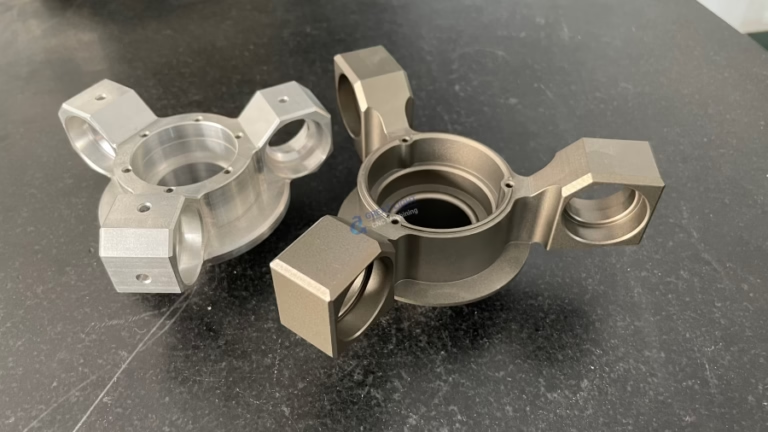
A five-axis machine adds a second rotary axis, either a trunnion that tilts the table or a head that tilts the spindle. Now the tool can approach a surface from an angle. That means short, stiff tools reach deep pockets, and surface finish on curved walls improves because the tool tip stays near its ideal cutting speed. Contoured molds, impellers, medical implants and aerospace brackets are the usual candidates.
Higher axis counts exist. Six-axis machines add a faster rotary or a wrist, and seven-axis mill-turn centers combine turning, milling and a second spindle. They are rare, expensive and usually reserved for one family of parts. For most drawings, five axes is where the practical ceiling sits.
- 1Choose 3 axesPrismatic parts, six-sided access is enough.
- 2Choose 4 axesRadial features on a rotational body.
- 3Choose 5 axesContoured surfaces, deep cavities, tight true position.
- 4Choose mill-turnTurned shaft plus milling in one cycle.
Which Axis Count Fits Your Part
Start with the geometry, not the machine list. Count how many distinct tool approach directions the part needs. If every feature faces one of six orthogonal sides, three axes plus good fixturing will do it. If features sit on an angle or follow a curve, you are already in five-axis territory.
Then check the tolerance callouts. A true position of Ø0.05 mm across features on three faces is hard to hold with three setups and easy with one five-axis setup. Conversely, a loose ±0.1 mm bracket does not benefit from a five-axis hourly rate. Match the process to the print, not the other way around.
Material and part size narrow it further. Aluminum cuts freely and forgives a light finishing pass. Stainless 17-4PH and titanium TC4 work-harden, so a five-axis setup that keeps the tool engaged and avoids re-cutting chips is worth the extra rate. Thin walls under 1 mm will move no matter how many axes you have, so plan supports and light finishing passes at Ra 0.8–1.6 μm.
Finally, ask about the setup count. Three setups on a three-axis machine means three chances for a datum error. One setup on a five-axis machine means one datum. For a part with tight inter-feature relationships, that alone often pays for the higher rate.
- 1Feature directionsCount distinct approach angles before anything else.
- 2Tolerance stack-upFewer setups means less accumulated error.
- 3Material behaviorHard alloys reward constant tool engagement.
- 4Wall thicknessBelow 1 mm, fixturing matters more than axis count.
How GreatLight Matches Machines to Axis Requirements
GreatLight runs 127 high-precision CNC machines across three wholly-owned plants, covering 7,600 m² with 150 technicians. The axis mix is deliberate: 27 three-axis machines, 12 four-axis mills, 16 simultaneous 5-axis machining centers and 16 mill-turn centers. That spread lets us put the part on the machine that actually fits it instead of forcing everything onto the largest available spindle.
Travel range matters as much as axis count. Our large five-axis platform reaches 4,000 × 400 × 150 mm, which covers long structural parts like EV battery tray rails and aerospace stringers. Medium platforms at 750 × 1,150 × 550 mm and 600 × 600 × 600 mm handle most enclosure and manifold work, while compact 500 × 500 × 450 mm and 500 × 310 × 200 mm machines take small, high-mix parts. The Ø400 mm rotary table covers four-axis work on cylindrical bodies.
Accuracy holds at ±0.005 mm (±0.0002 in) on qualified features. Finishes run from Ra 1.6–3.2 μm as machined down to Ra 0.2–0.8 μm when a fine finish is specified. Every part is inspected before shipment, with raw material checks, in-process monitoring and final inspection, and reports go out on request. Qualification rate sits at 99.99%.
We hold ISO 9001:2015, IATF 16949:2016, ISO 13485:2016 and ISO 27001:2022. Those matter when a buyer is deciding whether a five-axis shop can serve automotive, medical or aerospace programs. Uploads stay confidential and an NDA is available on request.
- 116 five-axis centersSimultaneous motion for contoured and undercut work.
- 216 mill-turn centersTurned parts with cross milling in one cycle.
- 34,000 mm travelLong structural parts fit without splicing.
- 4±0.005 mmQuoted tolerance on qualified features.
Step by Step: Specify the Right Axis Count
Use this order before you send a drawing out for quote.
- 1Map every feature directionList each face, hole and pocket with its normal vector. If they fall on six orthogonal directions, 3 axes is enough. Any angled face or swept curve pushes you toward 5.
- 2Count the setups a 3-axis route needsOne setup per approach direction, plus one for back-side work. Four or more setups is a signal to price a 4- or 5-axis route as well.
- 3Check the tightest tolerance calloutLook at true position and profile tolerances. Ø0.05 mm or tighter across multiple faces usually needs one setup, so budget for 5 axes.
- 4Look at depth-to-diameter ratioPockets deeper than 4× the tool diameter need a longer tool, which chatters. A tilting head lets a short tool reach the floor. That is a real five-axis argument.
- 5Screen the materialAluminum and brass behave on any machine. 17-4PH, Inconel and TC4 (Ti-6Al-4V) cut better with constant engagement, which favors simultaneous 5-axis toolpaths.
- 6Check the wall thicknessWalls under 1 mm deflect under cutting force. Plan light finishing passes and supports; no axis count fixes a flimsy part.
- 7Price both routesAsk for a 3-axis quote and a 5-axis quote on the same drawing. Compare total cost, not hourly rate. Two extra setups often cost more than the axis premium.
- 8Confirm the inspection planDecide which features get CMM reports. That tells the shop what to hold and helps catch datum errors before parts ship.
Axis Count Compared
Matching part type to machine class.
| Axis count | Typical parts | Setup count | Watch out for |
|---|---|---|---|
| 3-axis | Plates, brackets, housings | 2–4 | Datum stack-up across flips |
| 4-axis | Manifolds, shafts, cam profiles | 1–2 | Chuck runout on long parts |
| 5-axis indexed | Angled faces, multi-side holes | 1 | Clearance between tool holder and part |
| 5-axis simultaneous | Impellers, molds, implants | 1 | Programming time and verification |
| Mill-turn | Turned shafts with cross features | 1 | Tool interference near the chuck |
| 6–7 axis | Specialized families only | 1 | Few shops, long lead times |
The short verdict
If your features face six flat sides, 3 axes is the right call and the cheapest route. If they follow a curve or sit on an angle, price 5 axes before you commit to a multi-setup plan.
Frequently Asked Questions
What is the difference between 3-axis and 5-axis CNC machining?
A 3-axis machine moves the tool along X, Y and Z only, so the part must be re-fixtured to reach a new face. A 5-axis machine adds two rotary axes, letting the tool approach the part from almost any angle in one setup.
The practical result is fewer datums and less accumulated error. Five-axis also lets a short, rigid tool reach deep pockets, which improves finish on contoured surfaces.
Are 5-axis machines more expensive to run?
Yes, the hourly rate is higher because the machine, the programming and the verification cost more. Simultaneous toolpaths need CAM time and a simulation pass before the first cut.
The trade is setups. When a 3-axis route needs four or more setups, the extra handling, fixturing and inspection often cost more than the five-axis premium. Price both routes on the same drawing before deciding.
Can GreatLight handle parts that need more than 5 axes?
Our core capability is 16 simultaneous 5-axis machining centers plus 16 mill-turn centers. Mill-turn covers many parts that people assume need 6 or 7 axes, because it combines turning and milling in one cycle.
Send the drawing and we will tell you honestly whether the geometry fits our platform or needs a different process. A free DFM analysis comes back with the quote.
What tolerances and finishes can the 5-axis platform hold?
We quote ±0.005 mm (±0.0002 in) on qualified features. Surface finish ranges from Ra 1.6–3.2 μm as machined to Ra 0.2–0.8 μm when a fine finish is specified.
Every part is inspected before shipment, with raw material checks, in-process monitoring and final inspection. Reports are available on request.
How do I get a quote and how fast does production start?
Upload the drawing through the online quotation page. Quotation and free DFM analysis come back within 12 hours, and production can start within 24 hours after approval.
There is no minimum order quantity; we run from one prototype to 10,000+ part runs. Uploads stay confidential and an NDA is available on request.
Which industries benefit most from 5-axis machining?
Aerospace, automotive and EV, medical devices, robotics and automation, and new energy all use it. The common thread is contoured geometry or tight inter-feature tolerances that are hard to hold across multiple setups.
We hold ISO 9001:2015, IATF 16949:2016, ISO 13485:2016 and ISO 27001:2022 to support those programs.
Send the drawing, get the axis call
Upload your part file and we will confirm which machine class fits it, along with a quote and a free DFM analysis.
12-hour quoteFree DFM analysisNo minimum order quantityNDA on request
More machining notes
We publish setup notes, tooling trials and inspection data from the factory floor.











