
How Long Is CNC Machine Training?
This page answers the question engineers and shop managers ask before they hire or retrain: how long is CNC machine training really. It breaks the answer into operator, setup, programming, and 5-axis levels, gives hour ranges for each, and shows which background factors add or remove weeks. Read it to plan a training budget and a realistic floor date.
Key takeaways
What counts as CNC machine training
CNC machine training is not one course. It is a ladder with four rungs: running a machine, setting it up, programming it, and holding tight tolerance on a 5-axis platform. Each rung has its own duration, and mixing them up is why people argue about the answer. Someone who says six weeks is talking about an operator. Someone who says two years is talking about a programmer.
The rung you are planning for decides everything else. A shop that needs a second operator for a 3-axis mill is buying weeks. A shop that needs someone to program a mill-turn cell with a Ø400 mm rotary table is buying years.
Training time is measured in machine hours, not weeks on a calendar. A 12-week program with two lab hours a week gives 24 contact hours. That is not enough to hold tolerance. Ask any school or training center for the lab-hour figure before you compare programs.
- 1OperatorRuns an existing program, loads parts, catches alarms.
- 2SetupBuilds workholding, sets tool offsets, proves the first article.
- 3ProgrammerWrites and edits CAM output, picks cutters, sets feeds.
- 45-axis specialistOwns rotary offsets, collision checks, post-processor behavior.
How long is CNC machine training by role
For an entry-level operator, plan 2–6 weeks of supervised running. The skill set is narrow: start the cycle, watch the load meter, swap parts, keep the coolant clean, and stop the machine when something sounds wrong. A new hire with no shop background usually needs the full six weeks and about 80 hours of machine time. Someone who already ran a manual mill or lathe often gets there in two.
For setup, plan 3–9 months. This is where the job gets technical. The person has to indicate a vise square within ±0.01 mm, touch off tools, set work offsets, and read a first-article report. They also need to know when to stop and ask. A setup tech who pushes a bad offset into a 4,000 mm gantry machine can scrap a casting worth more than a week of wages.
For a CAM programmer, expect 12–24 months of guided work before they can be trusted on a job alone. They need to understand stock definition, toolpath entry, cutter engagement, and how a 0.5 mm stepover changes tool life. Reading G-code helps, but the real skill is predicting what the cutter will do before the program runs.
For 5-axis, plan 2–4 years from first setup job to independent work on simultaneous motion. Rotary offsets, post-processor limits, and collision checks take repetition. There is no shortcut that survives contact with a titanium aerospace bracket.
- 1Watch the hourly countTrack supervised machine hours per trainee, not weeks elapsed.
- 2Pair every lesson with a partSkill sticks when the trainee inspects a real first article.
What changes the timeline
Prior mechanical work is the biggest lever. A trainee who has run a manual lathe already understands feeds, speeds, and chip formation. They can skip the first month of a typical operator course. A trainee from an office role needs that month back.
The part mix matters just as much. A shop running one family of aluminum brackets on a 3-axis machine can bring a setup tech to competence in three months, because the workholding repeats. A job shop running stainless, titanium, and Inconel across 127 machines exposes the trainee to far more variables, and the curve stretches.
Material and tolerance raise the bar. Holding ±0.005 mm on a 6061 housing is a different exercise from holding the same band on 17-4PH after heat treat. The second one teaches thermal growth, tool wear, and re-fixturing, and it takes longer.
Instruction quality decides how much of that time is wasted. One mentor per two trainees with structured checklists beats a classroom of twenty. If the shop has no internal trainer, the trainee learns by trial and error, and error at this level is expensive.
- 1Prior trade backgroundManual machining experience can cut 3–6 weeks from operator training.
- 2Machine type3-axis work is faster to learn than mill-turn or simultaneous 5-axis.
- 3Tolerance targetMoving from ±0.05 mm to ±0.005 mm adds months of practice.
Training program formats and what each gives you
Community college and vocational programs run 6–24 months. They cover blueprint reading, metrology, manual machining, and CNC basics, with a certificate at the end. The advantage is structure and a broad base. The disadvantage is lab time. Many programs give 4–8 hours a week on a machine, split across a class.
Short vendor courses run 3–5 days and focus on one control or one CAM package. A Haas or Fanuc control class teaches the panel, the offsets page, and alarm recovery. It does not teach setup judgment. Treat it as a supplement, not a path.
Apprenticeships and in-house programs run 1–4 years and produce the strongest machinists. The trainee works beside a senior hand on live jobs. Hours are high, and the feedback loop is fast. This is how most shops actually build a 5-axis programmer.
Self-teaching works for motivated people with access to a machine and a CAM seat. It is also the slowest route, because it has no one to catch a bad habit before it becomes a crash. If you go this way, buy a metrology course alongside it. Inspection skill is what tells you whether your part is actually good.
When to hire instead of train
Training pays when you have steady work for the skill and a mentor who can teach it. If you need one 5-axis programmer for a single aerospace program, training someone from scratch is the wrong move. Hire the skill, then train your own people to support it.
Cross-training makes sense for adjacent skills. A 3-axis operator moving to a 4-axis mill is a 2–8 week project, and the payoff is fast. Moving the same person to simultaneous 5-axis programming is a multi-year project. Pick the one that matches your order book.
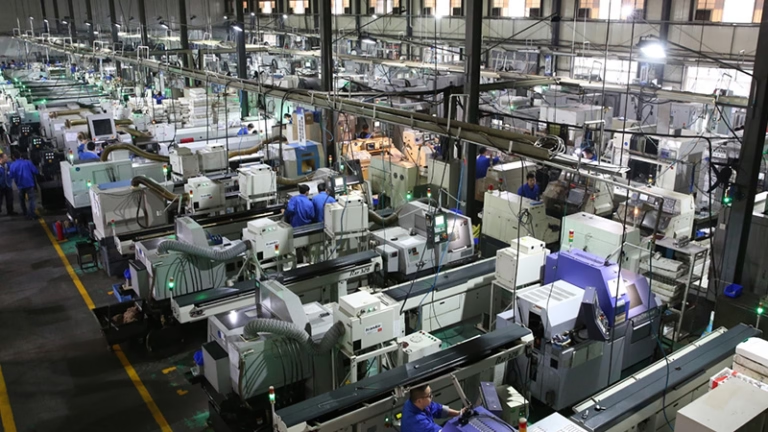
The shop floor is where the numbers come from. GreatLight runs 16 simultaneous 5-axis machining centers, 12 four-axis mills, 27 three-axis machines, and 16 mill-turn centers across three plants, with 150 technicians on staff. On that fleet, a new operator reaches basic competence in weeks and a setup tech takes months. That ratio has held across materials from 6061 and 7075 aluminum to 17-4PH and TC4, and it is why we plan training around a named part family rather than a calendar.
How to plan a training schedule that holds
- 1Define the target task firstWrite down the exact job the trainee must do alone: run a 3-axis cycle, set a vise, or program a 4-axis part. A vague goal like learn CNC has no finish line and no schedule.
- 2Count required machine hoursUse 40–80 hours for operator, 250–500 hours for setup, 800–1,500 hours for programming, and 2,000+ hours for independent 5-axis work. These are guided hours at the panel, not reading time.
- 3Block the machine time before day oneReserve one machine and one mentor slot. If the trainee only gets leftover time, the schedule slips by months. Book it the same way you book a production job.
- 4Start on aluminum, then move upLet them make chips on 6061 before they touch 17-4PH or TC4. Aluminum forgives a wrong feed. Titanium does not, and a broken 12 mm carbide end mill teaches the wrong lesson.
- 5Add inspection from week oneHave them measure their own parts with calipers, then a micrometer, then a height gauge. A machinist who cannot verify a dimension will not trust the offsets page.
- 6Track first-article pass rateLog pass or fail on every first article. When the rate stays above 90% for a month on that part family, the trainee is ready for the next rung.
- 7Review the schedule every 30 daysCompare planned hours against logged hours. If the trainee is behind, the problem is usually machine access, not ability. Fix the access before you extend the timeline.
- 8Certify only against a partSign-off should name the part number, the tolerance band, and the machine. A generic certificate says nothing about whether the person can hold ±0.005 mm on a Friday afternoon.
Training paths compared
| Path | Typical duration | Best for | Main limit |
|---|---|---|---|
| Vocational or college program | 6–24 months | Beginners with no shop background | Low lab hours per week |
| Vendor control or CAM course | 3–5 days | Operators learning one control | No setup or judgment training |
| In-house apprenticeship | 1–4 years | Building a setup tech or programmer | Needs a dedicated mentor |
| Self-taught with CAM seat | 12–36 months | Motivated people with machine access | No one catches bad habits |
| Cross-training an existing machinist | 2–8 weeks | 3-axis hand moving to 4-axis | Rotary offset errors early on |
The short answer
Weeks for an operator, months for setup, years for 5-axis programming. Pick the rung you actually need, then count machine hours instead of weeks.
Frequently asked questions
Can I learn CNC machining in one month?
You can learn to run an existing program on a 3-axis machine in about one month if you get 40–80 supervised machine hours. That means loading parts, starting the cycle, and reacting to alarms.
You cannot learn setup, programming, or 5-axis work in that window. Those take months to years of guided practice.
Do I need a degree to work as a CNC machinist?
No. Most machinists enter through vocational programs, apprenticeships, or on-the-job training. A degree helps for process engineering roles, not for running or setting a machine.
What employers check is whether you can hold a tolerance on a real part and read a first-article report.
How long does it take to learn G-code?
Basic G-code for a 3-axis mill, meaning G0, G1, G2, G3, tool length offsets, and work offsets, takes 2–4 weeks of part-time study. You can read most programs after that.
Writing safe, efficient code for a 5-axis part is a different skill. Expect 12–24 months of CAM work and machine time before you can do it without a mentor reviewing the output.
Is it faster to learn on a 3-axis or a 5-axis machine?
Start on 3-axis. The coordinate system is simpler, so the trainee learns offsets, tool setting, and inspection without also managing rotary tables and collision risk.
Move to 4-axis once first-article pass rate is stable, then to 5-axis. Skipping the middle step is the most common cause of crashes in training.
How do I keep a trained machinist from leaving?
Give them a visible skill ladder with a pay step at each rung: operator, setup, programmer, 5-axis. People leave when the next rung is not defined.
Also rotate them across materials and machine types. A machinist who only ever runs one aluminum bracket on one machine gets bored and starts applying elsewhere.
Does GreatLight train customer engineers on our processes?
We support customer engineering teams during prototyping and production ramp. That includes DFM feedback, first-article inspection reports on request, and review of tolerances and surface finish calls before a run starts.
We do not run a public machining school. Training happens around a specific project, with your drawings and our process data.
Need parts while you train your team?
Send your drawings and get a quotation with free DFM analysis within 12 hours. Prototype to 10,000+ parts, no minimum order quantity.
12-hour quote100% inspection±0.005 mm tolerance
More machining notes
We publish setup notes, tooling trials and inspection data from the factory floor.











