
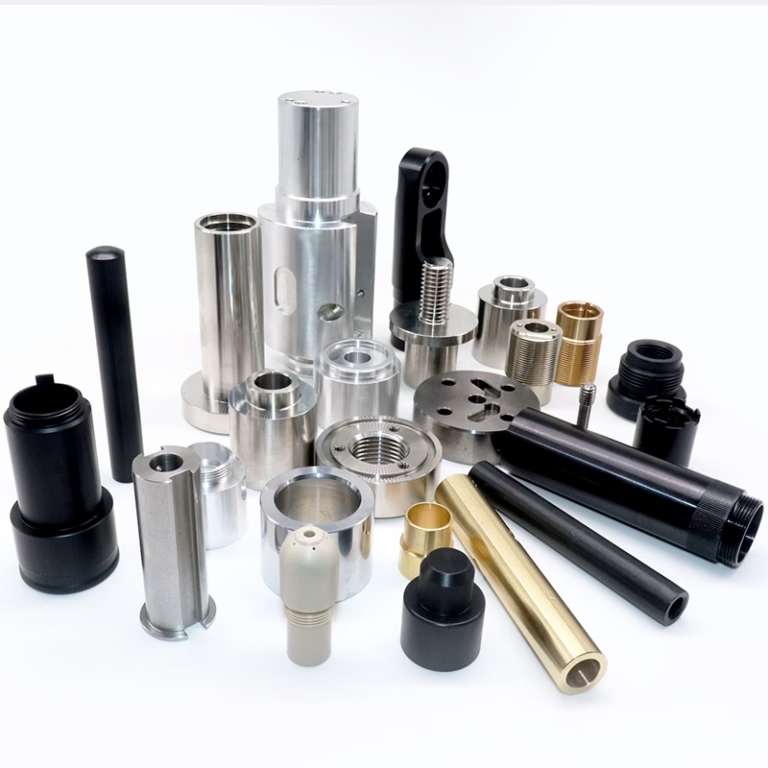
In the world of precision manufacturing, where intricate designs meet robust materials, the CNC laser cutting machine stands as a cornerstone technology. For clients seeking precision parts machining and customization, understanding how this powerful tool works is key to unlocking its full potential for your projects. At its core, a CNC laser cutting machine is a sophisticated marriage of optics, motion control, and thermal dynamics, transforming digital designs into physical reality with remarkable accuracy and speed.
H2: The Core Principle: Concentrated Energy for Precision Cutting
The fundamental principle behind a CNC laser cutting machine is the use of a highly focused beam of light—a laser—to melt, burn, or vaporize material along a predetermined path. Unlike mechanical cutting with blades or drills, it is a non-contact, thermal-based process. This eliminates tool wear and mechanical force, allowing for intricate cuts, sharp corners, and excellent edge quality on a vast range of materials, from thin stainless steel sheets to thick acrylic plates.
H2: Deconstructing the Machine: Key Components
A typical CNC laser cutting machine is composed of several integrated systems:
H3: 1. The Laser Resonator: The Heart of the System
This is where the laser beam is generated. Common types for industrial cutting include:
CO2 Lasers: Excited by an electrical discharge in a gas mixture (primarily carbon dioxide). Excellent for cutting, engraving, and etching non-metals (wood, acrylic, leather) and some metals.
Fiber Lasers: The laser is generated within a doped optical fiber and amplified. They are highly efficient, require less maintenance, and are superior for cutting reflective metals like stainless steel, aluminum, and brass.
Nd:YAG/Nd:YVO Lasers: Solid-state lasers effective for both metals and non-metals, often used for high-precision marking and cutting.
The resonator produces a powerful but diffuse beam of coherent light.
H3: 2. The Beam Delivery System: The Guiding Path
This system, comprising mirrors and lenses, precisely directs and conditions the laser beam from the resonator to the cutting head.
Mirrors (Bending Units): Guide the beam across the machine’s working area.
Focusing Lens: Located in the cutting head, this is arguably the most critical optical component. It concentrates the laser beam down to an incredibly fine point (often as small as 0.1mm diameter), creating the extreme power density necessary for cutting.
H3: 3. The Cutting Head: The Point of Action
This is the business end of the machine. It houses the focusing lens and a nozzle. An assist gas (such as oxygen, nitrogen, or compressed air) is blown coaxially through this nozzle.
Function: The gas helps eject molten material from the kerf (the cut width), protects the lens from spatter, and, in the case of oxygen, creates an exothermic reaction that increases cutting energy for steels.
H3: 4. The CNC Controller and Motion System: The Brain and Muscles
The Computer Numerical Control (CNC) system is what makes the process automated and precise.
Software: CAD/CAM software is used to create or import a part design, which is then translated into a set of numerical instructions (G-code).
Controller: This computer interprets the G-code and precisely coordinates the movement of the machine’s motors.
Motion System: Typically, the cutting head moves in the X and Y axes over a stationary bed (flying optics), or the bed moves (moving material). Advanced systems offer dynamic Z-axis control to maintain optimal focal distance over uneven materials.
H3: 5. The Work Bed and Exhaust System
Work Bed: Supports the material being cut. It is often a slatted or honeycomb structure that allows debris and slag to fall through while supporting the sheet.
Exhaust/Extraction System: Crucial for safety and cleanliness, it removes fumes, particulates, and heat generated during the cutting process.
H2: The Step-by-Step Cutting Process
Design & Programming: A 2D or 3D vector file of the part is prepared. The CAM software nests parts for material efficiency, sets the cutting path, speed, power, gas type, and pressure.
Material Setup: The sheet material is placed and leveled on the work bed.
Initiation: The operator starts the program. The CNC controller positions the cutting head at the start point.
Piercing: The laser fires at a high power setting to create a small hole in the material.
Cutting: The head begins moving along the programmed path. The focused laser beam heats a localized area to its melting or vaporization point. The assist gas jet blows the molten material away, creating a clean cut.
Completion & Unloading: After the cycle finishes, the cut parts (and remaining skeleton) are removed. Parts often require minimal to no secondary finishing.
H2: Advantages for Precision Parts Machining and Customization
For a manufacturer like GreatLight CNC Machining Factory, integrating CNC laser cutting into our service portfolio is a strategic decision that directly benefits our clients:
Extreme Precision and Repeatability: Capable of holding tolerances within ±0.1mm or better, ideal for complex, high-tolerance components.
No Tool Wear or Contamination: The non-contact process means no cutting forces, eliminating part deformation and the cost/time of tool changes.
Excellent Edge Quality: Produces smooth, burr-free edges, often eliminating the need for secondary finishing.
High Flexibility and Speed: Changing from cutting one design to another is as simple as loading a new file, enabling rapid prototyping and cost-effective small-batch production.
Complex Geometry Made Simple: It can easily produce intricate shapes, sharp angles, and small features that are challenging or impossible with mechanical methods.
Conclusion
Understanding how a CNC laser cutting machine works reveals it as far more than just a “cutter.” It is a pinnacle of controlled energy application, digital precision, and automated manufacturing. For industries demanding intricate, high-quality sheet metal parts, prototypes, or custom components, it is an indispensable technology. While GreatLight CNC Machining Factory is renowned for our advanced multi-axis CNC machining capabilities that excel in complex 3D geometries, our comprehensive approach to manufacturing means we leverage the right technology—including precision laser cutting—for the right application. This ensures our clients receive the most efficient, cost-effective, and high-quality solution for their specific part requirements, from a simple bracket to the most complex engine component.
Frequently Asked Questions (FAQ)
H3: Q1: What materials can a CNC laser cutter cut?
A: Modern industrial laser cutters handle a wide range: metals (stainless steel, mild steel, aluminum, brass, titanium), plastics (acrylic, polycarbonate, ABS), wood, fabrics, leather, rubber, and composites. Material choice dictates the type of laser (fiber vs. CO2) and assist gas required.
H3: Q2: What are the limitations of laser cutting?
A: Key limitations include material thickness (though powerful machines cut several inches of metal), heat-affected zone (HAZ) which can alter material properties near the cut, and difficulty with highly reflective materials (like pure copper) without specialized lasers. It is primarily a 2D profiling process, though 3D laser cutting systems exist.
H3: Q3: How does laser cutting compare to CNC punching or plasma cutting?
A: Laser Cutting offers the best precision, edge quality, and flexibility for complex shapes, especially in thin to medium sheets. CNC Punching is faster for high-volume production of simple shapes with standard holes but requires tooling. Plasma Cutting is better for very thick metals (over 25mm) but has a wider kerf, more slag, and less precision.
H3: Q4: What file format is needed for laser cutting?
A: Vector files are essential. The industry standards are DXF (Drawing Exchange Format) and DWG (AutoCAD). AI (Adobe Illustrator) and PDF with vector data are also commonly accepted. The file should contain clean, closed contours.
H3: Q5: Can laser cutting be used for prototyping?
A: Absolutely. It is one of the fastest and most economical methods for producing precise sheet metal or plastic prototypes. The lack of tooling costs and quick setup make it ideal for iterative design testing and functional prototyping.
H3: Q6: How does a factory like GreatLight ensure precision in laser cutting?
A: Precision stems from a combination of factors: high-quality, well-maintained optics; a rigid and accurate motion system; calibrated CNC controls; and deep process expertise. At GreatLight CNC Machining Factory, our commitment to systems like ISO 9001 ensures this precision is consistent and reliable across every job. For a deeper look at our commitment to precision across all our services, including our core competency in complex part manufacturing, explore our capabilities in precision 5-axis CNC machining services{:target=”_blank”}. To stay connected with industry insights and our latest projects, follow our professional updates on LinkedIn{:target=”_blank”}.



















