

1 Preface
The gunner’s scope is an important element of a tank and armored vehicle. She is responsible for searching, aiming and tracking targets. The curved sleeve is an important part of the shooter’s scope zoom system. Its precision and dimensional stability directly determine the stability of the shooter. shooter’s scope.
At present, the processing of curved sleeve parts is mainly carried out by ordinary four-axis milling or electric pulse milling combined with grinding. The processing quality of parts fluctuates greatly, the processing efficiency is low, and the cost is high. With the continuous upgrading of CNC equipment and the continuous improvement of processing auxiliary tools and heat treatment technology, reasonable and feasible technical solutions can be formulated based on the enterprise’s processing capabilities to meet the precision requirements of parts, fill the gaps in the processing of these parts. parts and improve parts processing quality and stability.
2 Analysis of processing technology
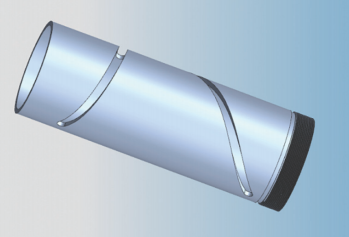
Figure 1 shows a typical thin-walled cylinder part made of 2A12-T4.[1]. The wall thickness of the part is 2mm, the length is 124mm, the inner hole and outer circle have IT7 level tolerance, and the coaxiality is φ0.02mm. At the same time, there are two functional curve slots distributed around the circumference of the workpiece, which constitutes an asymmetrical distribution. The axial strokes of the two curves are 16.5mm and 46mm respectively, accounting for 50.4% of the total axial length of the part, and the curved groove width tolerance is only 0.03mm . Parts require high precision, structural rigidity is low. and the processing is easily deformed.
a) Structural dimensions
b) Three-dimensional view
Figure 1 Typical parts of a thin-walled cylinder
3 Process design
3.1 Division of processes
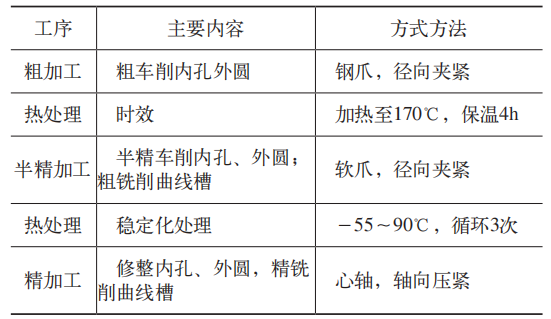
The material removal rate during workpiece processing is approximately 85%. Significant stress is generated during processing. Once the two function curves have been processed, the part will undergo significant deformation at the same time. is necessary to ensure its size stability during use, so the processing of the part is divided into three stages: roughing, semi-finishing and finishing.[2]respectively adding aging treatment and stabilization treatment in the middle to ensure dimensional stability when finishing and assembling parts. The treatment content of each stage is shown in Table 1.
Table 1 Content of treatment at each stage
3.2 Determine the machining allowance
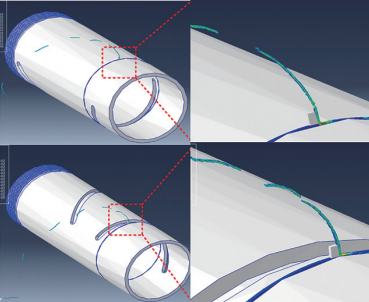
Based on experience in processing similar parts, a margin of 0.5-1mm is generally left after rough machining of parts. The machining accuracy of parts mainly depends on the semi-finishing and finishing processes. Since parts have low rigidity and significant deformation before finishing, the machining allowance must be minimized while meeting the deformation and strength requirements of the parts. Using abaqus 2020 software to simulate the part turning process (see Figure 2) and calculating the cutting force, residual stress and radial changes, it was found that the main deformed part is in the middle of the two grooves, in the length of one of the curves 20 to 30mm The most significant change (see Figure 2a).
a) Simulation of the cutting process
b) Changes in cutting force
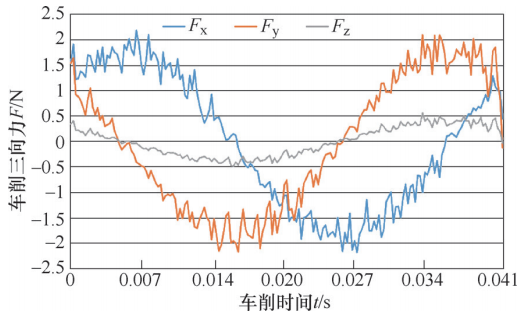
Through the analysis of the cutting force during the processing of the workpiece, it can be seen that the axial force Fz does not change significantly during processing, and the radial force Fx continues to change as the workpiece is processed, and the change is the most important. in the middle of the long groove, corresponding to The radial deformation of the part is 0.12 mm, the finishing allowance of the part is therefore determined at 0.2 mm.
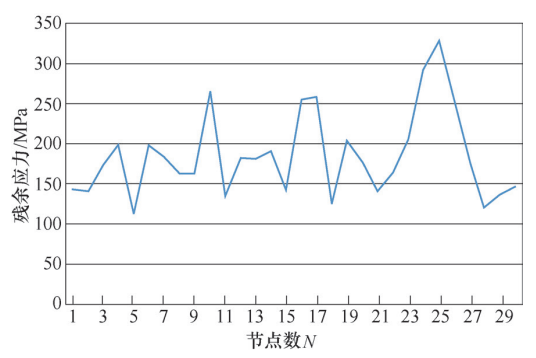
c) Changes in residual stresses
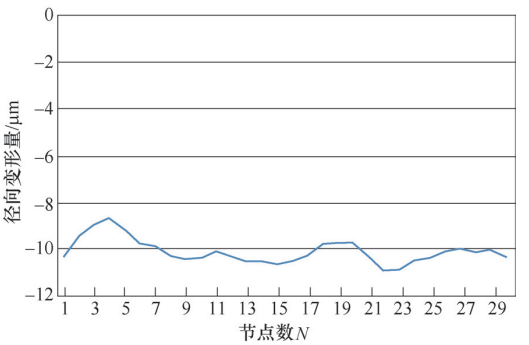
d) Changes in radial strain
Figure 2 Part cutting simulation analysis
4 tooling design
Due to the low rigidity of this part, it deforms very easily when tightening. During the finishing phase, reducing part deformation during clamping becomes an element of the luminaire design since there are two functional curved grooves in the outer circle. of the workpiece, it is easy to deform when using end face compression, so when designing the process, reserve a processing table on the end face of the workpiece in advance. piece. , to facilitate axial compression of the lower surface of the part. At the same time, in order to improve the reliability of clamping, when designing the fixture, the structural characteristics of thin-walled parts are fully utilized, the inner hole of the. The lens barrel is positioned with a chuck, and the reserved process step is pressed with a threaded sleeve at the bottom, the top is designed with an internal expansion bracket as auxiliary compression to improve the stability of workpiece processing.[3]to avoid displacement and vibration when milling curved grooves. The fastener and tightening are shown in Figure 3.
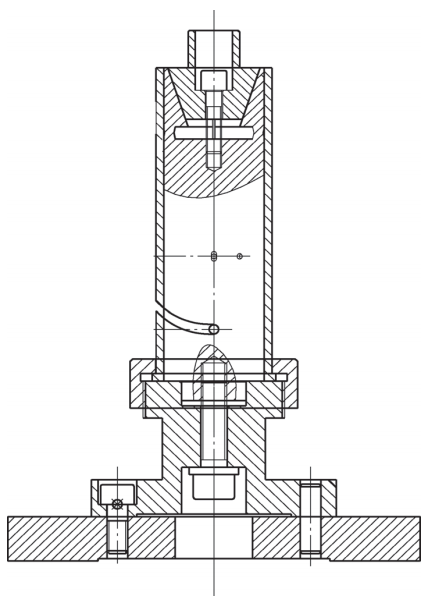
a) Sectional view
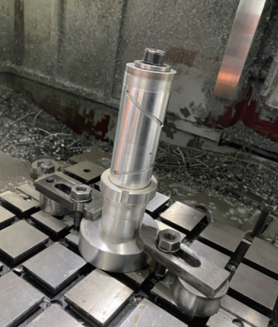
b) Physical objects
Figure 3 Clamp and clamp
5 CNC programming
In the initial test, the processing program was processed using a computer to directly generate the coordinates of the points. Since the values in the equations given by the coins are already accurate to 9 decimal places, some need to calculate the power N of. the value, then perform product or addition and subtraction calculations. Therefore, the error in the calculation results is large, and when processing the program on the computer, the density of points also affects the accuracy of the calculation results. are too dense, the processed program will be longer, which will affect the ability of the machine tool to read the program. At the same time, the CNC program The amount of data is much larger than the machine tool memory, which makes program calls inconvenient. .
During the programming process, macro programs are used for manual programming according to the workpiece curve equation, which greatly shortens the program sequence, makes it easier to read and edit the program, and optimizes the calculation method. of the program to improve the precision of the curve points. Originally, when dealing with point accuracy, power derived data was added, subtracted, multiplied and divided with the -N power of 10. Since the machine tool macro program has restrictions on values after the decimal point, it is easy to cause loss of data precision. Later, the calculation method was improved and a comprehensive calculation method was adopted, that is, the Nth power of the data was decomposed into the form of 2 times 2 times 2 times, and then times both times. After the calculation, the result. of 2 times was multiplied by 10. -2 power, which controls the data value within the allowed error range and improves the calculation accuracy.
Since the feed rate is difficult to control when the fourth axis participates in the movement, it is easy to make the processing speed too fast at a certain point. The reverse time feeding method is introduced during programming. Using this instruction standardizes the cutting speed during the processing process, achieves smooth processing of parts, and improves the processing quality of parts. The part processing macro code is shown in Figure 4.
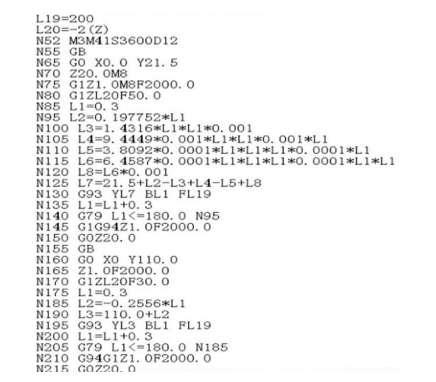
Figure 4 Parts processing macro program code
6Conclusion
This article focuses on the structural characteristics and processing difficulties of high-precision hyperbolic lens barrel parts. Through the division of processing steps, aging and stabilization processing, tooling design and macro program reduction processing, the processing and assembly process of parts is basically well controlled. solves the problem of processing quality of this part, greatly reduces production costs, saves labor and material resources, improves enterprise competitiveness, and also provides process idea for structural parts processing similar.
Daguang focuses on providing solutions such as precision CNC machining services (3-axis, 4-axis, 5-axis machining), CNC milling, 3D printing and rapid prototyping services.



















