
CNC Machining Services From China Supplier: 7 Proven Checks
This guide is for engineers and sourcing managers who need to qualify good quality cnc machining services from china supplier partners without flying over. It covers the checks that separate a capable shop from a broker, and the numbers to request before releasing a PO.
In this article
- 1
- 2
- 3
- 4
- 5
- 6
- 7
- 8
- 9
What decides quality before price
What to verify, and the number to ask for
Use this as a screening sheet. Anything a supplier cannot answer in writing is a gap worth noting.
| Check | What to ask | A workable answer |
|---|---|---|
| Achievable tolerance | Which machines hold ±0.005 mm? | Named machine types and part size range |
| Surface finish | What Ra can you hold as machined? | Ra 0.8–1.6 μm typical, Ra 0.2–0.8 μm on request |
| Quality system | Which certificates are current? | ISO 9001:2015, plus IATF 16949 or ISO 13485 if relevant |
| Inspection | What is checked before shipment? | 100% inspection, reports on request |
| Minimum order | Can you run one prototype? | No MOQ, from one part to 10,000+ |
| Lead time | When does production start? | Quote in 12 hours, production within 24 hours |
| Data security | How are CAD files handled? | Secure uploads, NDA available on request |
| Materials | Which grades do you stock? | Aluminium, stainless, steel, titanium, plastics |
The verdict: qualify the process, then compare the price
Good quality cnc machining services from china supplier partners are found by checking machines, metrology, certificates and inspection data first. Price comes after the process is proven.
Machine park: the first real filter
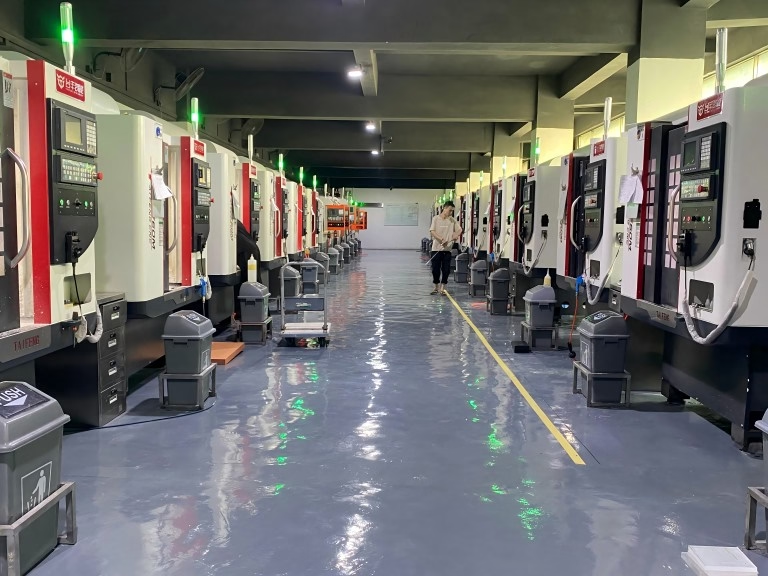
A supplier can claim anything on a website. The machine list is harder to fake. Ask for the count and type of CNC machines, then match that against the geometry you need. A shop with 127 high-precision CNC machines and 16 simultaneous 5-axis machining centers can cut angled holes, undercuts and contoured pockets in one setup. A shop with only 3-axis mills will need multiple fixtures, and each refixture adds position error.
Part size matters as much as machine count. If your part is long, ask about travel. We run one machine with 4,000 × 400 × 150 mm travel, plus 750 × 1,150 × 550 mm and 600 × 600 × 600 mm beds, and a Ø400 mm rotary table for cylindrical features. A supplier who cannot state travel figures is likely quoting through a broker rather than running the part in-house.
The number of setups drives both cost and tolerance. One 5-axis setup on a complex bracket can hold ±0.005 mm between features. The same bracket on three separate 3-axis operations may drift to ±0.02 mm or worse. When you compare quotes, ask how many setups each shop plans. The cheaper quote often hides an extra two operations.
- 1Ask for machine count and typeMills, mill-turn centers and 5-axis centers are not interchangeable.
- 2Confirm maximum travelA 4,000 mm envelope covers long rails and housings that small beds cannot.
- 3Count the setupsEvery additional fixture is a new chance for stack-up error.
Tolerance and surface finish: matching the claim to the drawing
±0.005 mm is a real capability, but it is not universal. It applies to specific features on specific materials under a controlled process. When a supplier promises that number across every dimension of a 500 mm part, they are either guessing or planning to sort parts after machining. Both cost you time.
Surface finish follows the same logic. As-machined surfaces usually land at Ra 1.6–3.2 μm. A good shop can reach Ra 0.8–1.6 μm as a standard high-quality finish, and Ra 0.2–0.8 μm when the drawing calls for it. If your design needs a sealing face or a bearing seat, state the Ra value on the drawing, not in an email thread.
Tolerance and finish interact with material. Aluminium 6061 and 7075 cut cleanly and hold tight numbers. Stainless 316L work-hardens and can pull a thin wall out of tolerance. Titanium TC4 (Ti-6Al-4V) needs slower feeds and more tool changes. A supplier who asks about material before quoting tolerance is doing the work properly.
- 1Put tolerance on the drawingGeneral notes like 'machine to standard' leave the decision to the operator.
- 2State Ra where it mattersSealing faces, bearing seats and sliding surfaces need a number.
- 3Expect different behavior by materialThin-wall stainless and titanium are the usual sources of drift.
Quality system and inspection: what the paperwork should show
Certificates are a starting point, not a finish line. ISO 9001:2015 tells you the shop documents its process and audits it. IATF 16949:2016 adds automotive discipline: traceability, change control, and a structured approach to corrective action. ISO 13485:2016 applies the same rigor to medical devices. ISO 27001:2022 covers how your files and data are protected.
After the certificate, ask what is measured. A serious shop inspects 100% of parts before shipment and can supply raw material checks, in-process monitoring records and a final inspection report. For a first article, ask for a full dimensional report against the drawing. For production, ask for key-dimension data at a stated frequency.
We work to a 99.99% qualification rate, which means the inspection loop catches problems before they reach a box. That number only holds if the shop has the metrology to support it: coordinate measuring machines, optical comparators, surface roughness testers and hardness testers. If a supplier cannot name their measuring equipment, treat the certificate as decoration.
- 1Match the certificate to your industryISO 9001 for general work, IATF 16949 for automotive, ISO 13485 for medical.
- 2Ask for a first article inspection reportIt shows whether the process, not just the sample, is under control.
- 3Confirm the measuring equipmentCMM, optical comparator, roughness and hardness testers.
Lead time, MOQ and quotation clarity
Lead time has two halves: how fast the quote arrives, and how fast the parts ship. A quotation and free DFM analysis within 12 hours means an engineer read your files. Production can start within 24 hours after that, and parts ship in 3–5 days for standard work. Historical late-delivery probability below 2% is a useful benchmark when you compare suppliers.
MOQ is where many buyers get surprised. No minimum order quantity means one prototype and a 10,000+ part run are both acceptable. That flexibility matters when you are validating a design and do not yet know the annual volume. A supplier who insists on 500 pieces for a first article is not set up for prototype work.
Read the quote line by line. Does it include material certification, finishing, and inspection? Does it state which dimensions are inspected? A low unit price that excludes anodizing, laser marking or a CMM report is not a low price. Ask for the same scope from every supplier before you compare totals.
- 1Time the quote, not just the partsA 12-hour turnaround with DFM feedback signals real engineering review.
- 2Confirm MOQ in writingOne prototype to 10,000+ parts removes the volume guesswork.
- 3Compare identical scopeFinishing, inspection and material certs must appear in every quote.
Materials and finishing: where hidden cost lives
A supplier who stocks a wide material range can keep your project in one place. We machine aluminium 6061, 6061-T6, 2024, 5052, 5083, 6063, 6082, 7075 and ADC12; stainless 303, 304, 316, 316L, 420, 430, 431, 440C and 17-4PH; steel 1018, 1045, 4130, 4140, 4340, A36 and tool steel; copper and brass grades including C36000; titanium TA1, TA2, TC4, Inconel and magnesium AZ31B / AZ91D; and plastics from ABS to PEEK and carbon fibre.
Finishing is usually the second-largest cost after machining. Anodizing in clear, colour, hardcoat or conductive variants, electroless nickel, zinc, silver and gold plating, powder coating, black oxide, bead blasting, tumbling, brushing and polishing are all common. Laser marking needs a minimum character height of 1.5 mm to stay legible. If your part number is smaller than that, it will not read cleanly.
The trap is a quote that treats finishing as an afterthought. Hardcoat anodizing adds thickness and can close a tight bore. Plating can change a press-fit dimension. Send the finish spec with the drawing so the machinist can leave the right allowance. Otherwise you pay twice: once to machine, once to rework.
- 1Check the material list against your BOMA shop that already cuts your grade has fewer surprises in the first run.
- 2Send the finish spec with the drawingAnodizing and plating change dimensions; the machinist needs the allowance.
- 3Respect the marking limitLaser marking stays legible at 1.5 mm character height or larger.
Confidentiality and engineering support
Your CAD files carry your design intent. Before uploading, ask how the supplier stores them and who can open them. Secure uploads and a signed NDA available on request are the minimum. ISO 27001:2022 certification shows the information security management system has been audited, which matters more if you work in medical, aerospace or defense-adjacent products.
Free DFM analysis is the other half of engineering support. A useful review flags features that cannot be machined as drawn: a pocket with a sharp internal corner, a hole deeper than 4× diameter, a wall too thin to hold without chatter. The feedback should arrive with the quote, not after the first parts fail.
Watch for the supplier who accepts every file without comment. It usually means no one looked. A shop that comes back with three questions about datums, tolerances or finishes is doing the job. Fifteen years in this business teaches that the cheapest quote is often the one that never asked.
- 1Sign the NDA before uploadingIt costs nothing and sets the tone for the relationship.
- 2Expect DFM feedback with the quoteSharp corners, deep holes and thin walls should be flagged early.
- 3Treat silence as a red flagA supplier with no questions has not reviewed your design.
A 6-step supplier qualification process
Run these in order. Each step is cheap; skipping one is expensive.
- 1Send a real drawing, not a sketchInclude material, tolerance, finish, quantity and any critical dimensions. A PDF plus STEP file gives the supplier enough to quote and to flag DFM issues.
- 2Request the quote and DFM notes togetherSet a 12-hour expectation. If the response is a price with no comments, ask which features they reviewed.
- 3Verify the machine and metrology listAsk for machine count, type, travel and measuring equipment. Match the largest travel to your part envelope.
- 4Order one prototype or first articleAsk for a full dimensional inspection report. Compare measured values against the drawing, not against a verbal OK.
- 5Test the finishing chainSend one part through anodizing or plating and check the critical dimensions after finishing, not before.
- 6Set the production rhythmAgree on inspection frequency, report format and packaging. Confirm the lead time in writing before releasing the full PO.
Questions buyers ask before the first PO
How do I know a Chinese supplier can actually hold ±0.005 mm?
Ask which machine holds it and on what part size. The tolerance is a process result, not a shop-wide property.
Then ask for a first article inspection report on a part similar to yours. The measured data tells you more than any capability statement.
Which certificates should I require?
ISO 9001:2015 is the baseline for general machining. Add IATF 16949:2016 for automotive parts and ISO 13485:2016 for medical devices.
If your files are sensitive, ISO 27001:2022 covers the information security side.
Is there a minimum order quantity for prototypes?
At our plants, no. We run from one prototype to 10,000+ part runs on the same equipment.
Some suppliers price prototypes as a separate, expensive service. Ask whether the prototype process matches the production process.
How fast can parts ship?
Quotation and free DFM analysis within 12 hours. Production can start within 24 hours, and parts ship in 3–5 days for standard work.
Complex geometry, special material or anodizing can extend that. Ask for the schedule in writing before you commit.
What inspection data will I receive?
Every part is inspected before shipment. Raw material checks, in-process monitoring and final inspection are standard, and reports are available on request.
For first articles, request a full dimensional report. For production runs, agree on key dimensions and sampling frequency up front.
Can you sign an NDA before I share files?
Yes. An NDA is available on request, and uploads are handled as secure and confidential.
Sign it before sending CAD data. It protects both sides and removes ambiguity later.
Send your drawing and get a quote with DFM feedback
Upload a STEP file and a PDF drawing. You get a quotation and free DFM analysis within 12 hours, with the tolerance, finish and inspection scope stated in writing.
12-hour quote100% inspectionNo MOQNDA on request
More machining notes
We publish setup notes, tooling trials and inspection data from the factory floor.











