
Rapid Prototyping Exporters Hub: How to Judge One
A rapid prototyping exporters hub is a manufacturing node, not a quoting website. This page explains what sits behind the price, which capacities change lead time, and how to check a hub before you release a CAD file.
What Makes an Exporter Hub Different From a Supplier List
A directory sells you a list of machine shops. A rapid prototyping exporters hub holds the machines, the metrology and the export paperwork in one place, then takes responsibility for the parts that leave the building. The difference shows up when a tolerance is missed or a shipment sits at customs. With a directory, you chase the shop. With a hub, one team answers.
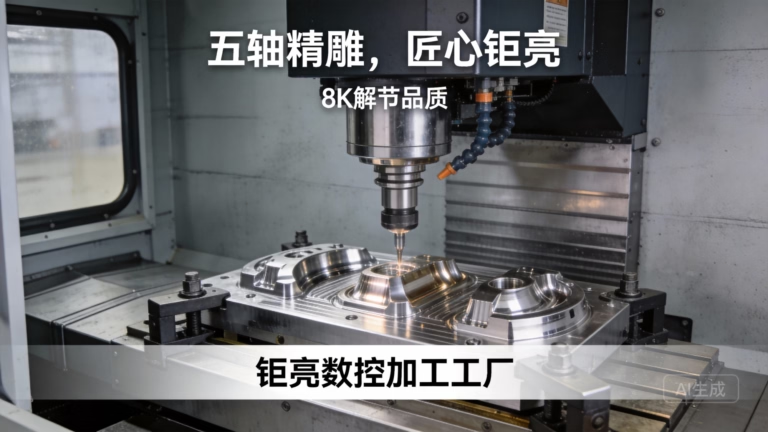
The physical side matters most. A hub that runs its own 5-axis centers, lathes, EDM and 3D printers can move a part between processes without shipping it to a third party. Every extra handoff adds days and adds a new place for a dimension to drift. GreatLight runs three wholly-owned plants across 7,600 m² with 127 high-precision CNC machines, so milling, turning, finishing and inspection stay under one roof.
The commercial side is less visible but just as real. Export means customs codes, material declarations, packing that survives air freight, and documents a receiving department will accept. A hub that ships overseas every week already has those templates. A domestic job shop quoting its first export order does not.
So when you compare hubs, compare the boring parts: who owns the machines, who signs the inspection report, and who handles the export documents. Those three answers predict the project more reliably than any instant-quote screen.
Machining Capacity That Actually Moves Lead Time
Machine count alone tells you little. What matters is whether the right machine is free when your file arrives. A hub with 16 simultaneous 5-axis machining centers, 12 four-axis mills, 27 three-axis machines and 16 mill-turn centers can route a job to the correct spindle instead of forcing every part onto one general-purpose mill.
Part size sets the routing. GreatLight machines up to 4,000 mm, with travels of 4,000 × 400 × 150 mm on the large frame, 750 × 1,150 × 550 mm and 600 × 600 × 600 mm in the middle range, and 500 × 500 × 450 mm or 500 × 310 × 200 mm on the compact machines. A Ø400 mm rotary table handles parts that need four-sided access in one setup.
Setup count is the hidden cost driver. A bracket machined on three faces in one 5-axis setup avoids three fixture builds, three datum resets and three chances to stack tolerance error. For a prototype run of five pieces that is the difference between a week and three days.
Capacity only helps if it is scheduled. Ask how many machines run per shift and whether prototyping jobs queue behind production orders. A hub that holds a dedicated prototype cell will quote a realistic date instead of an optimistic one.
- 15-axisComplex geometry, angled holes, deep pockets in one setup
- 2Mill-turnShafts and housings with turned and milled features on one platform
- 3Large frameParts up to 4,000 mm where rigidity is the limit
Tolerance, Finish and Inspection: Where Claims Meet Parts
Any hub can print ±0.005 mm on a website. The question is which features that applies to and how it is verified. Tight tolerance is realistic on a milled pocket with rigid tooling and a stable material. It is not realistic across a 900 mm weldment, because thermal movement and fixturing dominate at that length.
Surface finish has the same boundary. As-machined aluminum lands around Ra 1.6–3.2 μm. A good finish is Ra 0.8–1.6 μm. Fine finishing reaches Ra 0.2–0.8 μm and usually needs a separate pass, a different tool and extra time. Specify finish only on the surfaces that seal, slide or show.
Inspection is what turns a claim into a record. GreatLight checks raw material on arrival, monitors in-process dimensions, and inspects 100% of parts before shipment, with reports on request. Ask for the report format before you order. A first-article report with numbered ballooned drawings is worth more than a certificate with no numbers.
Material behavior belongs in the same conversation. Aluminum 6061-T6 and 7075 machine cleanly but move differently after stress relief. Titanium TC4 and Inconel wear tools fast, so cutter paths and feeds need to change. A hub that has run these alloys will flag the risk at quote stage.
- 1Send the GD&TTolerance without datum callouts invites a guess
- 2Mark critical facesFinish and flatness specs on every surface raise cost fast
- 3Ask for the reportConfirm the format before production, not after
Six Checks Before You Release a CAD File
Run these in order. Each one can end the conversation early and save you a lost week.
- 1Confirm who owns the machinesAsk for the plant address and the machine list. A hub that brokers every job cannot control a ±0.005 mm bore or a delivery date.
- 2Send a real drawing, not a renderingInclude GD&T, material grade and finish callouts. Watch what comes back: a marked-up DFM note beats a bare price.
- 3Check the certification scopeISO 9001, IATF 16949, ISO 13485 and ISO 27001 cover different things. Ask which scope applies to your part type.
- 4Ask how tolerance is verifiedCMM, height gauge or optical, and whether the report ships with the parts. Vague answers here predict vague parts.
- 5Test the response loopA hub that returns a quote and DFM analysis within 12 hours usually keeps that pace once the order is live.
- 6Agree the handoffIncoterms, packing, labeling, and whether uploads and drawings stay confidential under NDA.
Which Hub Fits Which Project
Match the project profile to the hub type before you request quotes.
| Project profile | Hub type that fits | Why |
|---|---|---|
| One-off bracket, simple 3-axis geometry | Local or regional shop | Freight and customs cost more than the part |
| Multi-face housing, ±0.005 mm on bores | 5-axis hub with in-house metrology | One setup holds the datum stack |
| Shaft with turned and milled features | Hub with mill-turn centers | No second fixturing, no re-datum |
| Prototype plus 10,000-part run | Hub with no MOQ and production cells | Same process carries from sample to series |
| Regulated medical or automotive part | ISO 13485 or IATF 16949 hub | Traceability documents are already in place |
| Large frame up to 4,000 mm | Hub with large-travel 5-axis | Few shops own a machine that size |
| Cosmetic enclosure, painted or anodized | Hub with in-house finishing line | Colour and gloss stay under one spec |
Pick the Hub by Constraint, Not by Price List
If your part is simple and local freight is cheap, use a nearby shop. If tolerance, multi-face geometry or a regulated paper trail drives the project, choose a rapid prototyping exporters hub that owns its 5-axis capacity, its metrology and its export documents. Pay for control, not for a logo.
Questions Engineers Ask Before Ordering
How fast can a prototype order start?
GreatLight returns a quotation and free DFM analysis within 12 hours. Production can start within 24 hours after drawing release and material confirmation.
Parts typically ship in 3–5 days depending on geometry, finish and material availability. Complex 5-axis work or fine finishing adds a pass, so confirm the date on the quote.
Is there a minimum order quantity?
No. Runs go from one prototype to 10,000+ parts, and the same process route can carry from sample to series.
Low-volume prototype pricing reflects setup time, so batching two or three design variants into one order usually lowers the per-part cost.
Which materials are available for prototyping?
Aluminum grades include 6061, 6061-T6, 2024, 5052, 5083, 6063, 6082, 7075 and ADC12. Stainless covers 303, 304, 316, 316L, 420, 430, 431, 440C and 17-4PH.
Steel, copper and brass, titanium TC4, Inconel, magnesium and engineering plastics such as POM, PEEK, PC and ABS are also machined. Material choice usually follows the function of the part, not the drawing default.
How is my design kept confidential?
Uploads are handled as secure and confidential. An NDA is available on request before any file transfer.
ISO 27001:2022 covers information security at the facility, which matters when drawings contain proprietary geometry or regulated product data.
Can one hub cover both machining and 3D printing?
Yes. Additive processes such as SLM, SLA and SLS work well as a bridge before metal cutting, or for parts where internal channels cannot be machined.
The practical gain is comparison. Printing a form-and-fit sample and machining the functional version from the same CAD file removes a vendor handoff and a translation error.
What happens if a dimension is out of tolerance?
Parts are inspected 100% before shipment, and inspection reports are available on request. Any deviation should be visible before the parts leave the plant.
Share the measurement method on the drawing so both sides agree on what the number means. Most disputes trace back to a missing datum callout, not a machining error.
Send a Drawing, Get a Real Answer
Upload your CAD file and drawing. A process engineer reviews the geometry, the tolerance stack and the material, then returns a quote with DFM notes within 12 hours.
12-hour quoteFree DFM analysis100% inspectionNDA on request
More From the Shop Floor
We publish setup notes, tooling trials and inspection data from the factory floor.











