
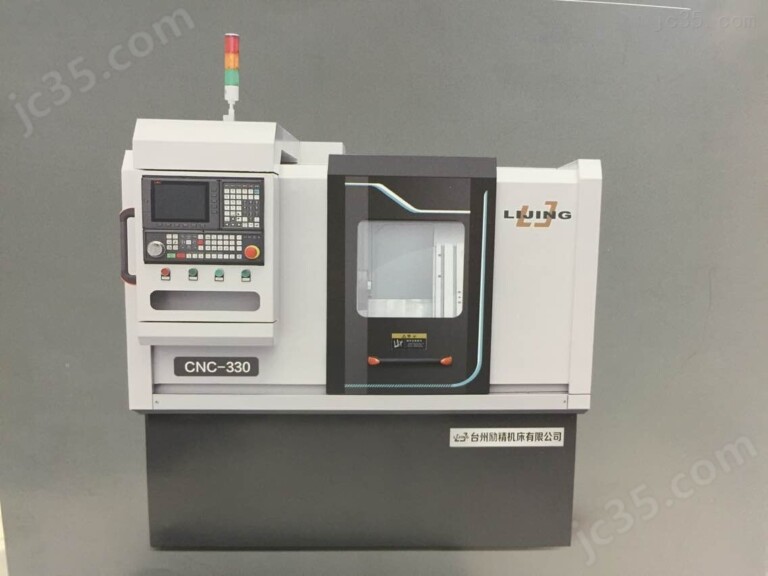
Revolutionizing Precision Manufacturing: The Transformative Impact of Inclined Bed CNC Lathes
The manufacturing landscape is undergoing a silent revolution, driven by a seemingly simple design shift: the inclined bed CNC lathe. Far more than a structural novelty, this 45°/60° angled architecture represents a fundamental reimagining of machining efficiency, precision, and material adaptability. Here’s how this innovation is rewriting the rules across critical industries.
🚀 Aerospace: Engineering Flight-Critical Perfection
Seamless Turbine Discs & Engine Receiver Precision
In aerospace, where micro-scale imperfections can cascade into catastrophic failures, inclined bed CNC lathes have become indispensable. Their tilted structure—garnered with multi-axis linkage technology—increases overall rigidity by 40%, a critical gain for machining titanium alloy turbine discs.
One aviation supplier leveraged a 45° inclined lathe with five-axis capability to slash vibration amplitudes by 40% and achieve surface roughness of Ra0.4 μm. This allowed them to surpass traditional flat-bed efficiency by 300%. When fabricating engine receivers, the integration of the C-axis (±0.001° indexing accuracy) and Y-axis enables 3D contour grinding in a single setup. The result? Cumulative positioning errors collapsed by 80%.
Technical Breakthroughs:
- Thermal Stability: Integrated AI-driven compensation systems limit thermal deformation fluctuations to <±0.003mm during 24-hour runs.
- Multi-Axis Machining: BMT power turrets enable "single-setup" turbine blade root machining, erasing 5 traditional processes.
- Titanium Mastery: High-torque spindles (up to 3,000 Nm) boost cutting efficiency in high-temperature alloys by 50%.
🔋 Automotive: Powering the Electric Vehicle Revolution
Redefining Motor Shaft & Gear Production for EVs
Electrification demands unprecedented precision and speed. For motor shafts, Yuhuan Luowei Machinery’s adoption of 45° inclined CNC lathes cut spline machining time by 33%. Linear rail systems amplify dynamic responses by 30%, while spindle speeds exceeding 10,000 RPM ensure rapid material removal.
In gear manufacturing, near-zero backlash on the X-axis (enabled by tilted design and center screw layouts) achieves ISO 5 tolerance—a 2-class leap over traditional methods.
Technical Breakthroughs:
- Turn-Mill Integration: 12-station servo turrets + Y-axis complete 6 semi-axle processes (turning, splining, drilling) in one cycle, slashing time by 60%.
- Adaptive Machining: AI algorithms sample vibration at 10 kHz, auto-adjusting feeds. This extends tool life by 40% for aluminum pistons.
- Sustainable Production: Dry cutting techniques cut fluid use by 90% while maintaining brake disc finishes at Ra0.4μm (meeting ECE R90 standards).
🏥 Medical: Precision Meets Biocompatibility
Nanoscale Tolerance for Surgical Tools & Implants
Machining biocompatible titanium requires sterilizable surfaces and microscopic accuracy. When producing ultrasonic scalpel handles, 45° lathes (with 0.002mm repeatability) maintained vibration amplitude tolerance under 5%. The angled bed’s gravity-led chip removal system prevents material re-cutting and surface impurities.
For implants like Mallory bridge frameworks, five-axis inclined beds eliminate 3 setups, control coaxiality within 0.005mm, and create osteocyte-friendly nanolayers via electrolytic cutting.
Technical Breakthroughs:
- Ultra-Precision: Screw threads machined to 0.004mm accuracy cater to medical catheters with 0.3mm bores.
- Clean-Room Compliance: Closed covers + tilted chip evacuation slash particulate emissions by 70%, qualifying units for GMP-certified workshops.
- Surface Engineering: Electro-ion cutting builds nano-oxide films on implants, boosting osseointegration rates by 30%.
🌬️ Energy: Heavy-Duty Machining, Intelligent Uptime
Wind Turbine Spindles & Nuclear Components
Energy equipment’s massive scale demands unwavering rigidity. Rongtian’s 60° inclined CNC lathes, equipped with hydrostatic slides, achieve 0.003mm repeatability on 6.3m wind spindles—even after 24 hours of continuous machining (<0.01mm thermal shift). Nuclear pressure vessel flange machining withstands 3,000 Nm torque via 20% larger structural sections than flat beds.
Technical Breakthroughs:
- Zero-Downtime Architecture: Module tool turrets enable 1.2-second tool changes; AI predicts insert wear (<8% error), reducing consumable costs by 25%.
- Digital Twin Integration: Path planning in virtual environments preempt collisions, cutting unplanned stops by 60%.
- Remote IoT: 128 sensors track tool health and hydraulics with 92% prediction accuracy for failures.
🧰 Moldmaking: Multi-Process Unification
Automotive Molds & Complex Cavities
Mold manufacturers adopt 45° lathes to consolidate drilling, milling, and contouring. With Y+C axis synergy, core-cavity tasks (holes, undercuts, curves) finish in one clamping pass. This reduces setups by 75%, shrinks cycle times, and achieves dimensional consistency enhancements of similar magnitude.
Technical Breakthroughs:
- Space Optimization: Inclined machines occupy 35% less floor space than flat beds.
- Speed-to-Finish: Linear roller guides achieve feed speeds to 20m/min on aluminum molds.
- Process Integration: 12-station turrets handle 16 operations (milling, drilling, tapping), centralizing 85% of mold processes.
The Future Is Angled
The inclined bed CNC lathe’s architecture does more than elevate precision—it redefines manufacturability. As sectors like space tech and quantum computing demand ever-tighter tolerances, this "gravity-optimized" design will underpin next-gen fabrication. Its fusion of AI control, ecological efficiencies, and mechanical stability isn’t just innovative; it’s foundational to industry 5.0.
In precision manufacturing, degrees matter. With the incline bed revolution, a tilt of 45° angles the world toward faster, cleaner, and microscopically perfect production.
[Image from original article: Inclined bed CNC lathe machining turbine blade]
[Suggested additional images: Automotive drive shaft machining; surgeon holding titanium implant before CNC; wind turbine spindle profile]
Note: Industry data adapted from leading machine-tool manufacturers’ performance records (2020-2024).



















