

High resistance bolts are the most common construction content in the construction of the steel structure, and all the engineers of the steel structure will have the impression that they are too familiar to them. However, this may not be the case.
1. what are high resistance bolts
High resistance friction bolt, literally translated by: Boulon pre-tight of high resistance friction, English abbreviation: HSFG. We can see that the high resistance bolts mentioned in Chinese construction are the abbreviation of pre-assembled bolts of high resistance friction. In daily communication, the words “friction” and “pre-assembled” are simply simplified, but many members of engineering and techniques have misunderstood the basic definition of high resistance bolts.
False idea 1:
Are the bolts with material notes exceeding 8.8 are “high resistance bolts”?
The central difference between high resistance bolts and ordinary bolts is not the resistance of the material used, but the shape of constraint. The essence is whether preload forces are applied and static friction forces are used to resist shear.
In fact, in the British standard specification, the high resistance bolts (HSFG bolt) mentioned in the American standard specification are only two types: level 8.8 and level 10.9 (BS in 14399 / ASTM-A325 and ASTM-490), but ordinary bolts contain 4.6.
2. Understanding the “high resistance” correctly, where it is strong
According to GB50017, the resistance to traction and shear of a single ordinary bolt (class B) and a high resistance bolt are calculated.
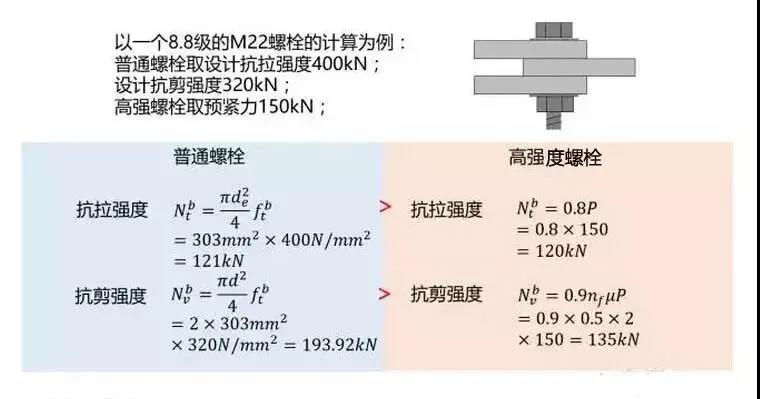
Thanks to the calculations, we can see that in the same level, the design values of traction resistance and the shear resistance of ordinary bolts are higher than those of high resistance bolts.
So where is the “fort” of high resistance bolts?
To answer this question, we must start from the working state of the two bolts, study the rules of elastic and plastic deformation, and understand the limited state when design damage is reached.
Constraint and deformation curves in the work states of ordinary bolts and high resistance bolts
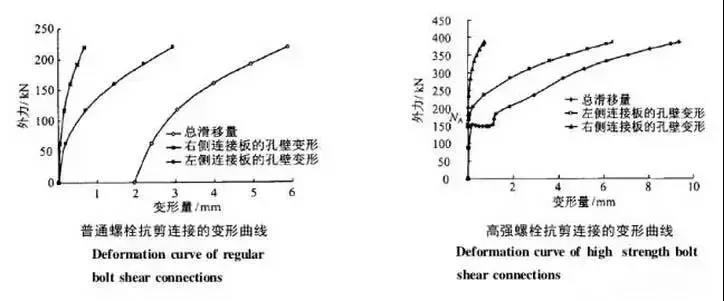
Extreme condition when designing damage
Ordinary bolts: the screw itself undergoes plastic deformation beyond the design permits, and the screw is shears.
When the ordinary bolts are connected, a relative shift occurs between the connection plates before starting to wear the shear force, then the bolt rod and the connection plate come into contact, causing elastic plastic deformation and a force Porting shear.
High resistance bolts: static friction between effective friction surfaces is won over and the two steel plates are relatively moved, which is considered damaged in design considerations.
Connecting the high resistance bolt, the friction force first carries the shear force. ). However, although it is damaged at this time, the bolt stem comes into contact with the connection plate and can always use its own elastic plastic deformation to withstand the shear force.
Misunderstanding 2:
Is the load capacity of high resistance bolts greater than that of ordinary bolts?
According to the calculation of a single bolt, we can see that the resistance to traction and shear of high resistance bolts is both lower than that of ordinary bolts. Its high resistance is that when you work normally, no relative shift is authorized, that is to say a small elastic-stow-plastic deformation and a great rigidity of the node.
We can see that given the charge of the design node, the nodes designed with high resistance bolts do not necessarily save the number of bolts used, but their deformation is small, the rigidity is high and the safety reserves are high. It is suitable for the use of main beams, such as positions that require high rigidity of the node, and comply with the principle of basic seismic design of “strong nodes and weak stems”.
The resistance of high -resistance bolts is not due to their own supporting bearing capacity design value, but is reflected in high rigidity, high safety performance and high resistance to damage.
3. Comparison between high resistance bolts and ordinary bolts
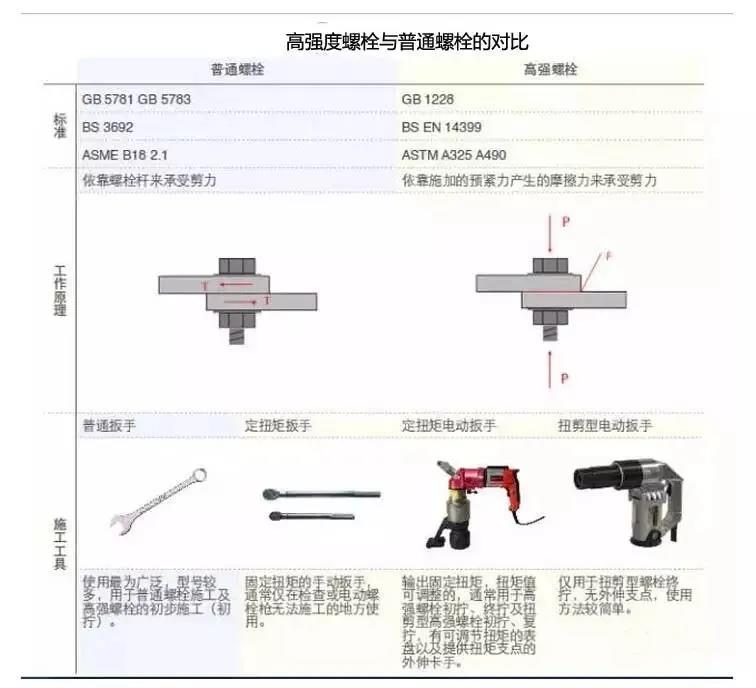
Due to the various principles of design constraint of ordinary bolts and high resistance bolts, they are very different in the construction methods of construction.
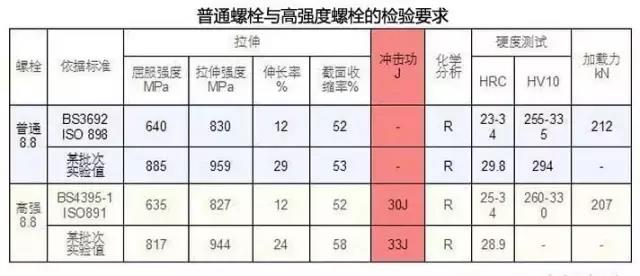
All mechanical performance requirements for ordinary quality bolts are slightly higher than those of high resistance bolts, but high resistance bolts have a more impact work acceptance requirement than ordinary bolts.
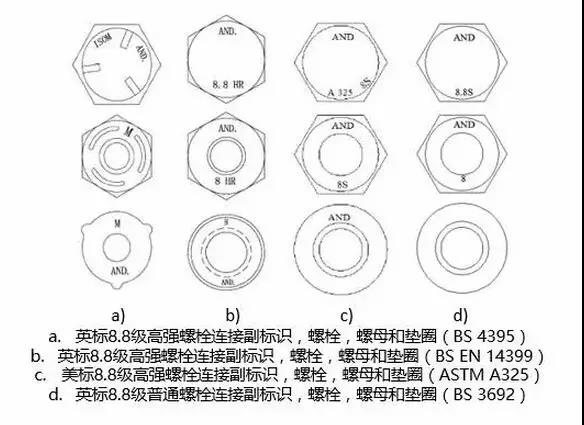
Labeling ordinary bolts and high resistance bolts is the basic method for on -site identification of bolts of the same quality. Since the calculation of the torque values of high resistance bolts in British and American standards is not the same, it is also necessary to identify the bolts of the two standards.
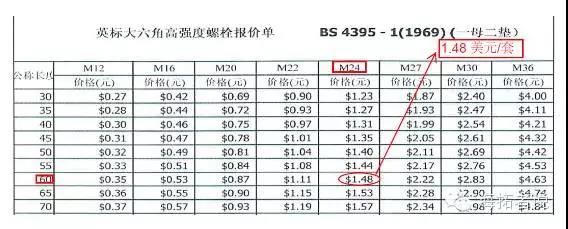
High resistance bolts: (M24, L60, 8.8 grade)
Ordinary bolts: (M24, L60, level 8.8)
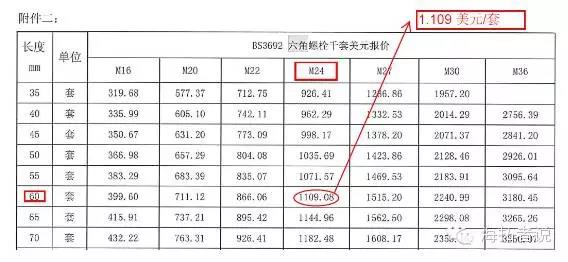
We can see that ordinary bolts represent around 70% of the price of high resistance bolts. material.
4. Summary
For an apparently simple question, it is not a simple thing to understand it in depth in depth, in a complete and correctly. The difference between the definition, the meaning and the deep meaning of the high resistance bolts and the ordinary bolts is the basic prerequisite for our correct understanding, the use of high resistance bolts and construction management.
Point of view
(1) It is indeed offered in certain books on steel structures that high resistance bolts refer to bolts with resistance exceeding 8.8 levels. For this point of view, first of all, British and American standards do not support it, and there is no “strong” and “low” definition for a certain specific level of intensity. Second, it does not comply with the “high resistance bolts” mentioned in our work.
(2) For the sake of comparison, the conditions of constraint of the groups of complex bolts are not considered here.
(3) The high -resistance to pressure bolts also consider the pressure force of the screw during the design. the back.
What do you know about high resistance bolts?
In production, the full name of the high resistance bolt is called a pair of high -resistance bolt connections, and is generally not simply called high resistance bolts.
Depending on the characteristics of the installation, it is divided into: large hexagon head bolts and torsion shear bolts. Among them, the type of torsion shear is only used in level 10.9.
Depending on the performance levels of high resistance bolts, they are divided into: 8.8 and 10.9. Among them, there are only large hexagonal bolts with high resistance in the level of 8.8. , the ratio of the real measured value of the elasticity limit and the real measured value of the resistance to the limit traction. Level 8.8 means that the tensile resistance of the bolt stem is not less than 800 MPa, and the elasticity limit ratio is 0.8;
The diameter of high resistance bolts in structural design is generally M16 / m20 / m22 / m24 / m27 / m30, but M22 / m27 is the second choice of choice.
In terms of shear resistance design, high resistance bolts are divided into: high resistance bolt pressure type and high -resistance bolt friction type as a function of design requirements.
The support capacity of the type of friction depends on the non -slip coefficient and the number of friction surfaces on the force of force transfer surface. considerably affected by the level of construction and many supervision units are supervised.
The loading capacity of the type bearing the pressure depends on the minimum value of the bolt shear resistance and the bolt pressure bearing capacity. When there is only one connection surface, the shear capacity of the type of friction M16 is 21.6 ~ 45.0 kn, while the shear capacity of the pressure type M16 is 39, 2 ~ 48.6 KN, which is better than the type of friction.
In terms of installation, the pressure process is simpler and the connection surface should only be removed from oil and floating rust. The traction bearing capacity along the axis management is very interesting in the specification of the steel structure. Value of design resistance to the traction of materials, which seems to be large differences, in fact, the two values are fundamentally the same.
When you wear the shear force and the traction force in the direction of the stem of the stem at the same time, the requirement of the friction type is the ratio of the shear force supported by the bolt and the load capacity shear and the sum of the axial force borne by the screw and the screw The tensile load capacity stress ratio is less than 1.0. The strength to the load capacity of the traction of the screw is less than 1.0, that is to say, in the same load combination, the pressure bearing of the same diameter is less than 1.0. High resistance bolts for the type of friction.
Since the connection friction surface can fail under a repeated action of a strong shock, the shear capacity at this time still depends on the bolt shear resistance and the pressure capacity of the plate. The resistance bolts are shealed.
Although the type bearing the pressure has an advantage in the digital design value, as it belongs to the type of shear failure, the bolt hole is a hole hole hole similar to ordinary bolts, and deformation when it is under load is much greater than the type of friction, so that the high resistance bolts are under pressure.
There are also differences in limited states of normal use of these two types:
The connection of the type of friction refers to the relative sliding of the connection surface under the basic combination of the loads;
The carrier connection refers to the relative shift between connectors under the action of the standard load combination;
Ordinary bolts
1. Ordinary bolts are divided into three types: A, B and C. The first two are refined bolts, which are rarely used. In general, ordinary bolts refer to ordinary class C bolts.
2. In some temporary connections and connections that must be removed, ordinary C level bolts are often used. The ordinary bolts commonly used in construction structures include M16, M20 and M24. The diameter of raw bolts in certain machine industries can be relatively large and have special uses.
Strong bolts
3. The materials of high resistance bolts are different from those of ordinary bolts. High resistance bolts are generally used for permanent connections. The commonly used are M16 ~ m30. Extra -ar-wide specifications of high resistance bolts have unstable performance and must be used with caution.
4. Connections of the main components of the building structure are generally in high resistance bolts connections.
5. High resistance bolts that are made in factory are not divided into pressure or friction.
6. Is it a high resistance bolt of the friction type or a high pressure type bolt? In fact, there are differences in design calculation methods:
(1) Bolts with high resistance of friction type have the ultimate state of sliding between plates and layers.
(2) High resistance bolts carrying pressure have slipped between plates as a limit of normal use, while connection failure is the limit of load capacity.
7. Strong resistance bolts can not fully use the potential of the bolts. In practical applications, high resistance bolts of a friction type must be used for very important structures or structures which carry dynamic loads, in particular when the loads cause a reverse constraint, and at present, the potential of Unexploited bolt can be used as a safety reserve. In addition, high resistance bolts connecting the pressure should be used to reduce costs.
The difference between ordinary bolts and high resistance bolts
8. Ordinary bolts can be reused, while high resistance bolts cannot be reused.
9. High resistance bolts are generally made of high resistance steel (n ° 45 in steel (8.8s), 20 mmtib (10.9s) and are prestressing bolts. The type of friction uses a torque key to apply The prestressing and the pressure- The type of rolling unscrews the plum flower head.
10. The ordinary bolts are generally of grade 4.4, 4.8, 5.6 grade 5.6 and 8.8. The high resistance bolts are generally classes of 8.8 and classes 10.9, with most classes 10.9.
11. The screw holes of the ordinary bolts are not necessarily larger than those of high resistance bolts. In fact, ordinary bolts have relatively small holes.
12. The screw holes A and B of ordinary bolts are generally only 0.3 to 0.5 mm more than the bolts. The level C screw hole is generally 1.0 to 1.5 mm more than the bolt.
13. The bolts with high resistance of friction type transmit loads by friction, so that the difference between the screw and the screw hole can reach 1.5 ~ 2.0 mm.
14. The characteristic of force transfer of the high resistance bolt bearing the pressure is to guarantee that under normal use, the shear force does not exceed the friction force and is the same as the high resistance friction bolt. When the load increases again, a relative shift will occur between the connection plates. The screw and screw hole are slightly smaller, ranging from 1.0 to 1.5 mm.
Anchoring bolt on column
15. There is no grade for anchor bolts, only materials: Q235 and Q345. The most commonly used anchor bolts in the construction structures are the anchoring bolts on a column.
16. The anchoring bolt on foot of the column is neither an ordinary bolt nor a high resistance bolt. Strictly speaking, it does not belong to a bolt. The anchoring bolts on the column are generally M20 or M24.
17. The manufacturing standards for the anchoring bolts on foot of the column must be the same as those of the ordinary bolts. The length of the anchor bolt on the buried column must be linked to the friction force with the concrete and the shape of the anchor bolt.
Expansion bolts and chemical bolts
18. Whether it is an extension anchoring bolt or a chemical anchoring bolt, it is not a form of connection in standard national specifications. All must use pre-incorporated parts.
19. The extension anchoring bolt is mainly based on the friction between the extension tube and the concrete to resist traction. The extent of the tensile resistance is linked to the construction process and has a large human factor, so there is no need to conduct traction experiences in random inspections.
20. The chemical anchor bolts are made by punching machines, then poured into a chemical suspension and put the bolt rod to form an anchor effect.
21. The expansion bolts and the chemical bolts are actually anchor bolts. In some cases, expansion bolts or chemical anchors are necessary because there is no pre-packaging in advance. But this situation should be avoided in design efforts. Because the anchor bolts must be pre-buried. For example, the anchoring bolt on the column. Because it is only in this way that the best connection and portage force can be ensured. In addition, the punch of the holes thereafter often damages the steel bars stressed in concrete and concrete itself.
22. In the specification of concrete, the components integrated into concrete are called integrated parts. According to documents from the Ministry of Construction, the expansion bolts should not be used in the rideaux walls. Generally, expansion anchoring bolts are strictly prohibited for new construction projects, and pre-highly should be used.
Daguang focuses on providing solutions such as precision CNC machining services (3-axis, 4-axis, 5-axis machining), CNC milling, 3D printing and rapid prototyping services.



















