
Durability CNC Alloy Machining Services
This guide helps engineers and buyers pick a supplier whose machining process actually preserves the alloy's fatigue life, not just its drawing dimensions. It covers alloy selection, heat treatment timing, tool paths, inspection depth and finish, so you can judge a quote before you commit.
In this article
- 1
- 2
- 3
- 4
- 5
- 6
- 7
What decides durability before you order
Durability CNC alloy machining services: criteria table
Use this table to compare quotes on the points that actually affect part life.
| Criterion | Weak signal | Strong signal | Why it matters |
|---|---|---|---|
| Alloy traceability | Grade name only | Mill certs with heat number | Confirms chemistry and temper |
| Heat treatment | Not mentioned | Sequence stated in DFM | Controls distortion and stress |
| Tolerance | ±0.05 mm claimed | ±0.005 mm with report | Fits mating parts without rework |
| Surface finish | Ra 3.2 μm only | Ra 0.8–1.6 μm available | Affects fatigue and sealing |
| Inspection | Final check only | Raw, in-process, final | Catches problems before shipping |
| Certifications | One general cert | ISO 9001, IATF 16949, ISO 13485 | Matches your industry audits |
| Lead time | Vague estimate | 3–5 days after production start | Keeps your build on schedule |
| Order size | High MOQ | One prototype to 10,000+ | Lets you validate before scaling |
How alloy choice and heat treatment shape durability
Durability in a machined alloy part comes from three things working together: the alloy chemistry, the temper, and the way the tool meets the material. A 7075-T6 bracket and a 6061-T6 bracket can share the same drawing, yet the 7075 part carries much higher strength and lower elongation. That trade matters when the part sees vibration or shock. Higher strength usually means less tolerance for stress raisers, so sharp internal corners become a real risk.
Heat treatment timing is the point most quotes skip. If a supplier machines 17-4 PH in the solution-treated condition and then ages it, you get one set of dimensions and one level of distortion. If they machine after aging, the part is harder to cut but stays closer to final size. Neither path is wrong. The problem is when nobody states which one is used, because the buyer cannot predict flatness or hole position after the furnace run.
Residual stress is the quiet killer. Every roughing pass bends the material slightly under the cutter. If a shop removes 6 mm of stock in one heavy pass, the part may spring when it is unclamped, and a later finishing pass cannot recover the lost geometry. Rough, stress-relieve, then finish is the safer sequence for long or thin alloy parts.
For corrosive service, the alloy family sets the ceiling. 316L and 17-4 PH resist chlorides far better than 400-series stainless. Inconel holds strength at high temperature but eats tool life. Magnesium AZ31B and AZ91D are light and machine fast, yet they need careful chip control because fine magnesium swarf ignites easily.
- 1Match temper to loadT6 for stiffness, annealed stock when you must form after machining.
- 2State the heat-treat stepAsk whether aging happens before or after the last finishing cut.
- 3Relieve before finishingEspecially on parts longer than 300 mm or with thin walls.
- 4Check corrosion pairingsAvoid mixing 400-series stainless with aluminum in wet environments.
Tool paths, clamping and finish that protect fatigue life
Tool path strategy shows up in the surface you cannot see. A constant-engagement path keeps chip load steady and spreads cutting heat, which lowers the tensile stress left in the skin of the part. A traditional zig-zag roughing pass with a full-width cut does the opposite. On a 4,000 mm long aluminum extrusion, that difference can decide whether the part cracks at a bolt hole after a few thousand cycles.
Clamping pressure is easy to overlook. Thin-wall alloy housings can be squeezed out of round by vise jaws, then spring back after release. Soft jaws machined to the part profile, or vacuum fixturing on flat plates, hold the work without deforming it. If a shop only offers standard vises, thin-wall durability work is a poor fit.
Surface finish is not cosmetic on a fatigue part. As-machined Ra 1.6–3.2 μm leaves tool marks that act as crack starters under cyclic load. Bringing the critical fillets and bores to Ra 0.8–1.6 μm, or Ra 0.2–0.8 μm on sealing faces, removes those initiation sites. Bead blasting or shot peening then puts the surface into compression, which is one of the cheapest ways to extend life.
Coating choice follows the wear mode. Hardcoat anodizing on 6061 gives a wear-resistant, electrically insulating skin. Electroless nickel adds corrosion resistance and uniform thickness on complex geometry. Black oxide is thin and mainly for appearance and mild corrosion protection. Pick the finish from the failure you expect, not from a catalog photo.
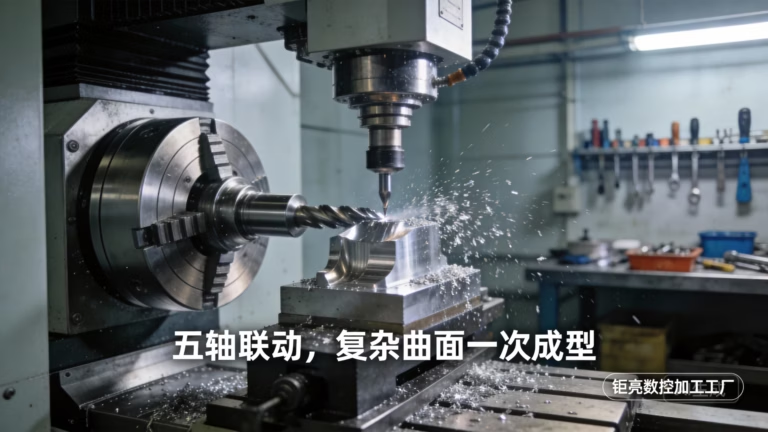
A shop that runs 16 simultaneous 5-axis centers and 16 mill-turn centers can keep a complex alloy part in fewer setups. Fewer setups mean fewer chances to introduce a locating error or a clamp mark, and that directly supports the durability goal.
- 1Ask for constant-engagement roughingLower radial depth, higher feed, steadier thermal load.
- 2Use soft jaws or vacuumProtects roundness on thin-wall housings and covers.
- 3Specify finish by functionRa 0.8–1.6 μm on fillets and bores, finer on seals.
- 4Peen high-cycle partsCompressive surface layer delays crack initiation.
How to vet a supplier for durability CNC alloy machining services
Start with the quotation itself. A useful quote names the alloy and temper, the tolerance it will hold, the finish range, the inspection steps and the expected ship window. A quote that lists only a price and a part number gives you nothing to compare. At GreatLight, quotation and free DFM analysis come back within 12 hours, and production can start within 24 hours of approval.
Ask what happens when a dimension is marginal. A durability-focused shop flags it during in-process monitoring, corrects the cut, and documents the change. A shop that only inspects at the end has to scrap or ship with a deviation. The difference is not talent, it is whether inspection is built into the route card.
Check certifications against your own audit list. ISO 9001:2015 covers general quality management. IATF 16949:2016 matters for automotive and EV programs. ISO 13485:2016 applies to medical devices. ISO 27001:2022 covers information security, which matters if your drawings are confidential. A supplier holding all four is set up for regulated buyers.
Confirm order flexibility. For durability work you often want one or two prototypes to test before committing to volume. No minimum order quantity means you can run a single piece, measure it, and adjust the design. Runs from one prototype to 10,000+ parts keep the same supplier on the job through validation and production.
Finally, look at machine mix. Durability problems often come from a part that needs five faces machined or a turned feature plus milled pockets. A shop with 5-axis and mill-turn capacity can do that in one or two setups. A shop limited to three-axis work will add setups, and each one adds risk.
- 1Read the quote line by lineAlloy, temper, tolerance, finish, inspection and ship window should all appear.
- 2Match certs to your industryIATF for automotive, ISO 13485 for medical, ISO 27001 for IP security.
- 3Prototype before volumeNo MOQ lets you verify durability on a single piece first.
- 4Count the setups5-axis and mill-turn capacity reduces handling and locating error.
When durability CNC alloy machining services are the wrong fit
Machining is not always the durable answer. If the part is a large thin shell with uniform wall thickness, die casting or sheet metal fabrication may give better stiffness per dollar. If the geometry is hollow with internal channels, vacuum casting or 3D printing can produce it in one piece where milling would need several bonded sections. Bonded joints are usually the weak point in a fatigue environment.
Very hard materials push the other way. Inconel and fully hardened tool steel machine slowly and wear tools fast, so cost per part climbs. If the design allows a softer alloy with a wear coating, that route often lasts longer for less money. The coating takes the wear while the softer core absorbs shock.
There is also a size limit to respect. Our maximum processing size is 4,000 mm, with large travels of 4,000 × 400 × 150 mm and a Ø400 mm rotary table for round work. Parts beyond that envelope need a different process or a split design, and splitting adds fasteners and joint fatigue.
One more boundary: cosmetic requirements that fight function. A mirror polish on a load-bearing fillet can remove the compressive layer you wanted. If appearance and fatigue life both matter, decide which surfaces get polished and which keep a controlled machined texture.
- 1Thin uniform shellsConsider die casting or sheet metal before machining.
- 2Internal channelsCasting or additive may beat a multi-piece machined assembly.
- 3Hard alloysInconel and hardened tool steel raise cycle time and tool cost.
- 4Size ceilingCheck the 4,000 mm envelope before you design around machining.
Five steps to specify and verify a durable alloy part
- 11. Define the failure mode firstWrite down whether the part fails by fatigue, wear, corrosion or impact. That single sentence decides alloy, temper and finish. A wear problem and a fatigue problem rarely want the same surface treatment.
- 22. Fix the alloy and temper in the drawingState the grade and temper, for example 7075-T6 or 17-4 PH H900. Add the heat-treat sequence if distortion matters. Avoid writing only 'aluminum' or 'stainless' because the shop will pick whatever is on the shelf.
- 33. Set tolerance and finish by featureReserve ±0.005 mm and Ra 0.8–1.6 μm for mating bores, bearing seats and fillets. Let non-critical pockets run at Ra 1.6–3.2 μm. Blanket tight tolerances raise cost without adding life.
- 44. Ask for the process route in the DFMThe free DFM analysis should list roughing, stress relief if needed, finishing and inspection points. If stress relief is missing on a long thin part, ask why before you approve.
- 55. Require inspection records on the first articleRequest raw material certs, in-process notes and a final dimensional report. 100% inspection before shipment is our standard, and reports are available on request. Keep the first-article record for your own traceability file.
Durability CNC alloy machining services: common questions
Which alloy gives the best durability for a load-bearing bracket?
For stiffness with moderate weight, 7075-T6 aluminum is a common choice, and 6061-T6 is easier to machine and weld. For higher temperature or corrosive service, 17-4 PH stainless or Inconel holds up better.
The alloy only sets the ceiling. Tool path, fillet radius and surface finish decide how close the part gets to that ceiling in service.
Should heat treatment happen before or after machining?
It depends on the alloy and the flatness you need. Machining in the annealed or solution-treated state is easier on tools, but the part may move during aging. Machining after aging keeps dimensions stable but raises cutting forces and tool wear.
Ask the shop to state the sequence in the DFM. If the part is long or thin, plan a stress-relief step between roughing and finishing.
What tolerance and finish can you hold on alloy parts?
We hold ±0.005 mm (±0.0002 in) on critical features. Standard machined finish is Ra 1.6–3.2 μm, with Ra 0.8–1.6 μm available as the normal fine finish and Ra 0.2–0.8 μm on request for sealing faces.
Tell us which features carry load or seal. Applying tight numbers everywhere adds cost without improving durability.
Do you have a minimum order quantity for durability testing?
No. There is no minimum order quantity, so you can start with one prototype and measure it before committing to volume. We run from a single piece to 10,000+ part runs on the same process.
That matters for durability work because the first article is where you find out whether the design and the process agree.
How do you protect confidential alloy drawings?
Uploads are secure and confidential, and an NDA is available on request. We also hold ISO 27001:2022 for information security, alongside ISO 9001:2015, IATF 16949:2016 and ISO 13485:2016.
If your program needs a signed agreement before files move, ask for it at the quote stage.
What lead time should I plan for?
Quotation and free DFM analysis come back within 12 hours, production can start within 24 hours, and parts typically ship in 3–5 days after that.
Heat treatment, plating and anodizing add outside process time, so mention those finishes early if your schedule is tight.
Send your alloy part for a durability-focused quote
Upload the drawing and we will return a quote with alloy, tolerance, finish and inspection notes within 12 hours.
12-hour quote and free DFMNo minimum order quantity100% inspection before shipmentNDA available on request
More alloy machining notes
We publish setup notes, tooling trials and inspection data from the factory floor.











