
Do CNC Machining Centers Use Ball Guides and Roller Guides?
['Yes. Almost every vertical machining center on the market uses one of these two linear guide types. The choice changes how the machine behaves under load, not just how it is priced.', 'This page is written for process engineers and machine buyers who need to read a spec sheet and know which guide fits a given part and tolerance.', 'By the end you should be able to tell when ball guides and roller guides differ in practice, and where the difference stops mattering.']
In this article
- 1
- 2
- 3
- 4
- 5
- 6
How ball guides and roller guides carry a cutting load
A linear guide is a rolling interface. The carriage on a CNC machining center does not slide across the rail; it rolls over a set of elements held in a cage. Ball guides use spheres. Roller guides use short cylindrical rollers. That single geometric difference drives almost everything else.
A sphere touches the raceway at one point. When the carriage is loaded, that point deforms into a small elliptical contact patch. Four rows of balls in a typical block give four such patches. Rollers touch along a line instead, so the same load spreads over a much larger area. The roller block usually carries two to three times the load of a comparable ball block.
The practical result is stiffness. Line contact resists elastic deflection better, which matters when a face mill pushes the table sideways. On a lightly loaded finishing pass the difference is small. On a heavy roughing cut it shows up as chatter, surface finish variation and tool wear.
Both types are preloaded at assembly. Preload removes internal clearance so the carriage has no free play. Too little preload and the axis feels loose at direction changes. Too much and friction, heat and wear all rise. Guide makers publish preload classes, and the machine builder picks one to match the intended duty.
- 1Point contactBall guide: small contact patch, lower load capacity, lower friction.
- 2Line contactRoller guide: long contact patch, higher stiffness, higher friction.
- 3PreloadBoth types run preloaded to remove clearance and backlash.
Where rigidity changes the cut: chatter and surface finish
Rigidity is the property that decides whether a cut sounds clean or squeals. The guide is one spring in a chain that also includes the ball screw, the bed casting and the spindle. Roller guides add stiffness at the guide, so a machine with them can usually take a deeper radial cut at the same spindle speed before chatter starts.
That matters most with long overhang tools and hard materials. A 16 mm end mill at 4× diameter reach in 4140 steel will deflect the whole loop. If the guide contributes less compliance, the stable cutting window widens. Titanium and Inconel parts feel this more than aluminium.
Surface finish follows the same logic. Chatter leaves a pattern of marks, and those marks are what a profilometer reads as Ra. Ball guides that deflect under load can push a nominal Ra 0.8–1.6 μm finish into Ra 1.6–3.2 μm territory on the same program.
There is a limit to this. If the part is thin, the workpiece itself is the weakest spring, and no guide upgrade will fix it. Guide rigidity only helps when the guide is the dominant compliance in the loop.
- 1Roughing in steelRoller guides hold the stable window wider.
- 2Thin-wall partsWorkpiece deflection dominates; guide choice matters less.
- 3Long toolsTool overhang amplifies any guide compliance.
Friction, rapid speed and position accuracy
Rolling friction is low in both designs, but a ball contacts the raceway over a point and slips slightly as it rolls. Rollers slip less. In practice the friction difference is small and the preload setting has more influence on drag than the element shape.
Where the difference becomes visible is rapid traverse. Lighter balls accelerate with less inertia, so ball-guide machines often quote higher rapid rates on the same drive. Roller carriages are heavier and need a bit more torque to reverse. For a job with long tool-to-tool moves this affects cycle time.
Position accuracy is a closed-loop property. The scale or encoder reports where the axis actually is, and the control corrects. A stiff guide reduces the correction the servo has to make, so following error at high feed drops. That is why roller guides show up on machines cutting at high feed with tight contour tolerance.
Thermal growth is the other side of friction. Higher drag means more heat in the guide, and heat moves the rail. Machines with roller guides usually need a warm-up cycle before holding ±0.005 mm across a long batch.
- 1Rapid traverseBall guides usually quote higher rapid rates.
- 2Following errorStiffer guides reduce servo correction at high feed.
- 3Warm-upRoller-guide machines benefit from a spindle and axis warm-up.
Service life, contamination and maintenance
Load capacity divides into static and dynamic ratings. Static rating is the load the guide can take without permanent raceway damage. Dynamic rating predicts fatigue life in kilometres of travel. Roller guides win on both, which is why heavy gantry and double-column machines use them on the X axis.
Contamination is the weak point of both designs. Chips and fine dust that reach the raceway will indent it, and an indentation becomes a bump every pass. Rollers are slightly more tolerant of a small particle because the contact line can bridge it, but neither type survives a failed wiper.
Maintenance is mostly about lubrication and seals. Linear guides need grease at the interval the builder specifies, and the wiper and scraper sets need replacing when they harden. A machine that runs dry will show guide noise before it shows a dimensional problem.
For a shop running three shifts in aluminium, ball guides are usually enough. For a shop cutting hardened steel or running a heavy first op all day, roller guides pay back over the machine life.
- 1Static ratingRoller guides take higher peak loads without brinelling.
- 2Dynamic lifeRoller guides last longer under the same cyclic load.
- 3SealsContamination kills both types faster than load does.
Which parts actually need the stiffer guide
The guide is only one variable in a machining quote. When we plan a job, we look at three things: how much material comes off, how tight the tolerance is, and how long the tool reaches.
A bracket in 6061 with ±0.05 mm tolerance and a 6 mm cutter does not need roller guides. A mould insert in 17-4PH with ±0.005 mm tolerance, deep pockets and a long reach tool does. The difference shows in tool life and in how many spring passes are needed to hit the dimension.
For five-axis work the rotary table adds its own compliance. A Ø400 mm rotary table with a heavy fixture can be softer than the linear guide, so the guide choice stops being the limiting factor. It is worth checking the whole loop before paying for a stiffer axis.
The honest answer is that most parts can be made on either machine. The guide type decides how easily, how fast, and how much the tooling costs to get there.
- 1Needs rollerHard steel, deep pockets, long tools, tight tolerance.
- 2Ball is fineAluminium, moderate tolerance, short tools, high mix.
- 3Check the loopRotary table and fixture may dominate compliance.
Ball guides and roller guides compared
Ratings assume comparable block sizes from the same maker.
| Property | Ball guide | Roller guide |
|---|---|---|
| Contact geometry | Point contact on four rows | Line contact on two to four rows |
| Load capacity | Lower | Roughly 2–3× higher |
| Rigidity | Moderate | High |
| Friction | Low | Slightly higher |
| Rapid traverse | Usually higher | Slightly lower |
| Cost | Lower | Higher |
| Best for | Aluminium, high-mix, finishing | Steel, heavy cuts, tight tolerance |
| Main wear risk | Raceway indentation | Raceway indentation and seal wear |
When to pick which
If the job is aluminium, high-mix and moderate tolerance, ball guides are the cost-effective choice. If the job is hardened steel or titanium with ±0.005 mm tolerance and long tools, roller guides on the cutting axes are worth the extra machine cost.
Questions engineers ask about linear guides
Can a CNC machining center use ball guides on one axis and roller guides on another?
Yes, and some builders do exactly that. The Z axis often carries less side load than X and Y, so a ball guide there is a reasonable cost trade.
The catch is matching stiffness across axes. If Z is much softer than X and Y, a 3D contour cut can show a different error in each direction. Builders compensate in the control, but the machine is no longer uniform.
Do roller guides always give better accuracy?
No. Accuracy comes from the encoder, the ball screw and the thermal stability of the frame as much as from the guide.
Roller guides help repeatability under load, which is what matters when the cutting force changes during a pass. On a light finishing cut with a sharp tool the two types can hold the same tolerance.
How do I know if the guides on my machine are worn?
Listen first. A dry or damaged guide makes a rhythmic noise that changes with feed rate.
Then check backlash with a dial indicator against a commanded move, and look for a surface finish that varies along one axis. A single-axis finish change usually points at the guide or the ball screw, not the spindle.
Does guide type change the surface finish I can ask for?
It changes how easily a finish is reached, not the ceiling. A machine with roller guides and a good spindle can hold Ra 0.2–0.8 μm on the right material.
On a ball-guide machine the same target may need a lighter finishing pass and a sharper tool to avoid chatter marks. Both can get there with the right parameters.
Are roller guides harder to maintain?
Not by much. Both need grease at the builder's interval and clean wipers.
Roller carriages are heavier, so handling them during a rebuild takes more care. Lubrication volume is similar, and the failure signs are the same: noise, heat and finish drift.
Should I check the guide type before sending a part for quotation?
It is worth asking which machines will run the job. The answer tells you whether tight tolerance and hard material are a good fit for that shop's capacity.
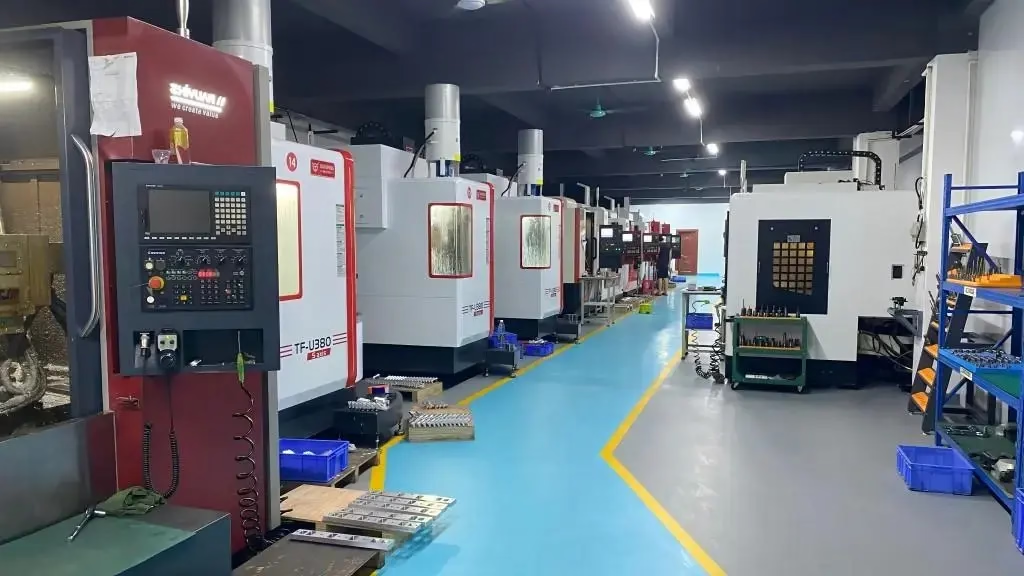
At GreatLight we run 127 high-precision CNC machines, including 16 simultaneous 5-axis centers, and we match the machine to the part rather than the other way round.
Send us the drawing and we will match the machine
Upload a STEP file and we return a quotation with free DFM analysis within 12 hours. No minimum order quantity, from one prototype to 10,000+ part runs.
12-hour quote100% inspectionNDA on request
More from GreatLight
We publish setup notes, tooling trials and inspection data from the factory floor.











