

The Comprehensive Guide to Resin 3D Printing: SLA vs. DLP Technologies Unveiled
Understanding Resin 3D Printing Fundamentals
Resin-based 3D printing has revolutionized rapid prototyping and manufacturing by enabling unprecedented precision and surface quality. Unlike filament-based methods, photopolymerization technologies cure liquid resin into solid objects using light energy, typically in the 365–405 nm ultraviolet (UV) spectrum. The process hinges on photochemical crosslinking, where UV-exposed monomers and oligomers in acrylic or epoxy-based resins polymerize, forming rigid molecular bonds layer by layer.
Key Advantages and Limitations
- Superior Resolution: Capable of achieving micron-scale details (25–100 μm), ideal for jewelry, dental models, and microfluidics.
- Material Constraints: Limited selection compared to FDM—options include standard, flexible, castable, and biocompatible resins, but high-temperature or engineering-grade variants remain scarce.
- Post-Processing Demands: Requires isopropanol washing and UV post-curing to achieve final mechanical properties, adding complexity.
Stereolithography (SLA): Laser-Powered Precision
Evolution and Core Mechanics
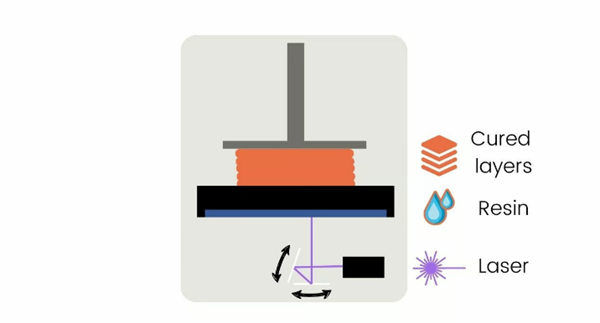
Invented by Chuck Hull in 1986, SLA pioneered industrial 3D printing. Modern systems predominantly use a bottom-up approach:
- A UV laser diode (e.g., 405 nm) precisely targets resin points via galvanometer mirrors (galvos).
- The laser scans cross-sectional contours raster-style, solidifying material point-by-point.
- The build plate incrementally rises after each layer, allowing fresh resin to flow beneath.
Technical Advantages and Drawbacks
- ✅ Exceptional Surface Finish: Continuous laser paths eliminate pixelation, producing optically smooth surfaces suited for molds and optical components.
- ✅ Consistent Energy Delivery: Focused laser beams ensure uniform curing depth.
- ❌ Speed Limitations: Printing time scales with model complexity due to sequential laser scanning.
- ❌ Proprietary Material Ecosystems: Laser wavelength specificity often locks users into manufacturer resins.
Digital Light Processing (DLP): Speed Through Projection
Innovation and Operational Principles
Leveraging Texas Instruments’ 1987 DLP chip technology, DLP replaces lasers with a digital micromirror device (DMD)—an array of microscopic mirrors that modulate UV light from an LED projector. Each layer exposes the entire cross-section simultaneously as a 2D image:
- Micromirrors tilt to reflect light or block it, creating UV "pixels".
- High-intensity LEDs project full-layer images onto the resin vat.
- Layer times remain fixed, whether printing one or ten identical parts.
Performance Trade-Offs
- ✅ Unparalleled Throughput: Layer curing in 1–10 seconds enables rapid batch production.
- ✅ Lower Entry Cost: Simplified optics reduce machine prices (as low as $300).
- ❌ Pixel Artifacts: Images may show stepped edges due to rectangular pixels (addressed via anti-aliasing in modern systems).
- ❌ Z-Axis Uniformity: Projector focal length constraints must stay <30–60 cm, restricting build volumes.

LCD (mSLA): The Cost-Efficient Hybrid
Masked Stereolithography (mSLA) illuminates resin through a high-transparency LCD panel, acting as a dynamic photomask. Unlike DLP:
- Monochrome LCDs transmit >80% of UV light, enabling faster prints than older RGB screens.
- Visible light resins (405–420 nm) allow standardized components but require unique formulations.
- Dominates the hobbyist market with sub-$300 printers but lags in industrial adoption.
SLA vs. DLP: Critical Comparison
| Key Factor | SLA | DLP |
|---|---|---|
| Light Source | Single-point laser | Full-layer LED projector |
| Print Speed | Depends on model complexity | Fixed per layer; faster for large builds |
| Surface Quality | Smooth continuous surfaces | Minor pixelation; optimized with anti-aliasing |
| *Resolution Scalability | Independent of build volume | Larger volumes reduce pixel density |
| Cost | $$$ (Premium systems >$3000) | $$ (Desktop systems from $300) |
| Calibration | Requires professional service | User-adjustable parameters |

Selecting the Right Technology
- Choose SLA For: Medical implants, optical lenses, or master patterns demanding <25 μm tolerances.
- Opt for DLP When: Batch-producing jewelry, dental aligners, or figurines at competitive speeds.
- Consider mSLA If: Budget-constrained prototyping or educational use justifies minor quality trade-offs.
Material advancements remain pivotal—companies like BASF and Formlabs are expanding resin capabilities for both technologies, reducing performance gaps. Hybrid systems employing lasers for edges and DLP for infill (e.g., Carbon’s CLIP) may dominate the next wave.
Final Insight: The SLA-DLP dichotomy persist by balancing precision-versus-throughput. As projector resolutions reach 10K and laser speeds accelerate, the convergence of both technologies will unlock new frontiers in digital manufacturing. What remains unchanged: resin 3D printing’s irreplaceable role in fabricating the microscopically intricate.



















