

Splines are no stranger to most people. Compared with the key connections of the transmission, they have the characteristics of a larger number of teeth, strong load capacity, easy automatic centering and high installation accuracy, and have been widely used.
There are three common types of splines: rectangular splines, involute splines, and triangular splines. Like gears, splines can also be made into drum-shaped teeth and helical teeth, which will not be expanded upon here.
The advantages of rectangular splines are high centering accuracy and good centering stability. Heat treatment deformation can be eliminated by grinding. The dimensional tolerance of centering diameter and position tolerance can achieve high accuracy. According to GB/T 1144, the centering method of rectangular splines is small diameter centering. It is mainly used for fixed or sliding connections under light and medium load conditions.
There are many centering methods for involute splines, including tooth side centering (commonly used), major diameter centering, and minor diameter centering (not commonly used). When loaded, there is a radial force on the teeth, which can play a self-centering role, which is beneficial to the uniform force of each tooth. The root has a rounded transition corner, high strength and long service life. It is used for connections with larger loads, higher centering accuracy requirements and larger sizes.
Triangular splines are easy to process and have small and numerous teeth, which facilitates adjustment and assembly of the mechanism and minimizes damage to the shaft and hub. It is mainly used for static connections with light loads and small diameters, and is particularly suitable for connections between shafts and thin-walled parts, disassembly tools, etc.
The most common spline processing methods are broaching or gear shaping for internal splines, and hobbing or milling for external splines. As shown below.


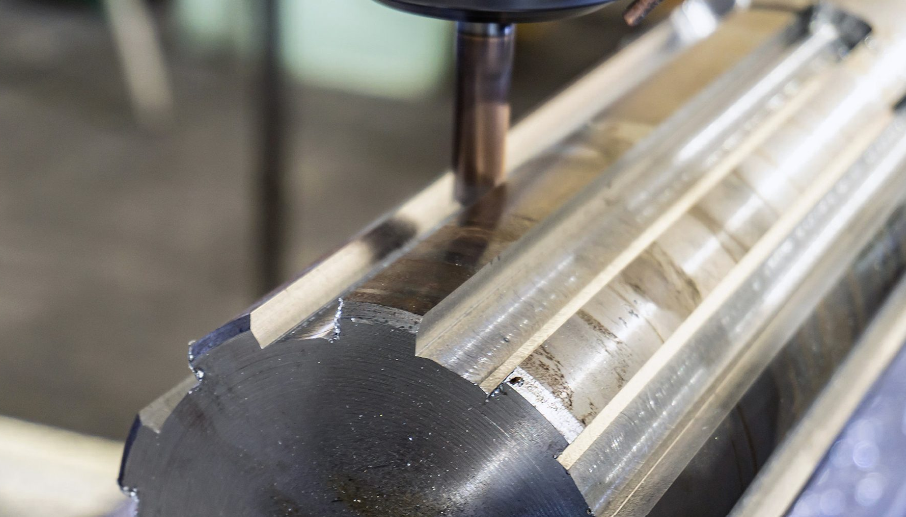
The above processing methods remove material. Additionally, the splines can also be manufactured by extrusion. Including tooth extrusion, tooth rubbing, etc. Here are some photos for your reference.


The extrusion method uses the plastic deformation of the material to make teeth. It ensures a uniform profile across the mold and can minimize material waste. It can be used for large-scale splined shafts. It should be noted that the fluted part to be extruded must be pre-treated to size before rolling (can be calculated using the constant volume principle), so that the desired final size can be obtained after extrusion.
Daguang focuses on providing solutions such as precision CNC machining services (3-axis, 4-axis, 5-axis machining), CNC milling, 3D printing and rapid prototyping services.



















