
CNC Treatment Solution for Coolant for Communication Equipment
A cold plate is only as good as the fluid inside it. This page explains how a CNC treatment solution for coolant controls filtration, chemistry and galvanic risk in liquid-cooled radios, base stations and rack switches. Written for engineers who must specify a loop and defend the choice.
In this article
- 1
- 2
- 3
- 4
- 5
- 6
Why a CNC Treatment Solution for Coolant Decides Loop Life
Most communication equipment does not die from a hot chip. It dies from what the cooling loop leaves behind. A cold plate machined to ±0.005 mm can lose most of its heat transfer in months if the fluid carries scale, biofilm or dissolved ions. The metalwork was never the weak point.
Direct liquid cooling pushes coolant through micro-channels close to the die. Those channels are narrow by design, often under 1 mm wide. Anything that deposits on the wall reduces flow and raises junction temperature. A 20 μm film of biofilm insulates better than the copper it sits on.
A CNC treatment solution for coolant borrows its logic from machine tool coolant management. Filter the fluid, control its chemistry, watch the metals it touches, and keep air out. Those four habits were developed on shop floors and they transfer to a sealed electronics loop with almost no change.
The difference is scale and consequence. A fouled machining sump costs a tool change. A fouled cold plate loop in a remote radio head costs a tower climb. That is why the treatment regime has to be designed into the part, not added after the rack is installed.
Particles and Biofilm: The Two Blockers in Micro-Channels
Filtration is the first lever. Loop filters in the 25–50 μm range catch the debris that a cold plate cannot tolerate. Go finer only if the pump can pay the pressure drop. Every micron of filtration costs something at the pump inlet.
Biofilm is harder. Microorganisms settle in the low-flow zones of a reservoir, then grow into a slime layer that spreads into the channels. Once it anchors, filtration does not remove it. The film also shelters sulfate-reducing bacteria that drive microbiologically influenced corrosion under the deposit.
Once biofilm anchors in a channel, no filter will remove it. The loop has to be flushed and recharged, and the root cause fixed. In practice the root cause is usually stagnant coolant, warm temperatures above 40 °C, and a biocide that was dosed once and never topped up.
Glycol-based fluids resist biological growth better than plain water, but they are not immune. At 30–50 % glycol by volume, growth slows without stopping. Periodic biocide dosing or a maintenance dose keeps the reservoir clean between service intervals.
Particle counters on the return line tell you more than a visual check of the reservoir. A clean reservoir can hide a loading channel that is already shedding oxide flakes from an upstream aluminum fitting.
Galvanic Couples and Ion Balance Inside the Loop
Impure water turns a loop into a small battery. Two dissimilar metals in the same conductive fluid form a galvanic couple, and the less noble metal gives up ions. Aluminum cold plates and copper traces are exactly that pair, and the voltage between them drives localized pitting.
The rate depends on water conductivity, temperature and the surface area ratio between the two metals. A large copper heat exchanger tied to a small aluminum cold plate is the worst case. Pitting on the aluminum side can perforate a thin wall in one season of continuous operation.
Deionized water reduces conductivity, but it does not stay deionized. It leaches ions from every wetted surface until it reaches equilibrium with the metals around it. That is why water alone is a poor long-term choice and why inhibitor packages exist.
Corrosion inhibitors work by forming a thin passive film on the metal surface. The film needs the right pH window, typically 7.5–9.0 for mixed-metal loops, and it needs replenishment as the additive depletes. Inhibitor concentration is a consumable, not a one-time fill.
Mixed-metal loops should use the same alloy family wherever possible. If aluminum and copper must coexist, isolate them with a dielectric fitting at the junction and keep the fluid chemistry inside the inhibitor supplier's window.
Entrained Air, Foam and Pump Cavitation
Air is an insulator. A bubble travelling through a cold plate occupies volume that should carry liquid, and the local heat transfer coefficient drops sharply around it. Entrained air can cut effective cooling capacity well before the pump shows any alarm.
Foam is worse because it feeds pump cavitation. Bubbles collapse against the impeller, erode the surface, and send flow and pressure oscillating. Cavitation damage looks like pitting but it is mechanical, not chemical, and no inhibitor will stop it.
Most air enters through a poorly placed reservoir return or a suction-side leak. A return line that drops into the fluid above the liquid level aerates the tank continuously. Running the return below the surface and adding a baffle solves most of it.
Deaeration takes time. A freshly filled loop needs a bleed cycle before it reaches stable performance. Expect several hours of circulation at reduced heat load, and check the reservoir level again after the first thermal cycle.
What CNC Machining Controls in a Cold Plate
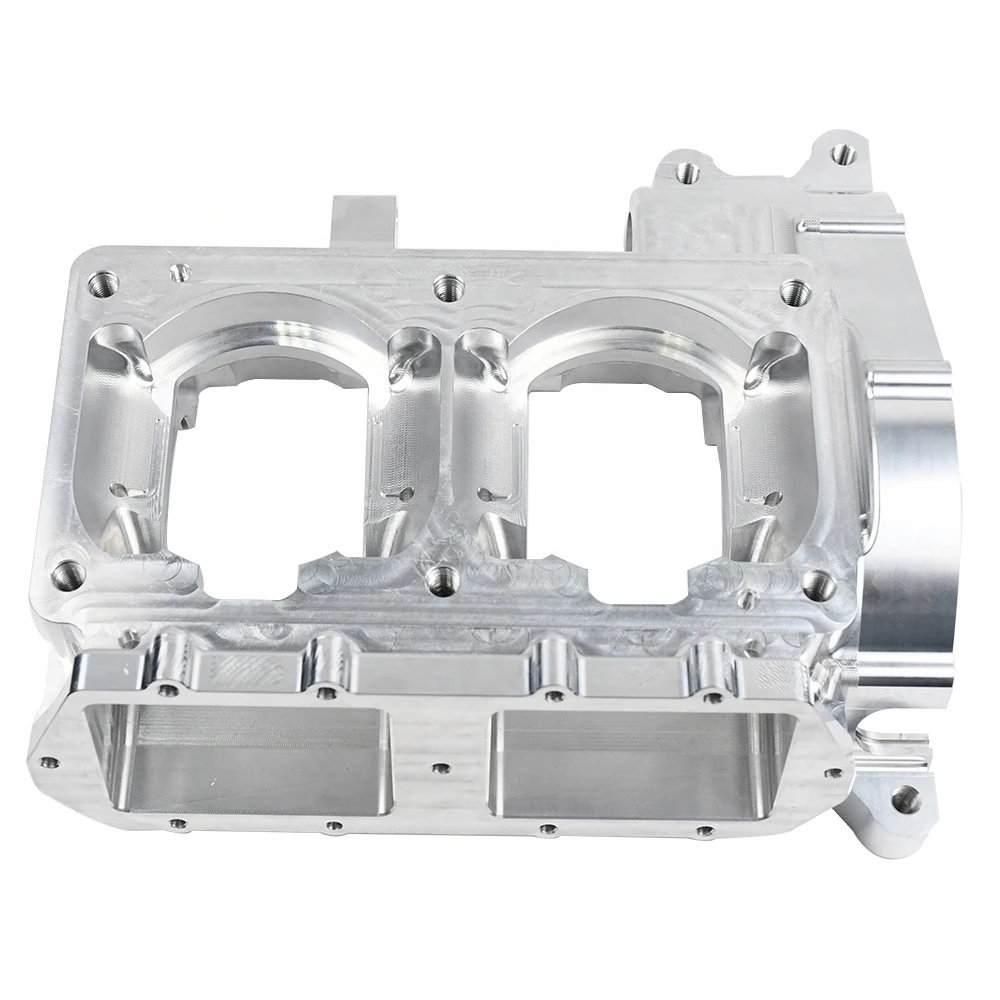
A cold plate is a machined part, and its surface finish sets the baseline for everything downstream. Rough channel walls trap particles and give biofilm a place to anchor. Machining to Ra 0.8–1.6 μm in the channels is a practical target for most communication cold plates.
For tight channel geometry we use 16 simultaneous 5-axis machining centers, which reach features that a three-axis setup cannot. Channel width, fin thickness and floor radius all affect both flow and cleanability. A sharp internal corner is a dead zone for fluid.
Burrs are the most common defect we see in incoming inspection of cooling parts. A burr at a channel edge is a particle source for the life of the part. Deburring and edge break are part of the process, not an optional step.
Material choice matters too. Copper and aluminum both conduct heat well, but they cannot share a loop without isolation. When a design calls for both, we machine the interface features so a dielectric fitting or a coated surface can be installed cleanly.
After machining, every cooling part goes through a cleanliness check and a leak test before shipment. A loop that arrives with machining residue will fail in the field, no matter how good the fluid chemistry is.
Which Loop Chemistry Fits Which Equipment
Pick the fluid and filtration class that matches the hardware, the service interval you can actually support, and the metals in the loop.
| Loop type | Typical fluid | Filtration | Best for |
|---|---|---|---|
| Sealed single cold plate | Deionized water + inhibitor | 25 μm | Edge compute, small radio units |
| Mixed metal rack loop | Glycol 30–50 % + inhibitor | 25–50 μm | Copper and aluminum in one rack |
| Large facility loop | Glycol + biocide program | 50 μm | Data center rows, CDU circuits |
| Prototype or short run | Deionized water + inhibitor | 25 μm | Bench validation, thermal testing |
| High dust environment | Glycol + biocide program | 25 μm | Outdoor cabinets, remote sites |
The Engineering Trade-Off
If the loop is sealed, single-metal and serviced on a fixed interval, deionized water with a maintained inhibitor package is the simplest choice. If it mixes copper and aluminum, or sits in a warm outdoor cabinet, use glycol with a biocide program and accept the lower heat capacity.
Frequently Asked Questions
Does glycol reduce cooling performance?
Yes, and the drop is measurable. A 50 % glycol mix has lower specific heat and higher viscosity than water, so the same pump delivers less heat removal at the same flow.
For most communication equipment the margin absorbs it. Where the design is thermally tight, stay with water and inhibitor and invest more in filtration and biocide control.
How often should coolant be replaced?
There is no universal interval. Replacement depends on inhibitor depletion, conductivity rise and particle counts, not on the calendar.
For a sealed rack loop, sampling every six months and replacing when the inhibitor falls below the supplier's minimum or conductivity drifts outside the window is a workable rule.
Can I mix two brands of coolant?
Do not. Additive packages can react with each other and drop solids into the loop. Two inhibitors that work alone can form a precipitate when combined.
If a change is unavoidable, drain, flush with deionized water, and refill with a single product.
What surface finish do cold plate channels need?
Ra 0.8–1.6 μm is a practical target for most communication cold plates. It limits particle retention without adding cost that does not pay back.
Finer finishes are justified only when the channel is very narrow or the fluid is heavily filtered. Rough walls trap debris regardless of the filter rating upstream.
How do I know if a loop has a galvanic problem?
Watch conductivity, pH and the color of the fluid. Rising conductivity with falling pH and a metallic tint usually means active corrosion.
Confirm with a coupon of the same alloy placed in the return line and inspected at the next service. Coupon weight loss tells you the rate before a wall perforates.
Do you leak test cooling parts before shipment?
Yes. Every cooling part is inspected 100 % before shipment, and reports are available on request.
We can also machine and finish to the interface features needed for a dielectric fitting when a loop mixes aluminum and copper.
Send Us the Cold Plate Drawing
Upload your part and we return a quotation with free DFM analysis within 12 hours. Production can start within 24 hours, and parts ship in 3–5 days.
12-hour quote100% inspectionNo minimum order quantity
More From GreatLight
We publish setup notes, tooling trials and inspection data from the factory floor.











