
CNC Swiss Machine Tool Basics
A guide for engineers and buyers who need small turned parts with tight tolerances. We cover how the sliding headstock and guide bushing work, which geometries benefit, and when a conventional lathe is the cheaper answer.
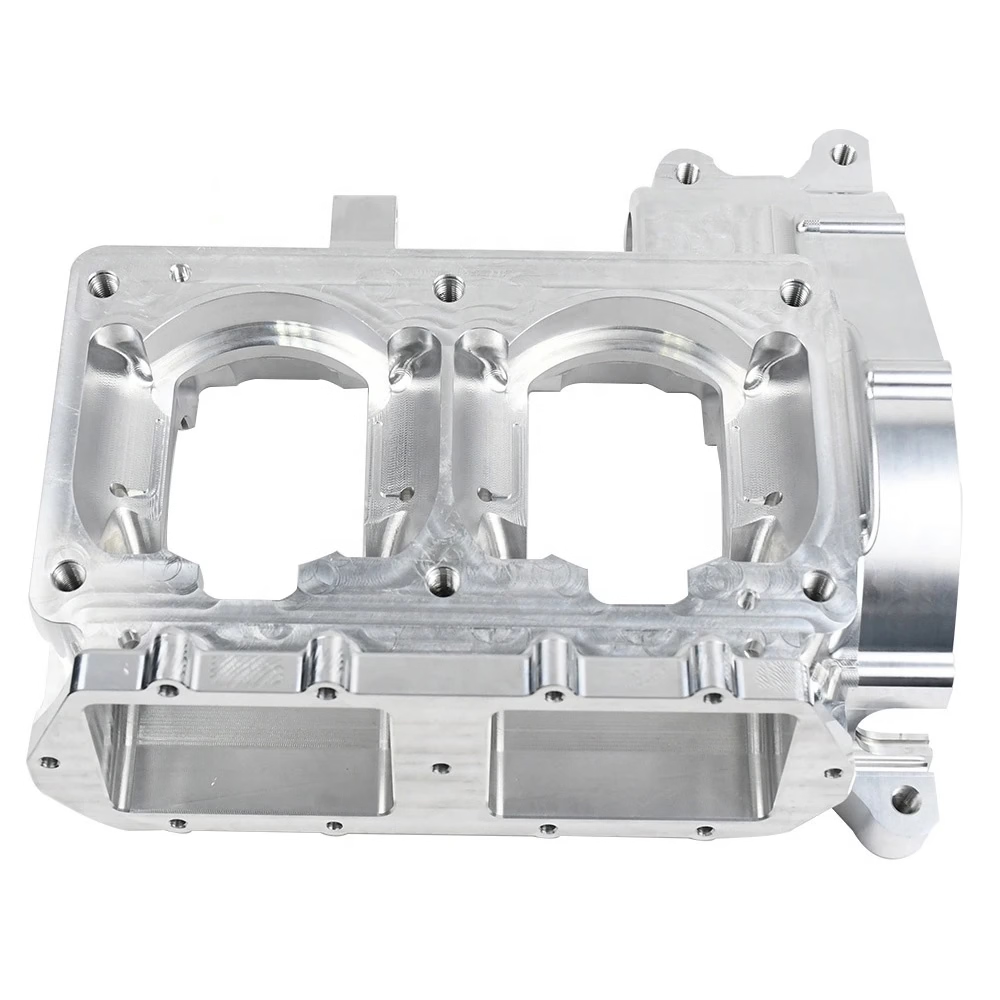
CNC Swiss machine tool basics: how the cut happens
On a conventional lathe, the bar sits still and the tool travels to it. On a Swiss-type machine the bar moves instead. The stock feeds through a guide bushing, and the cutting tools sit within a few millimeters of that bushing face. The bushing supports the bar right where the cut happens.
That short support distance is the whole trick. A Ø3 mm stainless shaft sticking 40 mm out of a chuck will deflect under cutting force. The same shaft inside a guide bushing deflects far less, because the unsupported length is only the depth of cut. This is why the process holds ±0.005 mm on slender parts that chatter on a turret lathe.
The headstock slides on a Z axis, pushing bar stock forward as the part is machined. Tools are mounted on a gang slide, and many machines add a second axis for B-axis or sub-spindle work. A sub-spindle picks up the part after the main cut and machines the back side without a second setup.
The trade-off is bar size. Most Swiss machines run Ø0.5 mm to Ø32 mm stock. Feed stock larger than the bushing and the machine stops being a Swiss lathe. The guide bushing needs a matching bore, so every bar diameter means a bushing change.
CNC Swiss machine tool basics come down to one idea: support the work where it is cut. Everything else in the machine serves that goal.
- 1Guide bushingHardened sleeve that supports the bar at the cutting zone.
- 2Sliding headstockFeeds bar forward along Z instead of moving the tool.
- 3Gang toolingTools mounted close together to shorten cycle time.
- 4Sub-spindlePicks up the part to machine the back end in the same cycle.
Which part shapes fit a Swiss-type lathe
The process rewards length-to-diameter ratios that would fail on a chucking lathe. A 10:1 L/D pin in 17-4PH stainless is routine on a Swiss machine. On a turret lathe the same part needs a steady rest, a slower feed, and often two operations to hold size.
Small diameters with several features along the axis are the classic fit. Think bone screws, connector pins, fuel injector nozzles, dental implant abutments, and sensor housings. These parts need turning, grooving, threading, and cross-drilling in one cycle.
Cross-drilling and milling are where gang tooling pays off. A live tool on the gang slide can drill a Ø1 mm cross hole while the part is still supported. Moving that hole to a mill after turning adds a second setup and a second tolerance stack.
Long shafts with a single diameter and no cross features are a weaker fit. A Swiss machine can make them, but a bar feeder on a conventional lathe may run them faster and cheaper. The guide bushing only earns its keep when the part is slender enough to deflect.
Parts larger than Ø32 mm usually go to a mill-turn center or a multi-axis machining center. Our 16 mill-turn centers cover that range, and our 16 simultaneous 5-axis centers handle the complex prismatic side of the same assemblies.
Material behavior in the guide bushing
The bushing grips the bar, so material hardness and surface finish matter more than they do on a chucking lathe. Cold-drawn or ground bar stock runs best. Hot-rolled black bar with scale can score the bushing and drift out of tolerance within a few hundred parts.
Free-machining grades are the easy path. 303 stainless, 12L14 steel, and C36000 brass break chips well and hold size. They are the right choice when the part does not need corrosion resistance or high strength.
Harder alloys need more attention. 316L, 17-4PH, and titanium TC4 (Ti-6Al-4V) work harden at the cut. Light radial depths, constant feed, and sharp inserts keep the cut under the work-hardened layer. A dwell on the same spot will raise tool wear fast.
Inconel and other nickel alloys are possible but slow. Cutting speeds drop, tool life shortens, and the bushing sees more heat. For these jobs we often run a carbide bushing and a high-pressure coolant line aimed at the cut.
Plastics behave differently again. POM and PEEK cut cleanly but expand with heat, so the bushing clearance must be set loose enough to avoid seizure. ABS and PC are usually better on a mill where clamping is gentler.
What drives tolerance and surface finish
The guide bushing sets the reference. If the bushing bore is worn, every diameter on the part shifts together. We check bushing wear on a schedule and replace it before it reaches the high end of its clearance range.
Thermal growth is the second factor. A Swiss machine runs a lot of parts per hour, and the headstock and bushing warm up. On tight jobs we let the machine idle to temperature, then hold size with in-process gauging rather than trusting the first-off reading.
Surface finish follows from the tool and the bar. A sharp insert on free-machining stock reaches Ra 0.8–1.6 μm without extra work. Pushing to Ra 0.2–0.8 μm usually means a wiper insert, a slower feed, or a secondary finish pass.
Chip control matters more than most people expect. A birdnest of chips wrapped around the bushing will mark the bar surface and move the part off size. Peck cycles and high-pressure coolant break chips before they wrap.
For most turned parts we hold ±0.005 mm and Ra 0.8–1.6 μm as standard. Tighter finish is available on request, and we inspect 100% before shipment.
Design rules that keep Swiss parts cheap
Keep the bar diameter close to the finished part. Every millimeter of material removed costs cycle time. A part designed at Ø8 mm bar that could run at Ø6 mm bar pays for the extra stock on every piece.
Avoid deep grooves and sharp internal corners. A groove wider than the tool lets the insert reach the bottom without rubbing. A narrow groove needs a small tool, a slower feed, and a higher risk of tool break.
Put cross holes on a single plane when you can. Tools on a gang slide approach from fixed directions. Holes at odd angles need a B-axis move or a second operation, both of which add cost.
Specify threads that match standard pitches. A nonstandard pitch means a custom insert or a thread mill pass, and both slow the cycle. Standard metric and UN threads cut at full speed.
Add a chamfer or radius to any sharp edge. Burrs on small turned parts are hard to remove by hand, and a designed edge break avoids a deburring step. Laser marking needs 1.5 mm minimum character height to stay readable.
Swiss-type lathe vs conventional lathe
Use this table to pick a process before you request a quote.
| Factor | Swiss-type lathe | Conventional lathe |
|---|---|---|
| Typical bar range | Ø0.5–32 mm | Ø6–100 mm and up |
| L/D without support | 10:1 and beyond | About 3:1 |
| Tolerance on slender parts | ±0.005 mm | ±0.025 mm or looser |
| Cross features | Live tools in one cycle | Often a second setup |
| Setup time | Longer, bushing and guide change | Shorter for simple parts |
| Best batch size | Medium to high volume | Low volume, simple parts |
| Weak point | Bar diameter limit | Chatter on long slender parts |
When to choose Swiss-type and when not to
If the part is smaller than Ø32 mm, longer than 3:1 in L/D, and needs cross features, run it on a Swiss-type lathe. If it is short, simple, and larger than Ø32 mm, a conventional lathe or mill-turn center will quote lower and ship faster.
Swiss machining questions engineers ask
What is the smallest diameter a Swiss-type lathe can run?
We run bar stock down to Ø0.5 mm on the Swiss platform. Below that, bar straightness and bushing clearance dominate, and the process becomes less repeatable.
Very small diameters also need a bar feeder that can push the stock without buckling, which is a machine-specific limit rather than a process limit.
Why does a Swiss part cost more to set up than a chucked part?
Each bar diameter needs a matched guide bushing, and the tools are set close together on a gang slide. That setup takes longer than clamping a blank in a three-jaw chuck.
The setup cost is spread across the run. At one or two pieces a conventional lathe is usually cheaper. At a few hundred pieces the Swiss cycle time wins.
Can a Swiss-type lathe hold ±0.005 mm on a long shaft?
Yes, provided the unsupported length stays short and the bar stock is ground or cold-drawn. The guide bushing supports the cut, so deflection does not grow with part length the way it does on a chucking lathe.
If the bar is hot-rolled with scale, the bushing wears and tolerance drifts. Material condition matters as much as the machine.
Which materials run best through a guide bushing?
Free-machining grades: 303 stainless, 12L14 steel, C36000 brass, and 6061 aluminum. They break chips and hold size with minimal fuss.
316L, 17-4PH, and titanium TC4 need lighter cuts and closer coolant attention. Inconel is possible but slow, and the bushing sees more heat.
Do I need a second operation for a cross hole?
Not if the hole is on a plane the live tooling can reach. Swiss machines with live tools drill and mill cross features in the same cycle as the turning.
Holes at odd angles or on multiple planes may need a B-axis move or a mill operation. We flag that in the DFM analysis before quoting.
How do I know if my part should be Swiss-turned or milled?
Start with the ratio of length to diameter. A turned part that is mostly round and longer than 3:1 belongs on a lathe. A part with pockets, slots, and faces on several sides belongs on a mill.
Many assemblies use both. We machine the turned bodies on Swiss lathes and the prismatic brackets on 5-axis centers, then inspect the assembly together.
Send us your turned part drawing
Upload a STEP file and we return a quotation with free DFM analysis within 12 hours. No minimum order quantity, from one prototype to 10,000+ part runs.
12-hour quote100% inspectionISO 9001 / IATF 16949
More from GreatLight
We publish setup notes, tooling trials and inspection data from the factory floor.











