
CNC Machining Services Saint Paul MN: How to Vet a Supplier
This guide is for design engineers and sourcing staff in Saint Paul who need machined parts and want a clear way to compare shops. It covers tolerance, lead time, order size, certifications, and what a quote should tell you. By the end you can shortlist suppliers without guessing.
In this article
- 1
- 2
- 3
- 4
- 5
- 6
- 7
- 8
CNC Machining Services Saint Paul MN: Key Takeaways
What to Compare Before You Send a PO
Use these columns to score each shop you contact.
| Check | What to ask | Pass signal | Red flag |
|---|---|---|---|
| Tolerance | Tolerance on your hardest feature | ±0.005 mm with CMM report | Verbal promise, no method named |
| Lead time | DFM turnaround and ship date | Quote in 12 hours, ship in 3–5 days | Vague '2–4 weeks' with no DFM step |
| Order size | Minimum order quantity | No MOQ, one piece accepted | High MOQ before any prototype |
| Certifications | Which certs, and for which plant | ISO 9001, IATF 16949, ISO 13485 | Certificate image, no scope stated |
| Quote detail | Material, finish, inspection lines | Itemized quote with finish spec | One lump sum with no breakdown |
| Inspection | Sampling or 100% before shipment | 100% inspection, reports on request | No inspection plan mentioned |
| Confidentiality | NDA and file handling | NDA on request, secure uploads | Files sent by plain email only |
| Finishing | In-house or outsourced | Anodizing, plating, coating coordinated | No answer on secondary ops |
The Short Version
Vet on tolerance, lead time, MOQ, certifications, and quote detail. If a shop answers all five with specifics, it can carry your part from prototype to production. If it answers in generalities, keep looking.
Check 1: Does the Tolerance Claim Match the Part?
Every shop will say it holds tight tolerance. The useful question is which tolerance, on which feature, measured how. Send a drawing with the two or three features that actually control fit and function, then ask what the shop can hold on those specific dimensions. A blanket claim like ±0.005 mm across an entire part is usually not what the shop means in practice.
Tolerance and surface finish travel together. A bore held to ±0.005 mm with a Ra 1.6–3.2 μm as-machined finish may be fine for a locating pin, but a seal surface often needs Ra 0.8–1.6 μm or better to work. Ask the shop to state both numbers on the same feature so you can see whether they understand the interface, not just the dimension.
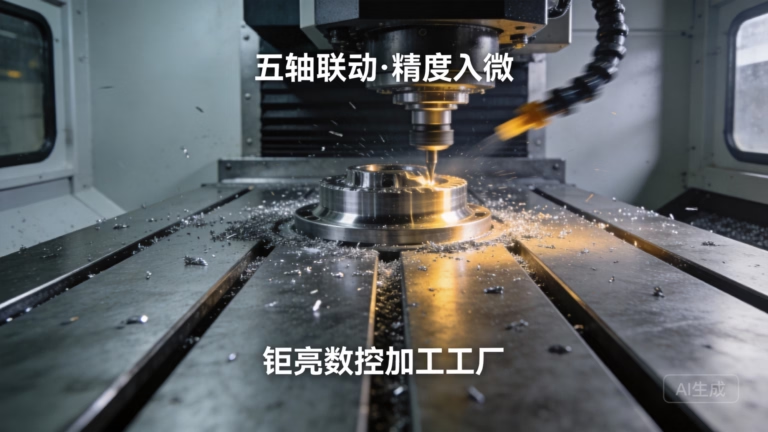
For parts with many features on different faces, the number of setups drives error stacking. A 5-axis machine that reaches five faces in one setup removes the re-fixturing error that comes from moving a part between three-axis machines. If your part has tight true position between features on different faces, ask how many setups the shop plans and on what machine.
The pass test: the shop names the machine, the setup count, the tolerance, the finish, and the inspection method without prompting. If any of those five is missing, you are talking to a sales desk, not a process engineer.
- 1Name the critical featuresTwo or three dimensions, not the whole drawing.
- 2Pair tolerance with finishA dimension without a Ra value is half an answer.
- 3Count the setupsMore setups mean more stacked error.
Check 2: Where Does Lead Time Actually Start?
Lead time in a quote usually means machining days. That number hides the two weeks before it, when the shop reviews your files, asks questions, orders material, and programs the part. Ask for the DFM turnaround separately. GreatLight returns quotation and free DFM analysis within 12 hours, and production can start within 24 hours after that, which makes the total timeline visible up front.
Material availability is the quiet variable. A 6061-T6 plate in a common thickness is usually on the shelf. A 4,000 mm long extrusion in 7075, or a small batch of Inconel, may need to be ordered. Ask whether the quoted lead time includes material procurement or starts after the stock lands. That single question explains most date slips.
Capacity matters when your volumes change. A shop with 127 high-precision CNC machines and 16 simultaneous 5-axis centers can absorb a volume jump without pushing your job to the back of the queue. A small shop with four machines cannot. If you expect to scale from prototype to production, ask how the shop handles that transition and whether the same process carries over.
One more thing: ask what happens when a part fails inspection. A shop that reworks or remakes on its own schedule, and tells you the same day, is worth more than a slightly cheaper quote that goes silent for a week.
- 1Separate DFM from machiningTwo numbers, not one.
- 2Ask about material stockEspecially for 7075, titanium, and Inconel.
- 3Check the failure planWho pays, who remakes, how fast.
Check 3: Minimum Order Quantity and Prototype Risk
If a shop quotes a minimum order quantity of 500 pieces before it has made one part, you are carrying all the risk. Fit, finish, and assembly problems show up on part one, not part five hundred. A supplier with no minimum order quantity lets you buy a single prototype, check it against your assembly, and only then commit to a 10,000+ part run.
The prototype should be made on the same process that will run production. A prototype machined on a 3-axis mill and a production run on a 5-axis center will not behave the same way on tolerance or finish. Ask which machine and which setup the prototype will use, and whether that carries into the production quote.
Cost per part drops with volume, but the drop is not linear. Setup, programming, and fixturing are one-time costs spread across the run. Ask for a price at three quantities, such as 1, 100, and 1,000 pieces. The shape of that curve tells you whether the shop is quoting setup honestly or burying it in unit price.
For low-volume, high-mix work, which is common in Saint Paul's medical, aerospace, and automation suppliers, flexibility beats unit price. A shop set up for quick changeover will quote a 20-piece run without a penalty that makes it pointless.
- 1Start with one partNo MOQ removes the upfront gamble.
- 2Same process, both stagesPrototype and production should match.
- 3Ask three price points1, 100, and 1,000 pieces.
Check 4: Which Certifications Apply to Your Industry?
Certifications are not decoration. Each one maps to a different set of customer requirements. ISO 9001:2015 covers general quality management. IATF 16949:2016 adds automotive-specific controls like PPAP and traceability. ISO 13485:2016 is the medical device standard. ISO 27001:2022 covers information security, which matters when you send proprietary CAD files.
Ask which legal entity and which plant hold the certificate. A group may hold ISO 9001 at one site and run your parts at another. The certificate scope should name the site that actually machines your parts. If the scope is vague, ask for the certificate number and check it against the issuing body.
For medical and automotive work, documentation is part of the deliverable. First article inspection reports, material certs, and inspection data may all be required. Ask what is included by default and what costs extra, before you place the order, so there is no surprise at shipment.
GreatLight holds ISO 9001:2015, IATF 16949:2016, ISO 13485:2016, and ISO 27001:2022. Every part gets 100% inspection before shipment, with raw material check, in-process monitoring, and final inspection. Reports are available on request. Ask for the report format you need at quote stage.
- 1Match cert to industryAutomotive and medical have their own rules.
- 2Check the site scopeThe certificate must cover the plant making your parts.
- 3Confirm report format earlyFAI, material certs, inspection data.
Check 5: What a Useful Quote Should Contain
A quote that says 'machined part, $42' is not a quote. It is a number. You cannot compare it to another shop, and you cannot tell where cost comes from. A useful quote separates material, machining, finishing, inspection, and freight. If your part needs anodizing, plating, or heat treatment, those lines should appear, or the quote should say clearly that they are excluded.
Finishing is where schedules slip. If the shop machines in-house but sends parts out for anodizing, the finishing vendor becomes an invisible step in your timeline. Ask whether secondary operations are coordinated by the shop or handed back to you. Coordinated finishing means one PO, one delivery, and one point of contact when something is late.
Material grade should be written on the quote, not assumed. 304 and 316L stainless behave differently in a chloride environment. 6061-T6 and 7075-T6 machine differently and finish differently. A quote that says 'aluminum' tells you nothing about the part you will receive.
Finally, ask what the quote assumes. Tolerances, finish, inspection level, and quantity should all be stated. If the quote assumes a looser tolerance than your drawing shows, the parts may pass their inspection and still fail in your assembly.
- 1Demand line itemsMaterial, machining, finish, inspection, freight.
- 2Ask who coordinates finishingIn-house or outsourced, with a name.
- 3Write the material grade'Aluminum' is not a specification.
Step by Step: Vetting a Shop in One Week
Run these steps in order. Each one filters out shops before you spend engineering time.
- 1Send one drawing with critical features markedMark two or three dimensions that control fit. Add the finish callout on each. Keep the rest of the drawing as context.
- 2Ask for DFM feedback and a quote in one replyA 12-hour turnaround is a reasonable benchmark. If DFM comments come back generic, the shop did not read the part.
- 3Request the machining planMachine type, number of setups, and inspection method. Three-axis for simple prismatic parts, 5-axis when features sit on multiple faces.
- 4Order one prototype at production settingsSame machine, same fixture logic, same finish. Measure it against your drawing before releasing volume.
- 5Test the finishing chainSend the prototype through anodizing or plating. Check color, thickness, and masking. This is where most prototype runs reveal problems.
- 6Confirm certification scope in writingGet the certificate number and the plant name. Match it to the site that made your prototype.
- 7Scale in two steps, not oneGo from 1 to 50 pieces before 1,000. Check first article inspection data at each step and confirm the process did not change.
Questions Buyers Ask Before Ordering
How long should a quote take?
For a clear drawing and a defined material, 12 hours is a workable benchmark for quotation and DFM feedback. Slower is not automatically worse, but a shop that takes four days to answer has a queue or a process problem.
If the part is complex or the material is unusual, expect questions before a firm number. That is a good sign, not a delay.
Can a shop hold ±0.005 mm on every feature?
Not economically, and usually not by design. Tight tolerance should sit on the features that control function. Everything else can run looser at lower cost.
Ask the shop to quote tight tolerance only where your drawing calls for it, and to flag features where the tolerance is tighter than the process needs.
What does no minimum order quantity really mean?
It means you can buy one part at a price that reflects setup and programming, not a penalty price designed to push you into volume. You pay for the setup once.
After the prototype passes, the same process scales to 10,000+ parts without a redesign or a supplier change.
Do I need an NDA before sending CAD files?
If the design is proprietary, yes. A mutual NDA protects both sides and takes little time to sign. Ask before you upload.
Also ask how files are stored and who can access them. ISO 27001:2022 covers information security management and is a useful signal here.
How do I know the finish will match across batches?
Fix the finish spec in writing: process, color, thickness, and masking. Then check a first article from each batch against a retained sample.
For anodizing, note that color can shift slightly with alloy and bath age. Hardcoat and clear anodize behave differently. Specify which one you need.
What if my part needs several processes?
Machining, heat treatment, plating, and assembly should sit under one project manager. Otherwise you become the coordinator, and every handoff adds days.
Ask for a single point of contact and a schedule that lists each step with its own date.
Send Your Drawing, Get a Real Answer
Upload your CAD files and get a quote with DFM feedback within 12 hours. No minimum order quantity, and your files stay confidential.
12-hour quoteNo MOQ100% inspectionNDA on request
More From the Shop Floor
We publish setup notes, tooling trials and inspection data from the factory floor.











