
CNC Machining Services for Automotive
This guide is for engineers and sourcing teams choosing a supplier for engine, transmission, EV and chassis parts. We cover the five checks that separate a shop that can hold your print from one that only says it can: tolerance and finish, quality system, material range, lead time, and how quotes are built. Read it before you send an RFQ.
In this article
- 1
- 2
- 3
- 4
- 5
- 6
- 7
- 8
Key takeaways
What to check before you award the PO
Five criteria, what a production-ready shop looks like, and what a red flag looks like.
| Check | Production-ready signal | Red flag |
|---|---|---|
| Tolerance and finish | States ±0.005 mm and names the inspection method | Quotes ±0.05 mm but claims ±0.005 mm on request |
| Quality system | IATF 16949:2016 plus ISO 9001:2015, audit reports on request | ISO 9001 only, or certificate not traceable to the plant |
| Material range | Lists aluminium, stainless, steel, titanium, plastics with grades | Says "all metals" and asks you for the grade spec |
| Lead time | Quote in 12 hours, production in 24 hours, parts in 3–5 days | Vague "4–6 weeks" with no milestone breakdown |
| MOQ and tooling | No minimum order quantity, one prototype to 10,000+ parts | Large MOQ or a separate NRE charge for every revision |
| Confidentiality | NDA available, secure uploads, no part photos published | Portfolio page with your competitor's unmasked prints |
Tolerance, finish and the print you actually get
Every shop quotes a tolerance. Few explain how they hold it. On a 200 mm aluminium housing, ±0.005 mm is a process capability claim, not a machine spec. Ask which machine runs the critical bore, how many setups it takes, and whether the fixture is dedicated or modular. A dedicated fixture on a 5-axis center is the difference between a repeatable bore and a scrap pile.
Finish matters for different reasons on different parts. A sealing face on a transmission valve body needs Ra 0.8–1.6 μm to let the gasket seat. A battery cooling plate channel needs Ra 1.6–3.2 μm and no burrs that could shed into the coolant loop. Bearing journals on a turbo shaft want Ra 0.2–0.8 μm. Write the finish on the drawing, callout by callout, or you will get as-machined everywhere.
The inspection plan is where a real quote separates itself. Raw material check, in-process monitoring with a probe or CMM, and final inspection before shipment. Ask for the report format. If the supplier cannot show you a sample dimensional report with the datum scheme from your print, the tolerance claim is unverified.
One more question: what happens when a dimension sits at the edge of the band? A shop that checks 100% before shipment and flags drift early saves you a containment event. A shop that samples five parts from a 500-piece lot and ships will not.
- 1Write the finishRa callouts per feature, not one global note.
- 2Name the datum schemeMatch it to your assembly stack-up.
- 3Request a sample reportBefore the PO, not after the first shipment.
Quality system: why IATF 16949 matters for automotive parts
ISO 9001:2015 proves a shop has a quality process. IATF 16949:2016 proves it was audited against automotive-specific requirements: APQP, PPAP, MSA, control plans, and traceability back to the mill certificate. If your part goes into a powertrain, braking, steering or an EV drive unit, the Tier 1 will ask for PPAP documents. A shop without IATF cannot support that without a lot of manual work.
The certificate itself is not the whole story. Check that the certificate names the manufacturing site, not a trading office. Check the scope statement covers CNC machining of the parts you are buying. A certificate that covers "metal fabrication" but not "precision machining" is not what you need.
Traceability is the practical part. From prototype to production, you want material certs on file, process records per lot, and a documented change-control path when a revision lands. GreatLight holds ISO 9001:2015, IATF 16949:2016, ISO 13485:2016 and ISO 27001:2022 across its plants. The ISO 27001 piece covers how your drawings and CAD files are stored, which matters when you send a full vehicle program package.
Ask one question in the RFQ: can you provide a PPAP Level 3 package on request? If the answer is a straight yes with a timeline, the quality system is real. If it is a maybe, treat the IATF claim as unverified.
- 1Certificate scopeMust name the machining site and process.
- 2PPAP readinessLevel 3 on request, with a stated timeline.
- 3Data securityISO 27001:2022 covers drawings and CAD files.
Material range and the machine mix behind it
Automotive parts pull from a wide material set. Aluminium 6061-T6 and 7075 for brackets and housings. ADC12 for die-cast covers that get finish-machined. 4140 and 4340 for shafts and gears. 17-4PH for high-strength valve components. Inconel and titanium TC4 for exhaust-side and high-temp brackets. Plastics like POM and PEEK for sensor housings and bushings.
The material list matters because it tells you what is already on the floor. A shop that lists 17-4PH has the right inserts, the right speeds, and the right post-machining heat-treat partners. A shop that says "all metals" and then asks you for the grade spec is quoting work it has not done before. That is where lead times slip.
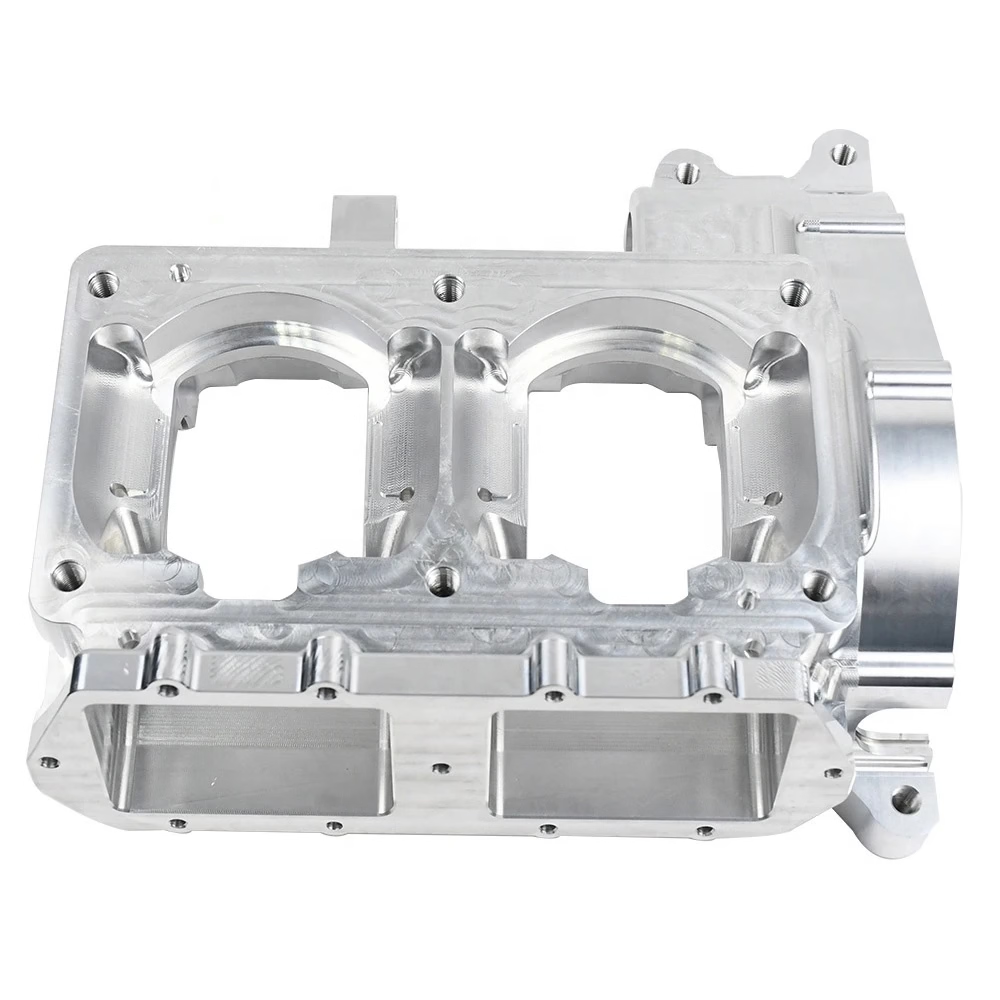
Machine mix is the second half of the story. A single 3-axis mill cannot reach the five faces of a transmission housing in one setup. A mill-turn center cuts a shaft with a keyway and a threaded end without re-chucking, which protects concentricity. For a part like an EV drive unit housing, a simultaneous 5-axis center with a Ø400 mm rotary table handles the angled fluid ports and the mounting face in one pass.
Ask the supplier to map your part to a specific machine. If the answer is "we will figure it out," the quote is a guess.
- 1Aluminium6061, 6061-T6, 2024, 5052, 5083, 6063, 6082, 7075, ADC12.
- 2Steel and stainless4140, 4340, 17-4PH (SUS630), 316L, 440C, 4130.
- 3Titanium and specialTC4 (Ti-6Al-4V), Inconel, magnesium AZ31B / AZ91D.
Lead time, MOQ and how the quote is built
Lead time in automotive is not one number. It is three: quote turnaround, production start, and shipping. A shop that quotes in 12 hours, starts production in 24 hours, and ships parts in 3–5 days is set up for the prototype-to-production transition. A shop that quotes in a week and starts in two weeks will cost you a build slot.
MOQ is the quiet deal-breaker. Prototype programs need one or two parts to validate a design. Production programs need 10,000+ parts with the same process. A supplier that charges a large MOQ on the prototype phase forces you to lock the design before you have tested it. Look for no minimum order quantity and a single process path from one part to 10,000.
How the quote is built tells you what you are paying for. A per-part price with a line for material, machining time, finishing and inspection is transparent. A single lump sum with no breakdown is not. Ask for the DFM note that comes with the quote. If there are no manufacturability comments, the supplier did not look at your model closely.
Confidentiality belongs in this check too. Automotive programs involve unreleased vehicle geometry. Secure uploads and an NDA on request are basic. If a shop publishes customer part photos on its website, your program will eventually show up there.
- 1Quote12 hours with a free DFM analysis.
- 2StartProduction can begin within 24 hours of PO.
- 3ShipParts ship in 3–5 days.
- 4MOQNo minimum, from one prototype to 10,000+ parts.
Finishing, assembly interfaces and the hidden cost drivers
Machining is only part of the part. Anodizing, electroless nickel, zinc plating, powder coating and black oxide change dimensions by a few microns and change fit by more if the callout is loose. A masked sealing face on a hardcoat anodized housing needs a note on the drawing. Skip the note and the gasket will not seat.
Assembly interfaces are where tolerance stacks hide. A bracket that bolts to three points on a chassis needs those three faces controlled to each other, not just to a single datum. Call out the functional datums and let the shop build the fixture around them. This is where a DFM review pays for itself before the first chip is cut.
Laser marking and engraving are common on automotive parts for traceability. Minimum character height of 1.5 mm keeps the mark readable after finishing. If your part number, lot code and date code all need to fit, plan the real estate on the print, not in the shop.
The hidden cost drivers are the ones nobody quotes: rework on a marginal feature, a second setup for a back-side face, a fixture that has to be built from scratch. A shop that flags these in the DFM note is cheaper over the program, even if the per-part price is higher.
- 1Finishing calloutsMask sealing faces and bearing bores.
- 2Functional datumsControl assembly interfaces to each other.
- 3MarkingMinimum character height 1.5 mm after finishing.
How to qualify a supplier in five steps
Run these in order. Each step filters out suppliers that cannot support your program.
- 1Send the print and the model togetherInclude the 3D model, the 2D print with GD&T, the material grade and the finish callouts per feature. Missing finish notes are the most common RFQ gap. A supplier who quotes without asking for them did not read the print.
- 2Ask for the tolerance planRequest the specific machine, the number of setups, and the inspection method for each critical dimension. For a ±0.005 mm bore, expect a CMM or a dedicated gauge, not a caliper. If the answer is generic, the tolerance claim is generic.
- 3Verify the quality certificate scopeAsk for the IATF 16949:2016 and ISO 9001:2015 certificates and check that the site address matches the plant making your parts. Then ask whether a PPAP Level 3 package is available.
- 4Test the quote turnaroundA 12-hour quote with a free DFM analysis is a working process. Time it. If the quote arrives late with no manufacturability notes, the production timeline will slip the same way.
- 5Run a prototype before the production POOrder one to five parts, inspect them against the print, and check the finish on the functional faces. Confirm the inspection report matches your datum scheme. Then release the production quantity with the same process, not a re-quoted one.
Common questions
What tolerance can CNC machining services for automotive parts actually hold?
On a well-fixtured 5-axis or mill-turn process, ±0.005 mm (±0.0002 in) is achievable on critical features such as bores, bearing seats and sealing faces.
That number depends on part size, material and setup count. A 4,000 mm long part will not hold the same tolerance as a 50 mm bushing. Ask for the tolerance per feature, not one blanket number.
Is IATF 16949 required for every automotive part?
No. Interior brackets, prototype fixtures and low-volume motorsport parts can run on ISO 9001:2015 alone.
But if the part sits in a powertrain, braking, steering or EV drive unit, the Tier 1 will ask for PPAP documents, and those come from an IATF 16949:2016 quality system. Decide based on where the part goes, not on the part's size.
How do you handle material traceability?
We keep mill certificates on file for each material lot and link them to the production record. Raw material is checked on receipt, in-process dimensions are monitored, and every part is inspected before shipment.
Inspection reports are available on request in the format your quality team uses. If you need full traceability back to the mill cert for a recall scenario, say so in the RFQ so the records are structured that way from the start.
What is the smallest and largest part you can machine?
The maximum processing size is 4,000 mm, with a large-machine travel of 4,000 × 400 × 150 mm. Medium travels include 750 × 1,150 × 550 mm and 600 × 600 × 600 mm.
Compact travels go down to 500 × 310 × 200 mm for small sensor housings and connectors. A Ø400 mm rotary table supports 5-axis work on round and prismatic parts.
Can you support both prototyping and production volumes?
Yes. There is no minimum order quantity, so a program can start with one prototype and scale to 10,000+ parts on the same process path.
The prototype stage is where the DFM analysis matters most. Catching a thin wall or an unreachable feature before the first cut saves a re-design cycle.
How are drawings and CAD files protected?
Uploads are secure and confidential, and an NDA is available on request. Our ISO 27001:2022 certification covers the information security management system around customer data.
We do not publish customer part photos or program names. If your program requires restricted access to the model inside the shop, state that in the RFQ.
Send your automotive print for a 12-hour quote
Upload the model and 2D print. You get a price, a DFM analysis and a tolerance plan back within 12 hours.
12-hour quoteFree DFM analysisIATF 16949:2016No minimum order quantity
More from GreatLight
We publish setup notes, tooling trials and inspection data from the factory floor.











