
In the fiercely competitive landscape of product development, the phrase “time is money” has never been more literal. For engineers and innovators across industries—from automotive and aerospace to medical devices and robotics—the bridge between a digital CAD model and a physical, functional prototype is a critical phase that can make or break a project. This is where the concept of a CNC Machining Prototype Service Factory comes into sharp focus. It’s not merely a vendor that mills a block of material; it is a strategic partner engineered to accelerate your R&D cycle, de-risk your designs, and deliver parts that are indistinguishable from future production components. The choice of this partner fundamentally determines the velocity and quality of your innovation.
However, the market presents a paradox. On one hand, countless machine shops offer “prototype services.” On the other, development teams consistently face a set of entrenched challenges that drain resources and delay timelines. Let’s dissect the core pain points that a truly capable CNC Machining Prototype Service Factory must resolve.
The Precision Prototyping Predicament: Why Many “Quick Turns” Go Wrong
The Illusion of Speed vs. the Reality of Lead Time: Many providers advertise “rapid turnaround,” but this often refers only to machine runtime. The true lead time is swallowed by back-and-forth communication for DFM (Design for Manufacturability) feedback, scheduling delays, inadequate in-house tooling, and sequential handoffs between departments. A true prototype factory operates on a parallel-processing model.
The “Black Box” of Precision: A supplier may claim a machine tolerance of ±0.002″. But does that account for thermal drift during a long machining cycle? Tool wear on deep cavities? Or the cumulative error from multiple setups? Prototype parts that fail to meet dimensional spec are not just scrap metal; they are wasted engineering time and lost validation windows.
Material and Process Fidelity: A prototype must behave like the final part. Using 6061 aluminum for a prototype when the production material is 7075-T6 or titanium can yield misleading stress test results. Similarly, a part requiring specific surface finishes or heat treatment in production must be prototyped with those processes in mind to yield valid data.
The Complexity Bottleneck: Modern designs—think intricate drone frames, conformal-cooled injection molds, or bespoke surgical guides—are geometrically complex. A factory limited to 3-axis machining will require multiple fixtures, introduce error, and cannot produce monolithic parts with undercuts or compound curvatures, forcing design compromise.
The Seamless Scalability Gap: The ideal prototype partner should provide a clear, validated path to low-volume production and eventually full-scale manufacturing. A disconnect between the prototype shop and production capabilities means relearning the part, requalifying suppliers, and often, redesigning for different equipment.
Deconstructing the Modern Prototype Factory: More Than Just Machines
So, what differentiates a job shop from a dedicated, high-performance CNC Machining Prototype Service Factory? The answer lies in an integrated ecosystem built on four foundational pillars.
Pillar 1: The Technological Backbone – Strategic Equipment Deployment
This is where capability is quantified. A leading factory, such as GreatLight Metal, doesn’t just have machines; it has a strategic array of complementary technologies.
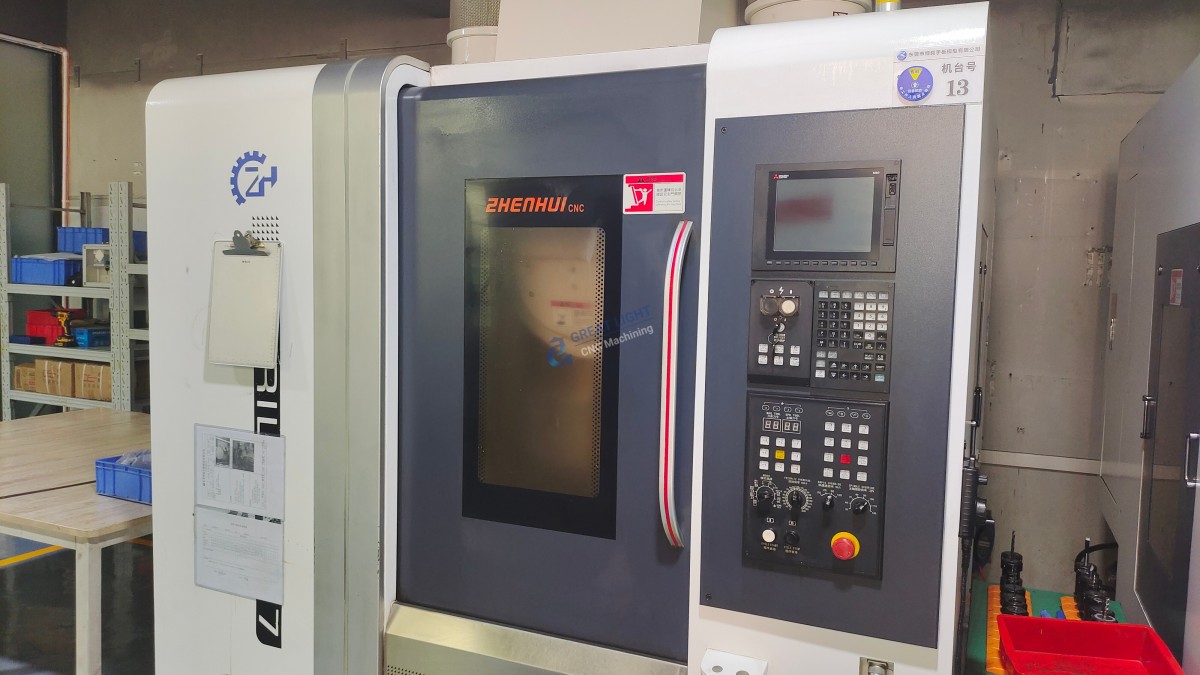
5-Axis CNC Machining Centers: The crown jewel for complex prototypes. A true 5-axis machine allows for continuous machining of five sides of a part in a single setup. This is not a luxury; it’s a necessity for accuracy on complex parts, as it eliminates the errors introduced by repositioning. It enables the machining of organic shapes, deep cavities, and precise angled features that are impossible with 3-axis equipment. For clients seeking unparalleled capability in this area, exploring specialized precision 5-axis CNC machining services{:target=”_blank”} is crucial.
Multi-Axis Mill-Turn Centers: For prototypes involving both turned (rotational) and milled features, a mill-turn center completes the part in one clamping, ensuring exceptional concentricity and saving days of logistics between a lathe and a milling machine.
Advanced Additive Manufacturing (3D Printing): Metal (SLM) and high-performance polymer (SLA, SLS) 3D printers are not competitors to CNC but powerful allies. They are used for ultra-complex, lightweight structures, integrated assemblies, or rapid form-and-fit models that guide the CNC machining of critical interfaces.
EDM (Electrical Discharge Machining): For prototypes requiring ultra-hard materials (like hardened tool steel for mold cores) or extremely fine, sharp features that would break a cutting tool, wire and sinker EDM are indispensable.
Pillar 2: The Process Engine – From File to Finished Part
The workflow is the factory’s central nervous system. It must be digital, transparent, and concurrent.
Intelligent DFM Analysis: Upon receiving a CAD file, engineers should perform automated and expert-driven DFM analysis, flagging potential issues like unreachable features, thin walls, or sharp internal corners. This feedback loop happens within hours, not days.
Digital Twin & Virtual Machining: Advanced CAM software creates a digital twin of the machining process, simulating toolpaths, detecting collisions, and predicting machining stresses before any metal is cut. This virtual validation is key to first-part success.
Integrated Metrology: Measurement isn’t a final step; it’s integrated throughout. In-process probing on CNC machines checks critical dimensions mid-production. Post-process, parts move to a climate-controlled metrology lab equipped with CMMs (Coordinate Measuring Machines) and optical scanners to generate full 3D inspection reports, providing irrefutable proof of conformity.
Pillar 3: The Quality Imperative – Systemic Assurance, Not Final Inspection
For a prototype that will be load-tested, fitted into a larger assembly, or used for regulatory submission, quality cannot be an afterthought. Top-tier factories build it into their DNA through internationally recognized standards:
ISO 9001:2015: The framework for a consistent, improving quality management system.
ISO 13485: For medical device prototyping, this certification is non-negotiable, ensuring traceability, risk management, and validation processes that align with regulatory pathways.
IATF 16949: For automotive prototypes, this standard mandates rigorous process control, change management, and defect prevention—exactly what is needed for parts destined for automotive validation (e.g., engine brackets, sensor housings).
Pillar 4: The Engineering Partnership – Collaborative Problem Solving
The most valuable output is often not just the part, but the knowledge. A factory’s engineers become an extension of your team. They advise on material selection (e.g., using pre-hardened steel to avoid post-machining distortion), suggest design tweaks that save 30% machining time without compromising function, and recommend post-processing (anodizing, plating, passivation) that matches production intent.
Case in Point: The Prototype Factory in Action
Consider a robotics startup developing a new hydraulic actuator for a humanoid robot. The housing is a compact, high-strength aluminum alloy part with intersecting fluid ports at compound angles and internal galleries. It must withstand extreme pressure cycling.
A Conventional Shop’s Approach: Machine the main block in 3-axis, then create separate port fittings. Requires assembly, multiple seals (potential leak points), and alignment challenges. The internal galleries might be impossible to machine.
A Modern Prototype Factory’s Solution (e.g., GreatLight Metal):
Collaborative DFM: Engineers suggest slight taper on internal galleries for tool access and recommend a specific aluminum grade (e.g., 7075-T651) for its strength-to-weight ratio.
5-Axis Machining: The entire housing, with all complex internal and external geometries, is produced monolithically from a single billet in one setup on a 5-axis CNC center. This ensures perfect alignment of ports, eliminates assembly, and maximizes structural integrity.
Process Fidelity: After machining, the part undergoes precision honing of the bore and Teflon impregnation for wear resistance, mirroring the final production process.
Validation: A full CMM report confirms all critical dimensions are within ±0.025mm. The part is delivered not just as a physical object, but as a validated component ready for pressure testing.
Conclusion: Choosing Your Strategic Manufacturing Accelerant
Selecting a CNC Machining Prototype Service Factory is a strategic decision with direct consequences for your product’s timeline, cost, and ultimate performance. Look beyond the quoted price per part. Evaluate the technological portfolio, the maturity of the digital workflow, the robustness of the quality system, and the willingness of the team to engage as engineering collaborators.
The goal is to find a partner that functions as a seamless extension of your own R&D lab—one that can translate your most ambitious designs into precise, functional, and reliable hardware with predictable speed. In this high-stakes environment, the right factory doesn’t just make parts; it builds your competitive advantage, one precise prototype at a time. For companies leading the charge in fields like robotics, aerospace, and advanced automotive systems, partnering with a technically profound and systematically reliable manufacturer is the first critical step from concept to reality. To see how industry leaders approach these partnerships, insights from platforms like LinkedIn{:target=”_blank”} can be revealing.



















