
CNC machining and 3D printing: a guide
Two processes that turn the same CAD file into very different parts. This guide covers how each one forms material, where the tolerances and costs come from, and how to pick between them for a prototype or a production run.
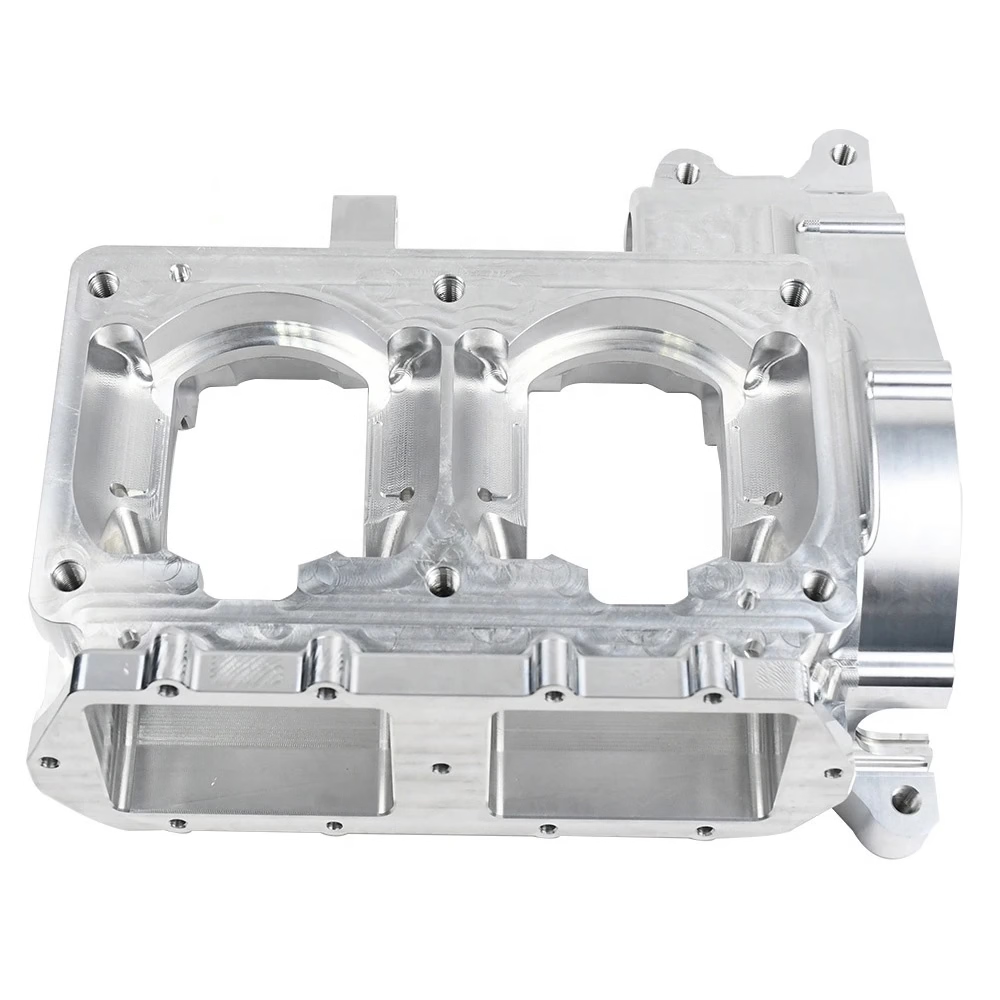
How CNC machining forms a part
CNC machining starts with a solid block, bar or casting and cuts material away. A rotating cutter or a single-point tool follows toolpaths generated from CAD and CAM software, and the machine's ballscrews and servos hold the cutter on that path. What is left at the end is the part. Nothing about the shape depends on a mold, a nozzle or a support structure.
The process is subtractive, so the geometry has to be reachable by a tool. A 3-axis mill cuts from one direction and needs open access to every face it touches. A 4-axis machine adds rotation about one axis; a 5-axis machine tilts and rotates the tool or the table together, so undercut walls, deep pockets and angled holes can often be finished in a single setup. Fewer setups means fewer repositioning errors and tighter position tolerance between features.
Heat is the main physical limit. Cutting metal converts energy into heat in the shear zone, and that heat moves into the chip, the tool and the workpiece. Too much heat at the cutting edge dulls carbide quickly; too much heat in the workpiece moves the part as it cools. Coolant, feed rate and depth of cut are how machinists keep that balance.
Rigidity sets the other boundary. A thin wall or a long, unsupported section will deflect under cutting force, spring back, and leave chatter marks. This shows up as a surface that reads Ra 3.2 μm when the drawing asked for Ra 0.8–1.6 μm. On our 5-axis centers we work up to a 4,000 mm maximum processing size, and tooling reach, not table size, is usually the first thing that runs out.
- 1Subtractive from solid stockBar, plate, block or casting becomes the finished part.
- 2Tool access drives designUndercuts and deep pockets favor 4-axis or 5-axis work.
- 3Heat and rigidity set limitsThin walls deflect; heavy cuts build heat.
How 3D printing builds a part
3D printing adds material instead of removing it. A slicer takes the solid model, cuts it into layers, and the machine deposits or cures material one layer at a time. FDM extrudes a thermoplastic filament through a heated nozzle. SLA and DLP cure liquid resin with a light source. SLS and metal systems fuse powder with a laser, layer by layer, in a build chamber.
The layer height is the resolution you feel on the surface. A 0.2 mm layer leaves visible stair-stepping on curved faces; a 0.05 mm resin layer is much smoother but takes longer to build. Printing direction also sets anisotropy: the bond between layers is weaker than the material inside a layer, so a part printed flat and a part printed standing up can have very different strength along the same axis.
Support structures are the cost of overhangs. FDM and SLA need supports under any face that overhangs beyond roughly 45°, and those supports have to be cut away and sanded. SLS does not need them because the surrounding powder holds the part, which is why it handles nested geometry and internal channels that would be awkward to machine.
Post-processing decides how the part performs. As-printed resin is brittle and continues to cure under UV light, so it is usually washed and post-cured. Metal printed parts go through debinding, sintering and often hot isostatic pressing before they carry real load. Skipping those steps is the most common reason a printed metal bracket fails early.
- 1Layer height = surface finish0.05 mm resin prints smooth; 0.2 mm FDM shows steps.
- 2Build direction = strengthLayer bonds are the weak plane in FDM and SLA parts.
- 3Post-processing carries loadSintering and HIP decide metal part properties.
Where each process wins and where it does not
Tolerance is the clearest split. Milled and turned metal parts hold ±0.005 mm (±0.0002 in) on critical features at GreatLight, and surface finish can reach Ra 0.2–0.8 μm after fine machining. FDM typically holds ±0.5 mm on a good day, and SLA improves that to roughly ±0.1 mm on small parts. If a bore needs to take a press-fit bearing, that is a machining job.
Mechanical property is the second split. Machined 6061-T6, 7075 or 17-4PH is fully dense and heat-treated to a known temper. Printed plastic is porous between layers and printed metal carries residual porosity unless it is sintered and pressed properly. For a part that sees fatigue cycling, high pressure or a safety factor, subtractive wins on a well-understood basis.
Cost follows quantity. Machining has almost no setup cost beyond programming and fixturing, so one prototype and ten thousand parts use the same basic tooling. Printing has low setup cost too, but build time scales with part volume and machine hours, so unit cost falls more slowly with quantity. Printing stays competitive when the geometry is complex and the volume is low.
Some geometry only prints. Internal conformal cooling channels, lattice infill and hollow sections that follow a curved surface are natural for additive and painful or impossible for a cutter. That is why the two processes often meet in the same program: a printed prototype to check fit and feel, then a machined version in the final alloy. Our custom 3D printing service and 5-axis machining both run in-house, so a design review can compare both routes before tooling is cut.
- 1Tight tolerance goes to machining±0.005 mm and Ra 0.2–0.8 μm on metal.
- 2Fatigue and pressure go to machiningFully dense, predictable temper.
- 3Complex internal geometry goes to printingLattices and conformal channels.
Materials, finishes and what we see in practice
The material list decides most of the argument. We machine 6061-T6, 7075, 304 and 316L stainless, 17-4PH, 4140, TC4 titanium, Inconel and magnesium AZ31B. Plastics cover ABS, PC, POM, PA, PEEK and carbon fibre. Printing covers resins, ABS, PC and POM for prototypes, plus metal powder routes when the geometry justifies the cost. If your part has to sit in a hydraulic valve body or a hot engine bay, the printable shortlist is small.
Finishing is where the two diverge again. Machined parts take anodizing in clear, colour, hardcoat or conductive form, electroless nickel, zinc, silver and gold plating, powder coating, black oxide, bead blasting, tumbling and polishing. Laser marking holds a minimum character height of 1.5 mm. Printed parts take dye, primer and paint, and most structural finishing steps do not apply.
Inspection is the last gate. We run raw material checks, in-process monitoring and a final inspection, with reports on request, and inspect 100% of parts before shipment. That matters more for printing than for machining, because layer defects and incomplete fusion hide inside the part rather than on the surface.
The pattern we see most often: a printed prototype for form and fit, then a machined version of the same envelope for test and production. It is a fast route, and it catches interference that a screen never shows. It also forces the design team to think about wall thickness and tool reach about two weeks earlier than they otherwise would.
- 1Metal choice is broad on the millAluminium, stainless, steel, titanium, Inconel, magnesium.
- 2Finish options are deeper on machined partsAnodizing, plating, powder coat, laser marking.
- 3Inspection covers the whole lot100% inspection before shipment; reports on request.
Step by step: choosing a process for a real part
Work through these in order. Most wrong process choices come from skipping step 2.
- 1List the functional requirementsWrite down load direction, operating temperature, mating tolerance, sealing surfaces and expected cycles. A part with no functional load is a fit-and-feel model; a part with a seal face is not.
- 2Mark the critical featuresCircle every dimension with a real tolerance callout, plus any surface that touches another part. If more than about a third of the drawing is critical, machining is usually the safer baseline.
- 3Check the geometry against tool accessLook for internal channels, deep pockets and undercuts. If a cutter cannot reach a feature without a long, thin tool, either redesign the feature or plan it as a printed part.
- 4Compare cost at the real quantityPrice the part at one unit, at fifty and at the production volume. Printing often wins at one and loses at fifty; machining spreads its cost the other way.
- 5Decide the material firstPick the alloy or plastic from the working environment, then choose the process that can hold it. Do not pick a process and hope a substitute material behaves the same.
- 6Plan the transitionIf printing is the first step, define what changes before machining: wall thickness for tool reach, draft and fillets, and which tolerances tighten. A printed part and a machined part of the same design are not interchangeable.
CNC machining and 3D printing at a glance
Typical values for industrial work; actual results depend on material, geometry and build orientation.
| Factor | CNC machining | 3D printing |
|---|---|---|
| Tolerance | ±0.005 mm (±0.0002 in) on metals | ±0.1 mm SLA to ±0.5 mm FDM |
| Surface finish | Ra 0.2–0.8 μm after fine machining | As-built layers; sanding needed |
| Material range | Aluminium, stainless, steel, titanium, plastics | Resin, ABS, PC, POM, PA, PEEK, metal powder |
| Density | Fully dense, wrought or cast stock | Porous between layers unless sintered |
| Setup cost | Programming and fixturing | Slicing and build prep |
| Best quantity band | One prototype to 10,000+ parts | Low volume, complex shapes |
| Typical lead time | Parts ship in 3–5 days | Depends on build height and queue |
| Geometry freedom | Cutter must reach the feature | Overhangs and lattices are natural |
The short version
Pick CNC machining when the part carries load, seals, mates to a tight bore or has to survive fatigue and heat. Pick 3D printing when the geometry is complex, the quantity is low, or you need a physical model this week. Use both when the design is still moving.
Questions engineers ask next
Can a 3D printed part be used as a functional metal part?
It can, if the process is metal powder bed fusion and the part goes through debinding, sintering and, where needed, hot isostatic pressing. Density and fatigue life still trail a machined wrought part of the same alloy.
For a bracket in a low-cycle application, printed metal may be acceptable. For a pressurized housing or a rotating component, we steer customers to machining unless there is a strong reason not to.
Does 3D printing replace CNC machining for prototypes?
Not entirely. Printing is faster and cheaper for shape verification, but it cannot confirm a press fit, a thread engagement or a surface that has to seal. Those need the real material and the real tolerance.
A common compromise is to print the housing and machine the critical insert, then assemble and test the pair.
How tight a tolerance can 3D printing hold?
SLA and DLP resin systems reach roughly ±0.1 mm on small features; FDM is closer to ±0.5 mm. Metal powder bed systems sit in a similar range before machining.
Shrinkage during sintering moves features, and the direction of the shrink follows the build orientation, so a printed bore is rarely round enough to accept a bearing without reaming.
Which process is cheaper for fifty parts?
It depends on part size and geometry, but the crossover usually lands in the tens, not the thousands. Small simple parts tip to machining early because build time still costs machine hours.
Send the model and we will price both routes in the same quote.
Do you need different CAD files for each process?
One solid model is enough. The CAM programmer generates toolpaths from it; the slicer generates layers from it. What changes is the model detail: printed parts need wall thickness and support planning, machined parts need tool reach and fillet radii.
If you only have a STEP file, we can still quote both. Our DFM analysis comes back within 12 hours with the changes we would make.
How do certifications affect the choice?
GreatLight holds ISO 9001:2015, IATF 16949:2016, ISO 13485:2016 and ISO 27001:2022. Medical and automotive programs usually need material traceability and inspection records, which are straightforward on machined lots.
Printed lots can be documented too, but the process window for metal printing has to be qualified per machine and per material. Ask early, before the design freeze.
Send the model, get both routes priced
Upload a STEP or STL file and we will return a quote with free DFM analysis within 12 hours, covering machining and printing options where both apply. Uploads stay confidential, and an NDA is available on request.
Quote + DFM in 12 hoursProduction starts in 24 hoursNo minimum order quantity
More from the shop floor
We publish setup notes, tooling trials and inspection data from the factory floor.











