
CNC Machine Shop 127 Sets Equipment: What the Number Actually Means
A cnc machine shop with 127 sets equipment is not a bigger version of a small shop. It is a different scheduling model. This page explains how machine mix, spindle count, and in-house process steps decide whether your part fits, what tolerance you can hold, and where the queue risk sits.
In this article
- 1
- 2
- 3
- 4
- 5
- 6
Why a CNC Machine Shop 127 Sets Equipment Schedules Differently
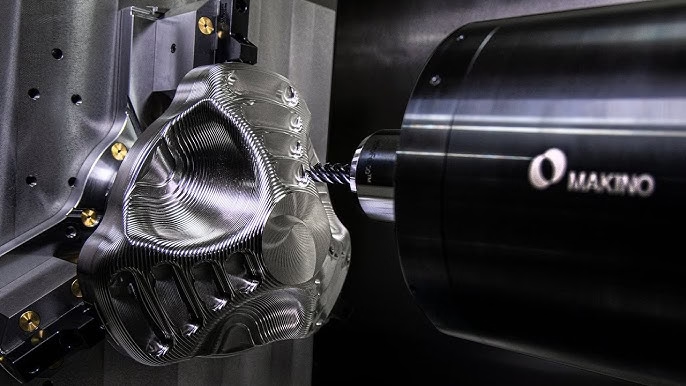
Most job shops quote from one constraint: the single mill or lathe that can reach your geometry. A cnc machine shop 127 sets equipment quotes from a mix. GreatLight runs 16 simultaneous 5-axis machining centers, 12 four-axis mills, 27 three-axis machines and 16 mill-turn centers. When one spindle is loaded, another can take the work without re-fixturing logic changing.
That mix matters more than the raw total. Five-axis work absorbs complex angles and deep pockets in one setup. Three-axis machines handle flat plates and simple pockets faster and cheaper. Mill-turn centers finish a shaft with turned diameters and milled flats in a single cycle. Routing a job to the wrong class of machine is the most common reason a quote looks slow or expensive.
The practical effect is queue depth. A 3-axis plate job in a shop with 27 three-axis machines waits behind a smaller backlog than the same job in a shop with three machines. The number does not remove queue time. It spreads it.
There is a limit. A 4,000 mm part still needs the large-travel machine, and only one class of machine reaches that envelope. Wide capacity helps most on parts under roughly 750 mm, where several machines can run the same program.
- 116 five-axis centersComplex angles, undercuts and deep cavities in one setup.
- 216 mill-turn centersTurned diameters plus milled features without a second fixture.
- 327 three-axis machinesPlates, brackets and simple pockets at lower hourly cost.
- 44,000 mm travelLarge frames and long rails, but only on the large-travel class.
Setup Count, Not Spindle Speed, Drives Tolerance
Tolerance is usually lost between setups, not inside a cut. Every time a part leaves a fixture, datum shift adds error. A component machined on three separate machines carries three chances to drift. The same component on a 5-axis center with a Ø400 mm rotary table is machined from fewer orientations, so the stack-up stays smaller.
GreatLight holds ±0.005 mm (±0.0002 in) on parts suited to the process. That figure is a shop capability, not a promise on every drawing. Thin walls, long unsupported sections and soft aluminum at high removal rates all push against it. An engineer should ask which machine class will run the part and how many setups the process plan uses.
Surface finish follows the same logic. As-machined surfaces land around Ra 1.6–3.2 μm. A controlled finishing pass reaches Ra 0.8–1.6 μm. Fine finishing gets to Ra 0.2–0.8 μm, usually on sealing faces, optical bores or sliding fits. Specify finish only where the function needs it. Blanket callouts raise cost and can force slower feed rates across the whole part.
The check we recommend: mark the datums on the drawing, then ask how many setups the quote assumes. If the answer is vague, the tolerance claim is vague too.
- 1One setup, one datum chainFewer orientations mean less stack-up error.
- 2Finish where it functionsSealing faces and bores, not every surface.
Machining Is Only One Link in the Process Chain
A part rarely ships straight off a mill. It gets deburred, anodized, laser marked, inspected and packed. When those steps sit at separate suppliers, each handoff adds days and each supplier adds its own incoming inspection. Moving a part between vendors is where most schedule slippage starts.
GreatLight keeps the chain under one roof: CNC milling and turning, die casting, vacuum casting, sheet metal fabrication, three 3D printing routes (SLM, SLA, SLS) and surface finishing. A prototype machined from 6061-T6 can move to die casting in ADC12 or zinc alloy for a low-volume run without retooling the supply chain. That transition is where job shops normally lose weeks.
Materials span the usual engineering set. Aluminum 6061, 7075, 2024 and 6082. Stainless 303, 304, 316L, 17-4PH. Steel 1018, 4140, 4340 and tool steel. Titanium TC4, Inconel and magnesium AZ31B. Plastics include POM, PEEK, PC and carbon fibre. Broad stock means fewer substitutions and fewer drawing changes.
Finishing options are anodizing (clear, color, hardcoat, conductive), electroless nickel, zinc, silver and gold plating, powder coating, black oxide, and bead blasting, tumbling, brushing or polishing. Laser marking holds a minimum character height of 1.5 mm, so plan part marks above that size.
- 1One vendor, one inspection recordFewer handoffs mean fewer tolerance arguments.
- 2Prototype to castingSame geometry, different process, no new supplier.
How Inspection and Certification Shape the Real Capacity
Machine count means nothing without inspection throughput. GreatLight inspects 100% of parts before shipment, with raw material checks, in-process monitoring and final inspection. Reports go out on request. A shop that can cut fast but measures slowly creates a bottleneck at the end of the line, which shows up as late delivery even when spindles were free.
Certifications decide which industries will accept the work. ISO 9001:2015 covers general quality systems. IATF 16949:2016 is the automotive and EV entry point. ISO 13485:2016 applies to medical devices. ISO 27001:2022 covers information security, which matters when drawings and CAD files leave your network.
The documented qualification rate is 99.99%. Read that as a process figure from a controlled production environment, not a guarantee for a first-article part with an untested process.
Lead time sits alongside quality. Quotation and DFM analysis come back within 12 hours, production can start within 24 hours, and parts ship in 3–5 days on standard work. Historical late-delivery probability is below 2%. Those numbers assume clean drawings and available material.
- 1100% inspectionIncoming material, in-process and final checks.
- 2Four certificationsISO 9001, IATF 16949, ISO 13485, ISO 27001.
From One Prototype to 10,000 Parts Without Changing Shops
There is no minimum order quantity. A single prototype and a 10,000-part run use the same quoting path. That matters because the first article usually reveals a design problem, and switching shops between prototype and production throws away everything learned in the first build.
At low volume, 5-axis machining and 3D printing make sense: no tooling cost, fast turnaround, easy revision. Between roughly 500 and a few thousand parts, die casting or vacuum casting starts to beat machining on unit cost, but only if the geometry and alloy suit it. Above that, tooling amortizes and casting wins clearly.
The break-even point is not fixed. It moves with part size, wall thickness, cosmetic requirements and alloy. A small zinc casting with a simple parting line pays back tooling early. A large aluminum housing with tight bores may never justify a tool if the annual volume stays in the hundreds.
Ask for both routes priced side by side. A shop with machining and casting in-house can quote both from one drawing, which is the only clean way to compare.
- 11 to 100 parts5-axis machining or 3D printing, no tooling.
- 2500 to 5,000 partsVacuum casting or die casting when geometry allows.
- 310,000+ partsTooling amortizes; casting usually wins on unit cost.
Which Process Route Fits Your Part
Use this as a first filter before sending a drawing.
| Route | Best fit | Watch out for | Typical batch |
|---|---|---|---|
| 5-axis machining | Complex angles, deep pockets, tight datums | Higher hourly rate than 3-axis | 1–500 parts |
| 3-axis machining | Flat plates, brackets, simple pockets | Extra setups on angled features | 1–1,000 parts |
| Mill-turn | Shafts with turned and milled features | Limited to rotational geometry | 1–2,000 parts |
| Die casting | Small housings, brackets in ADC12 or zinc | Tooling cost and draft angles | 1,000+ parts |
| Vacuum casting | Cosmetic covers, low-volume enclosures | Softer than machined metal | 50–500 parts |
| 3D printing (SLM/SLA/SLS) | Prototypes, lattices, internal channels | Anisotropy and surface texture | 1–50 parts |
When Wide Capacity Helps and When It Does Not
If your part is under roughly 750 mm with complex angles and a tight datum chain, a shop running 127 machines will usually compress your schedule and hold ±0.005 mm without heroics. If your part is a single large weldment over 4,000 mm, or an untested process on a first article, the machine count buys you very little and you should judge the shop on process planning instead.
Questions Engineers Ask About Machine Capacity
Does 127 machines mean my parts ship faster?
Not automatically. It means the queue spreads across more spindles, so a mid-size job is less likely to sit behind one long run. Standard work ships in 3–5 days, and production can start within 24 hours.
Work that depends on one specific machine class, such as a 4,000 mm part, still waits for that machine.
How do I know my tolerance is realistic?
Ask which machine class will run the part and how many setups the process plan uses. GreatLight holds ±0.005 mm on parts suited to the process.
Thin walls, long unsupported sections and deep cavities that need a long tool are the usual reasons a callout fails in production.
Can you quote machining and die casting from the same drawing?
Yes. Machining, die casting, vacuum casting and sheet metal all sit in-house, so both routes can be priced side by side.
That comparison is the fastest way to find the volume where tooling starts to pay back.
What is the minimum order quantity?
There is no minimum order quantity. Jobs run from a single prototype to 10,000+ part runs.
The quoting path is the same at both ends, so the first article and the production run stay in one process record.
How are drawings and CAD files protected?
Uploads are secure and confidential, and an NDA is available on request. GreatLight holds ISO 27001:2022 for information security.
That certification matters when your drawings leave your own network.
Which materials can be machined?
Aluminum 6061, 7075, 2024, 6082 and ADC12; stainless 303, 304, 316L and 17-4PH; steel 1018, 4140 and 4340; titanium TC4, Inconel and magnesium AZ31B; plastics including POM, PEEK, PC and carbon fibre.
Wider stock means fewer material substitutions mid-project.
Get a Process Plan, Not Just a Price
Send a drawing and we will return a quotation with DFM analysis within 12 hours, including the machine class and setup count we plan to use.
12-hour quote100% inspectionNo minimum order
More From GreatLight
We publish setup notes, tooling trials and inspection data from the factory floor.











