
CNC Machine Service in Winter Haven FL: How to Pick a Supplier
This guide is for engineers and buyers sourcing CNC machine service in Winter Haven FL and the wider Central Florida corridor. It lists the checks that actually separate capable shops from convenient ones, and the points where a local shop stops being the right answer.
In this article
- 1
- 2
- 3
- 4
- 5
- 6
- 7
- 8
Key takeaways
Local shop vs. regional shop vs. online platform
Three sourcing routes for CNC machine service in Winter Haven FL
| Criterion | Local Winter Haven shop | Regional job shop | Online platform |
|---|---|---|---|
| Best fit | MRO, one-off repair, quick mod | Prototype to 10,000+ runs | Simple standard parts |
| Tolerance floor | Often ±0.025 mm | Down to ±0.005 mm | Varies by routed shop |
| Lead time | Days, if the machine is free | 3–5 days typical | Quoted fast, shipped later |
| MOQ | Usually one piece | No MOQ at good shops | Often one piece |
| Certifications | Rarely beyond ISO 9001 | ISO 9001, IATF 16949, ISO 13485 | Depends on the shop used |
| Inspection reports | On request, limited | 100% before shipment, reports on request | Not always traceable |
| Who you talk to | The machinist | The process engineer | A support queue |
The short version
Use a local Winter Haven shop for repair and simple one-offs. Use a shop with 5-axis capacity, documented inspection and matching certifications when the geometry, tolerance or volume goes past what a local spindle can hold.
What CNC machine service in Winter Haven FL usually covers
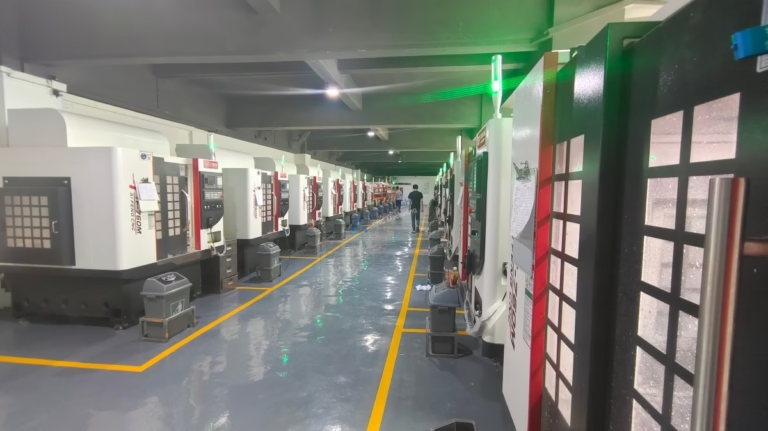
The Winter Haven industrial base is a mix of aerospace suppliers, agricultural equipment builders, specialty vehicle shops and smaller tech firms. Most of the CNC work that moves through the area is not high-volume production. It is maintenance and repair, low-volume prototyping, and quick-turn modifications to fixtures or brackets that are holding up a line.
That mix sets the expectations. A shop doing repair work needs to quote fast, hold a reasonably tight tolerance on a bore or a face, and turn the part around in days rather than weeks. A shop doing production work needs the opposite discipline: process control, documented inspection, and the ability to repeat the same cut on the 500th part.
Those are different capabilities. A local shop that is excellent at the first job may not have the 5-axis capacity, the metrology, or the material stock for the second. The question to ask up front is which of the two you are buying.
- 1Repair and MROOne part, tight deadline, often reverse-engineered from the worn original.
- 2PrototypingGeometry still moving, so DFM feedback matters more than price.
- 3ProductionDrawing frozen, repeatability and inspection records are the priority.
Tolerance, finish and the geometry that decides the machine
Tolerance is the first number buyers quote and the last one they should fix. ±0.005 mm is achievable on a well-maintained machine, but not on every feature of every part. Long thin walls deflect. Deep pockets need smaller tools that flex. A 400 mm bore is harder to hold than a 40 mm one, even with the same callout.
The practical approach is to mark the critical features and leave the rest at general tolerance. A mounting face, a bearing bore, a dowel hole and a sealing surface carry the tight callout. A clearance hole for an M6 screw does not. Doing this cuts cycle time and inspection time without touching function.
Surface finish follows the same logic. Ra 0.8–1.6 μm is a normal machined finish for most aluminum and steel parts. Ra 0.2–0.8 μm needs a finer step-over, a sharper tool and sometimes a secondary operation, which adds cost. Ra 1.6–3.2 μm is fine for brackets, covers and non-sealing surfaces.
- 13-axisPrismatic parts, plates, housings open on one side.
- 24-axisCylindrical parts with features on the OD, or parts needing multiple faces without re-fixturing.
- 35-axisImpellers, undercuts, deep cavities, five-face parts in one setup.
Lead time, MOQ and what the quote should tell you
Lead time is where local sourcing usually wins, and where it also quietly fails. A Winter Haven shop three miles away is fast when its spindles are free. When they are not, the part waits. Ask how the shop schedules rush work and whether it will tell you honestly if the machine is booked.
For a supplier with real capacity, the numbers look different. A quotation and free DFM analysis can come back within 12 hours, production can start within 24 hours, and parts can ship in 3–5 days. Those are commitments a shop can only make if it holds its own machines rather than brokering work out.
MOQ is the other number that gets misread. No minimum order quantity means the shop will run one part. It does not mean the one part is cheap, because setup, programming and fixturing do not scale down. If you need ten prototypes and ten thousand production parts, ask for both prices at the same time so the transition is planned, not improvised.
- 1Quote clarityDoes it list material, machine, finish, inspection and freight separately?
- 2AssumptionsA quote with no stated assumptions will produce change orders later.
Certifications, materials and traceability
Certifications are a filter, not a ranking. ISO 9001:2015 tells you the shop has a documented quality system. IATF 16949:2016 adds the automotive discipline around change control and PPAP-style documentation. ISO 13485:2016 covers medical device work. ISO 27001:2022 matters when you are sending drawings and CAD files that you do not want copied.
If your part goes into a regulated assembly, a shop without the matching certificate will push the burden back onto you. You will be the one chasing material certs, inspection data and revision control. That cost shows up late, usually the week before a build.
Material availability is the quieter constraint. Aluminum 6061, 7075 and 2024, stainless 303, 304, 316L and 17-4PH, steel 1018 and 4140, and titanium Ti-6Al-4V are routine. Inconel, beryllium copper and magnesium AZ31B need longer lead times and different tooling. If your design calls for one of those, ask about stock before you finalize the drawing.
- 1AerospaceMaterial certs and dimensional reports are standard expectations.
- 2Automotive and EVIATF 16949 process control and change notification.
- 3MedicalISO 13485, clean handling and lot traceability.
When a Winter Haven shop is the right call, and when it is not
Use a local shop when the part is simple, the deadline is short, and you can walk the drawing over. Repair work, one-off fixtures and quick modifications fit this model well. You get the machinist on the phone, you get the part back fast, and you can inspect it yourself.
Move to a regional or overseas partner when the geometry gets hard, the tolerance tightens, or the volume climbs. Five-axis work, thin-wall parts, exotic alloys and production runs need machines and metrology that most local shops do not carry. They also need a process engineer who will push back on the drawing before the first chip.
The trap is the middle case. A part that is slightly too complex for the local shop but not complex enough to justify a full supplier audit. That is where buyers lose weeks to rework. If the part has more than two tight features, or the material is not mild steel or 6061, get a second opinion from a shop that runs the right machine before you commit.
Seven steps before you place the order
- 1Send the 3D model, not just the PDFSTEP or IGES plus the 2D drawing. The model lets the shop run DFM checks and catch missing datums.
- 2Mark critical features onlyTag the fits, bores and sealing faces with ±0.005 mm or your functional limit. Leave the rest at general tolerance.
- 3State the material grade and temper6061-T6 is not the same as 6061. 17-4PH condition H900 behaves differently from annealed stock.
- 4Ask for the machine and setup planWhich machine, how many setups, and what fixture. If the answer is vague, the quote is vague.
- 5Confirm inspection scope100% inspection before shipment, with reports on request. Ask which dimensions get measured and with what.
- 6Check MOQ and the prototype-to-production pathGet both prices at once. No minimum order quantity should apply from one prototype to 10,000+ part runs.
- 7Sort out confidentiality earlySecure uploads and an NDA on request. Do this before you send the drawing, not after.
Questions buyers ask
How tight a tolerance can a shop realistically hold?
±0.005 mm is achievable on rigid parts with short tool reach, on a machine that is maintained and temperature-stable. It applies per feature, not to the whole drawing.
Long bores, thin walls and deep pockets drift. If a feature needs that tolerance, say so on the drawing and expect the shop to inspect it specifically.
What is a reasonable lead time for prototype parts?
A shop with in-house capacity can quote and return DFM feedback within 12 hours, start production within 24 hours, and ship in 3–5 days.
Anything faster usually means the shop is brokering the work out, which puts the schedule and the quality out of its hands.
Is there a minimum order quantity?
At a direct machine shop, no. One prototype is a normal order. The same shop can run 10,000+ parts on the same process.
The setup cost does not shrink with quantity, so a single part carries the full programming and fixturing load.
Which certifications should I require?
ISO 9001:2015 for a baseline quality system. Add IATF 16949:2016 for automotive and EV programs, ISO 13485:2016 for medical devices, and ISO 27001:2022 if your files are sensitive.
Match the certificate to where the part ends up, not to the shop's marketing page.
What surface finishes are standard?
Ra 1.6–3.2 μm as-machined, Ra 0.8–1.6 μm for most functional surfaces, and Ra 0.2–0.8 μm when a sealing or bearing surface needs it.
Anodizing, plating, powder coating, black oxide, bead blasting and laser marking are common secondary operations. Laser marking needs a minimum character height of 1.5 mm.
How do I protect my design when sending files out?
Use secure uploads and sign an NDA before the first drawing leaves your system. A shop that offers an NDA on request will usually have the process ready.
Keep revision control on your side too. Send one controlled revision and note what changed.
Send the model and get a real answer
Upload your STEP file and drawing. We return a quotation and free DFM analysis within 12 hours, with the machine, setup and inspection plan stated up front.
12-hour quoteNo MOQ100% inspectionNDA on request
More from GreatLight
We publish setup notes, tooling trials and inspection data from the factory floor.











