
CNC Aluminum Processing Technology
Aluminum cuts fast, but it does not cut the same way twice. This page covers the mechanics behind CNC aluminum processing technology: how alloy grade, tool geometry, spindle speed and heat removal interact, and where each machining setup stops making sense. It is written for design engineers and buyers who need to judge a process window, not read a sales page.
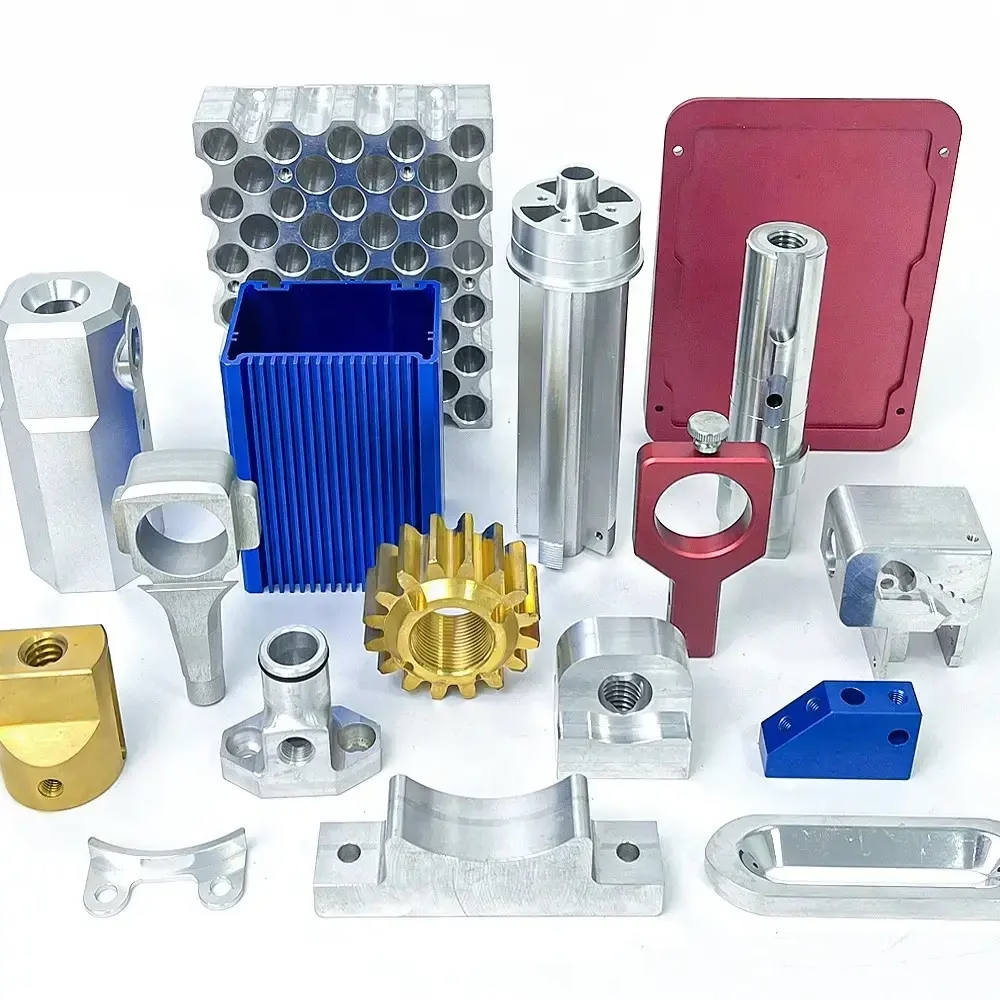
Why the metal behaves differently at the cutting edge
The metal is soft, light and thermally conductive. Those three properties drive everything else in this process. Softness means low cutting forces, so a light machine can take a real cut. It also means the material deforms before it shears, which produces a built-up edge on the tool tip.
Thermal conductivity is the bigger surprise. Most of the heat leaves with the chip instead of soaking into the workpiece. That is good for part stability, but it means the tool runs hotter than the part, and coolant aimed at the wrong place does very little. Chip thickness and feed rate matter more than spindle speed alone.
Silicon content changes the picture again. A 6061-T6 grade with low silicon cuts clean and predictable. Cast ADC12 or a 7075 billet with high zinc behaves differently, dulls edges faster and pushes you toward coated carbide. Grade choice is not cosmetic here; it sets the tool life curve.
- 1Low cutting forceThin walls and tall ribs survive if the setup is rigid.
- 2Heat in the chipAir blast often beats flood coolant on deep pockets.
- 3Silicon and zincHigher alloy content needs coated tools and lighter feeds.
Chip evacuation is the real constraint
Aluminum chips are soft, stringy and light. They do not break on their own. Left in a pocket, they get recut, weld to the flute and turn into a heat sink that ruins both the finish and the tool. This is the single most common cause of a scrapped aluminum part.
Trochoidal tool paths and high-speed machining help. A smaller radial engagement with a deeper axial cut keeps the chip thick enough to carry heat away but narrow enough to clear the slot. Typical roughing runs at 8–12% radial engagement of cutter diameter, with the rest of the energy going into a stable axial depth.
Through-spindle coolant or a strong air blast does the rest. On deep pockets, program a peck retract so chips exit before the next pass. If you hear a change in pitch, stop. The flute is probably loading up.
- 1Trochoidal roughingConstant engagement, better chip clearing, longer tool life.
- 2Air over floodBlast clears chips better than flood on open aluminum pockets.
- 3Peck retractSchedule exits so chips leave the cut zone.
Thermal control sets the surface finish
Aluminum expands roughly twice as much as steel per degree. A part that measures on size at 25 °C can shift several microns after an hour of cutting. For tight tolerances, rough, let the part cool, then finish. That two-stage approach is standard on anything held to ±0.005 mm.
Spindle speed and feed rate are not independent knobs. Push speed without feed and the tool rubs. Push feed without speed and you break the edge. On a 6061-T6 part, a three-flute carbide cutter at 12 mm diameter typically runs around 12,000–18,000 rpm with a chipload in the 0.05–0.12 mm per tooth range.
Finish passes skip the roughing chipload. A light spring pass at Ra 0.8–1.6 μm is achievable on a rigid setup. Ra 0.2–0.8 μm needs a finer stepover and a freshly ground edge.
- 1Rough then restLet the part reach room temperature before the finish pass.
- 2Chipload firstSet chip thickness, then back into spindle speed.
- 3Spring passOne light pass without offset removes tool deflection marks.
Picking the right machine setup for the part
Three-axis work is still the workhorse. Flat plates, simple pockets, drilled hole patterns and parts with one open side all run fine on a three-axis mill. Setup is fast, programming is simple, and cost per part stays low. If the geometry is reachable from one direction, do not overcomplicate it.
Four-axis adds a rotary table. That means four sides of a part in one setup, which kills the re-fixturing error on parts like manifolds, brackets and housings. A Ø400 mm rotary table covers most of this work.
Five-axis simultaneous machining is for the parts that cannot be reached otherwise. Impellers, complex contoured housings, undercut features and deep angled holes. The trade-off is real: programming time goes up, and a poorly planned tool path can cost more than the part is worth. Use it when the geometry demands it.
- 13-axisOne-direction access, flat or stepped geometry.
- 24-axisFour sides in one setup, rotary work, drilled patterns.
- 35-axisContoured surfaces, undercuts, deep angled features.
Typical parameters by alloy and setup
Starting points for a rigid setup with coated carbide tooling and good chip evacuation. Adjust for machine rigidity and tool overhang.
| Alloy | Typical use | Roughing speed | Finish target |
|---|---|---|---|
| 6061-T6 | General parts, housings | 12,000–18,000 rpm | Ra 0.8–1.6 μm |
| 6082 / 6063 | Extrusions, frames | 10,000–16,000 rpm | Ra 1.6–3.2 μm |
| 2024 | Aerospace structures | 8,000–14,000 rpm | Ra 0.8–1.6 μm |
| 7075 | High-strength parts | 6,000–12,000 rpm | Ra 0.8–1.6 μm |
| 5052 / 5083 | Sheet, marine, tanks | 10,000–15,000 rpm | Ra 1.6–3.2 μm |
| ADC12 | Cast housings | 8,000–12,000 rpm | Ra 1.6–3.2 μm |
When each setup pays off
Choose 3-axis when the geometry opens from one direction and cost per part matters. Move to 4-axis when four sides need to hold position in one setup. Go to 5-axis only when the surface or undercut cannot be reached any other way. The extra programming time is real, and it only pays back on parts that need it.
Common questions from engineers
What is the tightest tolerance you hold on aluminum parts?
We hold ±0.005 mm (±0.0002 in) on qualified features. That figure assumes a rigid setup, a controlled temperature and a two-stage rough-then-finish sequence.
On long or thin parts, the achievable tolerance depends on the aspect ratio. Send the drawing and we will tell you which features can hold that band and which cannot.
Which aluminum grades do you machine most often?
6061 and 6061-T6 cover most work. We also run 2024, 5052, 5083, 6063, 6082, 7075 and cast ADC12.
Grade choice affects tool life more than most people expect. High-silicon castings and high-zinc billet dull edges faster than 6061.
How do you stop chips from scratching the finish?
Chip evacuation is the first step. Trochoidal roughing, air blast and scheduled peck retracts keep chips moving out of the cut.
For cosmetic surfaces, we leave a controlled finishing allowance, clean the fixture, then take a light spring pass.
Can you machine a single prototype and then scale up?
Yes. There is no minimum order quantity, so a single part and a 10,000-piece run use the same process window.
We keep the setup and tooling data from the prototype so the production run starts from a proven path.
What surface finishes are available after machining?
As-machined parts land at Ra 1.6–3.2 μm. A controlled finish pass reaches Ra 0.8–1.6 μm, and fine work can reach Ra 0.2–0.8 μm.
Post-processing includes anodizing, plating, powder coating, bead blasting, brushing and laser marking.
How do you handle part confidentiality?
Uploads are handled as confidential, and we sign an NDA on request before any drawing review.
Our quality system is certified to ISO 27001:2022 for information security, alongside ISO 9001:2015, IATF 16949:2016 and ISO 13485:2016.
Send a drawing, get a process window
We review your part, flag the features that fight the process, and return a quotation with free DFM analysis within 12 hours. Production can start within 24 hours, and parts ship in 3–5 days.
12-hour quote100% inspectionNo minimum order quantityNDA on request
More from GreatLight
We publish setup notes, tooling trials and inspection data from the factory floor.











