
Cheap Complex CNC Machining: Where the Money Actually Goes
A cheap complex CNC machining quote is easy to get and hard to trust. This page breaks down which features drive the price, why the lowest bid often costs more after assembly, and what to verify in a supplier before you release a PO. Written for design engineers, R&D leads, and buyers sourcing tight-tolerance parts.
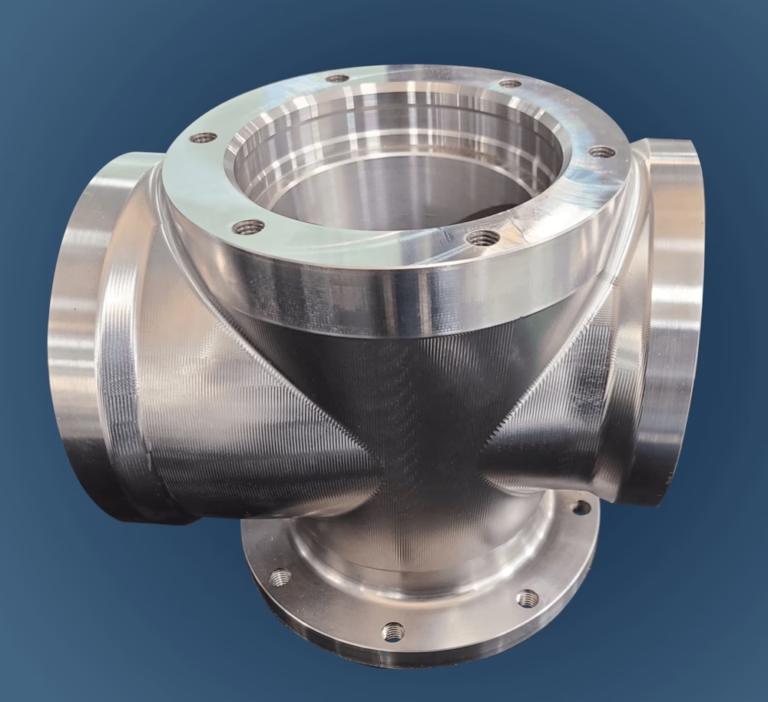
What makes a part expensive to machine
Price is set by setup count, fixturing, tool access, and tolerance stack, not by how impressive the 3D model looks.
What "complex" means on the shop floor
Complexity shows up when features fight each other. Deep pockets on five faces, a thin wall that chatters, a 0.05 mm true position callout across two datums, or a pocket bottom that no end mill can reach without a long-reach tool. Any one of these is routine. Three on the same part and the job moves from a 3-axis machine to a 5-axis setup.
The geometry that costs money is rarely the shape you see in the CAD viewer. It is the number of distinct setups, the number of orientations the part must be held in, and how much of the surface must be reached without re-clamping. A block with 40 drilled holes on one face is cheap. The same 40 holes spread over four faces is not.
Sharp internal corners matter too. A corner radius smaller than the smallest cutter you can fit means EDM or a second operation, and both add cost fast. When we quote, we flag every corner radius under 1 mm and every depth-to-diameter ratio over 5:1, because those are the features that push a cheap complex CNC machining job into a different price band.
- 1Five-sided accessDrives the part to simultaneous 5-axis; 16 such centers in house.
- 2Thin walls under 1 mmChatter and spring-back; needs light passes and support.
- 3Deep pockets over 5:1Long-reach tools deflect; expect slower feed rates.
- 4Tight true positionOften forces a single-setup strategy to hold the datum stack.
The five cost drivers behind every quote
Setup count is the first driver. Each new orientation costs a fixture, a probe cycle, and a first-article check. Two setups on a 3-axis mill can undercut one setup on a 5-axis center when the batch is small, because fixturing a 5-axis part takes longer to engineer. We run both, so the choice is made per part, not per policy.
Tool access is the second. If a feature can only be reached with a 3 mm end mill sticking 60 mm out of the holder, the tool will deflect and the cut will be slow. That single feature can add more cycle time than the other twenty features combined.
Tolerance is the third driver, and the one buyers underestimate most. Going from ±0.05 mm to ±0.005 mm does not double the price. It can triple it, because it forces temperature control, in-process probing, and sometimes a finish pass that removes almost nothing. The fourth and fifth drivers are material and finish. Titanium and Inconel cut at a fraction of aluminum speeds. Hardcoat anodizing and electroless nickel add handling and racking time that has nothing to do with the machining itself.
Feature vs cost impact
Rough guide to how a single feature changes cycle time and setup count on a typical bracket or housing.
| Feature | Typical cost impact | Why |
|---|---|---|
| Holes on one face only | Low | One setup, standard drill cycle |
| Holes on four faces | High | Extra setups or 5-axis indexing |
| Corner radius under 1 mm | High | Micro cutter or EDM, slow feed |
| Wall thickness under 1 mm | Medium to high | Light passes, support, chatter risk |
| ±0.005 mm tolerance | High | Probing, thermal control, finish pass |
| Ra 0.2–0.8 μm finish | Medium | Extra finishing pass, slower spindle |
| Titanium or Inconel | High | Low cutting speed, tool wear |
| Standard aluminum 6061 | Low | High speed, long tool life |
Where low bids hide their margin
Most cheap complex CNC machining quotes are not dishonest at the start. They are optimistic. The supplier assumes the part will run clean, then discovers a fixture problem or a tool that breaks twice a shift. The recovery usually lands on the buyer, either as a schedule slip or as a part that passes the print and fails in assembly.
The common shortcuts are predictable. Substituting 6061 for 7075 because the buyer did not specify temper on the drawing. Skipping stress relief on a long thin part so it moves after the final cut. Deburring by hand and calling a sharp edge acceptable. Running a single first-article check on a 500-piece order and shipping the rest on trust.
None of these show up on an invoice. All of them show up later, in rework, in a warranty return, or in a line that stops because two parts will not mate. The tolerance is ±0.005 mm on the drawing, and a supplier without in-process probing cannot honestly hold it on a complex part.
- 1Material substitutionWrong temper or alloy changes strength and finish.
- 2No stress reliefLong parts move after machining and drift out of tolerance.
- 3Hand deburring onlyInconsistent edges; a risk on mating and safety surfaces.
- 4Sampling instead of 100%Defects escape on mixed-lot and multi-setup runs.
How to judge a supplier without visiting the plant
Ask for the process plan, not the price. A supplier who can tell you how many setups, which machine, and where the datums are has already done the work that separates a real quote from a guess. If the answer is a single number with no method behind it, the number is not comparable to anything.
Check the machine list against your geometry. A shop with only 3-axis mills will outsource your five-sided part or quote it with four setups. GreatLight runs 127 high-precision CNC machines, including 16 simultaneous 5-axis centers, 12 four-axis mills, 27 three-axis machines, and 16 mill-turn centers, with a maximum processing size of 4,000 mm. That range means the routing is chosen for the part instead of the part being forced onto the available machine.
Ask how inspection is handled on a complex run. 100% inspection before shipment, with raw material checks, in-process monitoring, and final reports on request, is the baseline for a ±0.005 mm callout. Certifications matter as a filter: ISO 9001:2015, IATF 16949:2016, ISO 13485:2016, and ISO 27001:2022 cover quality, automotive, medical, and data security. They do not guarantee a good part, but they do mean the process is audited.
Finally, ask about quantity. A supplier with no minimum order quantity can take one prototype and the same process into a 10,000+ part run. That continuity is worth more than a few percent off the first order, because the second order runs on proven tooling.
Design choices that cut cost without cutting quality
Loosen what does not need to be tight. A mounting hole at ±0.1 mm costs a fraction of the same hole at ±0.005 mm, and it usually does the job. Reserve the tight tolerance for the two or three features that set the fit, and mark the rest as general tolerance.
Standardize corner radii to the cutter sizes the shop already stocks. If every pocket has a different radius, the shop either buys tools or adds EDM time. One or two values across the part removes that decision entirely.
Design for one orientation where the geometry allows. If the critical bores can all be reached from the top face, the part runs in a single setup and the datum stack stays simple. That single change often beats any negotiation on hourly rate.
Add a note about deburring and edge break. Leaving it unstated invites a disagreement at inspection. A 0.2 mm edge break on all machined edges is easy to hold and removes most of the argument.
Let the supplier do a DFM review before you freeze the revision. We return a quotation and free DFM analysis within 12 hours, and production can start within 24 hours once the drawing is released. Catching a deep pocket or an unreachable corner at that stage costs nothing. Catching it after the first article costs a revision.
Cases where the cheapest quote is the right one
Not every part needs a premium supplier. A simple bracket in 6061 with loose tolerances, one setup, and a cosmetic finish is a commodity. Any competent shop can make it, and the cheapest qualified bid is the correct choice. Paying more buys nothing on that part.
The same logic applies during concept validation. If the part exists to test fit and the print will change next week, buy the cheap version, in the cheapest material, with the fastest process. Do not anodize a part you are going to cut up.
The line is drawn at function. Once a part carries a load, seals a fluid path, or sits in a medical or automotive assembly, the tolerance and the inspection plan are not optional. At that point the comparison is not between two prices on a PO. It is between a part that works and a part that has to be remade.
Questions engineers ask before they order
Is a cheap complex CNC machining quote a warning sign by itself?
No. A low quote is often correct, especially for simple geometry or a loose tolerance band. The warning sign is a low quote with no process explanation behind it.
Ask which machines, how many setups, and how the critical features will be inspected. A supplier who cannot answer those three questions is guessing, and the guess gets corrected on your schedule.
What tolerance can actually be held on a complex part?
We work to ±0.005 mm (±0.0002 in) on critical features, with surface finishes from Ra 0.2–0.8 μm up to Ra 1.6–3.2 μm as machined.
Holding that on a complex part depends on the setup and the inspection plan, not on the machine alone. In-process probing and a single-setup strategy are usually what make the difference.
Which materials are available, and which ones raise the price?
Aluminum grades such as 6061, 7075, 2024, and 6082 are standard, along with 303, 304, 316, 316L, 17-4PH stainless, 1018, 1045, 4130, 4140 steel, copper and brass grades, and plastics including POM, PEEK, and PC.
Titanium (TA1, TA2, TC4), Inconel, and magnesium AZ31B or AZ91D cut at much lower speeds, so expect a higher price and a longer cycle regardless of who machines them.
Can I order just one part to check the process?
Yes. There is no minimum order quantity, and the same process runs from a single prototype up to 10,000+ part runs.
A first article is the cheapest way to test a supplier. Order one, inspect it against the print, then release the production quantity on proven tooling.
How is confidential geometry protected?
Uploads are handled as secure and confidential, and we operate under ISO 27001:2022 for information security. An NDA is available on request before you send files.
If your program requires it, we can sign your NDA rather than ours. Send it with the drawing package and we will review before quoting.
What lead time should I plan for?
Quotation and free DFM analysis come back within 12 hours. Production can start within 24 hours of release, and parts ship in 3–5 days.
The historical late-delivery probability is below 2%. For complex parts, add time for a first article if the geometry is new, because that check is where most schedule risk actually sits.
Send the drawing. Get a quote you can audit.
Upload your STEP file and we return a price with the process plan, setup count, and DFM notes attached, so you can compare quotes on the same basis.
12-hour quoteFree DFM analysis100% inspectionNDA on request









